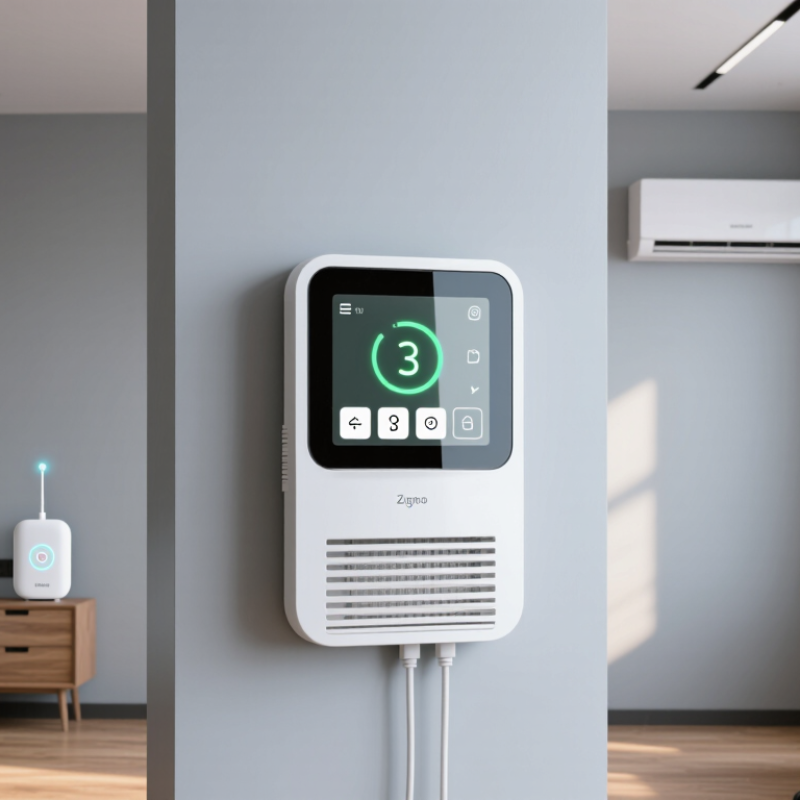
| Device type | Wireless room thermostat using the Zigbee mesh protocol | Measures room conditions, receives control commands, and sends operating requests to a compatible controller or actuator. |
| Controlled equipment | Fan coil unit with a fan and hydronic heating or cooling coil | The thermostat controls air circulation and water-valve operation to maintain the selected room temperature. |
| Temperature sensing | Electronic room-temperature sensor; some installations also use a remote or return-air sensor | The measured temperature is compared with the user-selected setpoint to determine whether heating or cooling is required. |
| Temperature setpoint | User-adjustable target temperature; the exact adjustment range depends on the thermostat configuration | A temperature difference, commonly called the control error, determines when the valve and fan should operate. |
| System configuration | Two-pipe or four-pipe fan coil system | A two-pipe system normally changes between heating and cooling according to seasonal water availability, while a four-pipe system can provide separate heating and cooling circuits. |
| Operating modes | Off, heating, cooling, automatic changeover, fan-only, and automatic fan operation | The selected mode limits which valve or relay can be energized and prevents conflicting heating and cooling commands. |
| Fan-speed control | Low, medium, high, or automatic speed; some units support variable-speed control | Automatic speed selection increases airflow when the temperature difference is larger and reduces airflow as the room approaches the setpoint. |
| Valve control | On/off valve control or proportional control, depending on the actuator and controller | The valve regulates or starts/stops chilled-water or hot-water flow through the coil, which changes the temperature of the supply air. |
| Typical control sequence | Sense temperature → compare with setpoint → request heating or cooling → open valve → start fan | The controller may use a short delay so that the fan starts after the coil begins receiving conditioned water, helping reduce drafts. |
| Zigbee communication | Low-power wireless communication through a Zigbee coordinator or gateway | Setpoints, schedules, mode commands, measured temperatures, and fault information can be exchanged with a building-control system. |
| Mesh-network behavior | Powered Zigbee devices may relay messages for other devices, depending on their role | Additional routers can improve network coverage, but the thermostat still requires compatible network settings and a suitable coordinator. |
| Power options | Battery-powered or mains-powered, depending on the installation design | Battery operation simplifies wall installation but requires battery monitoring; mains-powered units can support continuous communication and local outputs. |
| Fan interlock | Control logic that coordinates fan operation with valve status | It can stop the fan when there is no heating or cooling demand and help prevent airflow across an inactive coil. |
| Scheduling and energy saving | Time schedules, occupancy settings, setback temperatures, and eco modes | Reducing heating or cooling during unoccupied periods can lower energy use without requiring continuous manual adjustment. |
| Control deadband | A small temperature range around the setpoint where no heating or cooling action is requested | The deadband reduces rapid switching of valves and fan stages when the room temperature is close to the target. |
| Installation requirements | Correct thermostat location, compatible actuator or relay outputs, suitable power supply, and Zigbee network coverage | Poor sensor placement, blocked airflow, incompatible wiring, or weak wireless coverage can cause inaccurate readings or unreliable control. |
| Main benefits | Wireless installation, centralized monitoring, flexible scheduling, and room-by-room control | The thermostat combines local temperature regulation with wireless building-management functions while avoiding the need for a dedicated wired communication cable to the room sensor. |



 08045479132
 Send Inquiry

 Send Inquiry
 Send SMS