| Primary purpose | Reduce occupational exposure to scattered X-ray radiation. | Scatter is produced when the primary X-ray beam interacts with the patient or another object. | Aprons are mainly intended for staff or others who must remain near the patient during an examination. |
| How lead works | Lead attenuates X-rays through its high density and high atomic number. | The amount of attenuation depends on lead-equivalent thickness, photon energy, beam angle, and coverage. | Thicker or higher lead-equivalent material generally provides greater attenuation but also increases weight and stiffness. |
| Common apron ratings | Lead equivalence describes the shielding performance compared with a specified thickness of lead. | Common nominal ratings include 0.25 mm, 0.35 mm, and 0.50 mm lead equivalent. | The appropriate rating should be selected according to the procedure, workload, X-ray energy, and local radiation-safety guidance. |
| Scattered radiation | Scatter is less predictable than the primary beam because it depends on patient size, beam direction, field size, and examination geometry. | In many diagnostic procedures, the patient is the principal source of scatter to personnel. | Standing away from the patient and out of the primary beam remains essential, even when an apron is worn. |
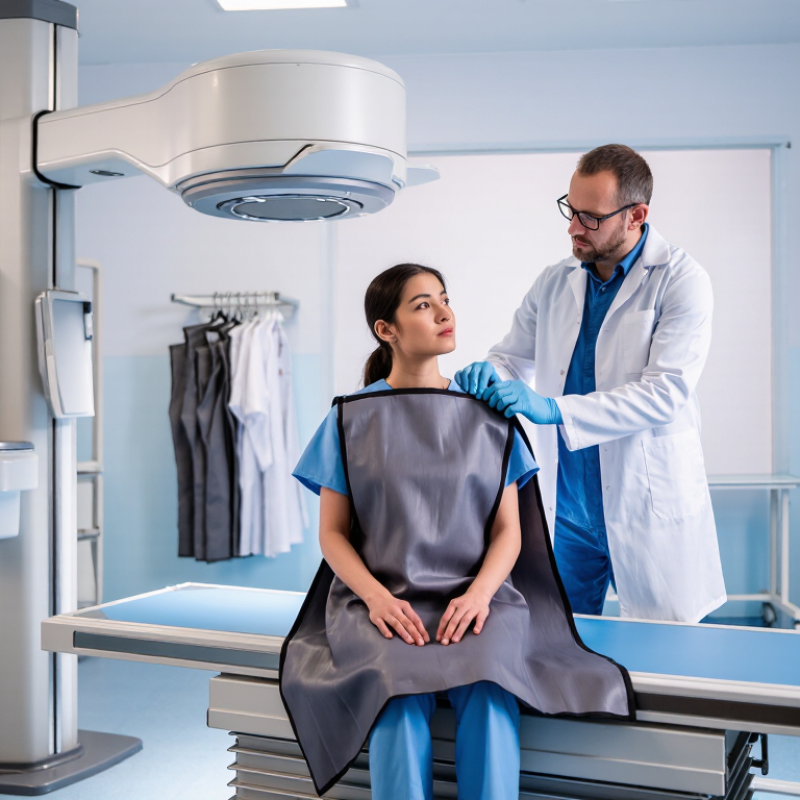
| Protection of vital organs | An apron can shield covered parts of the torso from incident scattered radiation. | Protection is limited to the areas covered by the apron; the head, neck, arms, and legs may remain exposed. | Correct sizing, full front coverage, and overlap at the sides are important for effective use. |
| Pregnancy considerations | A lead apron may provide additional shielding when a pregnant worker must be near an X-ray source. | Declared pregnant workers should follow facility policy, use dosimetry when required, and minimize exposure by time, distance, and shielding. | An apron is a supplement to radiation-control measures, not a replacement for safe work practices. |
| Distance and positioning | Radiation intensity from a point source decreases approximately according to the inverse-square relationship. | Doubling the distance from the source can reduce exposure rate to approximately one-quarter, when other conditions remain comparable. | Use the greatest practical distance and stand at an appropriate angle to the beam and patient. |
| Primary-beam limitation | Protective aprons are not designed to justify intentional exposure to the direct primary beam. | The primary beam has much higher intensity than typical scattered radiation and should always be avoided. | Never place any body part in the primary beam, even when wearing protective clothing. |
| Inspection and storage | Repeated folding can create cracks or defects in lead-based protective materials. | Aprons should be stored flat or on a suitable hanger and inspected according to facility procedures. | Damaged or visibly cracked protective garments should be removed from service until evaluated. |
| Best-practice summary | Effective radiation protection combines engineering controls, administrative controls, and personal protective equipment. | The core principles are time, distance, shielding, beam restriction, and appropriate monitoring. | Use a lead apron only when a person must remain near the source, and always follow applicable local regulations and radiation-safety protocols. |



 08045479132
 Send Inquiry

 Send Inquiry
 Send SMS