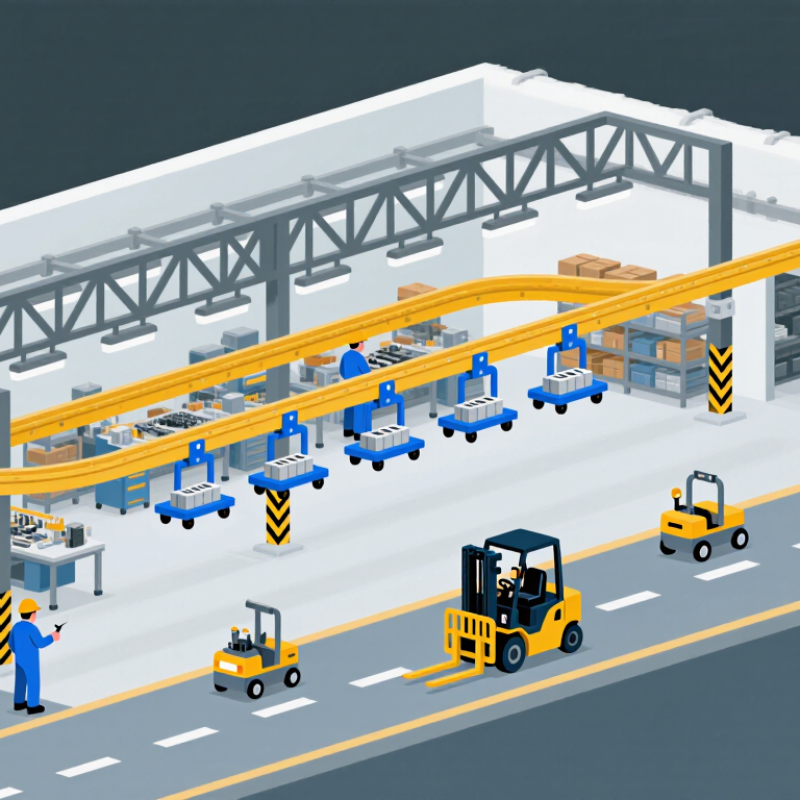
| What it is | A trolley rail system uses trolleys that travel along a fixed track to move suspended loads between workstations or process areas. | It creates a defined material route and can keep floor space available for people, equipment, and other traffic. |
| Main components | Track or rail, trolley wheels, load attachment (such as a hook or carrier), and supporting structure. Powered layouts may also include a drive, controls, and suitable load carriers. | Each component must be compatible with the load, route, environment, and chosen operating method. |
| Operating methods | Trolleys may be moved manually or by a powered conveyor arrangement. The appropriate option depends on load, travel distance, throughput, and process requirements. | Manual movement can suit simpler routes; powered movement can support repeatable, coordinated flow where the system is designed for it. |
| Load capacity | Capacity is system-specific and must be confirmed from the ratings of the track, trolley, supports, attachments, and any drive equipment. Include the weight of the load carrier and attachments in the suspended load. | The allowable system load is limited by the weakest applicable component and its rated installation conditions. |
| Route layout | Routes can be straight or include engineered curves, branches, and stops. Track geometry, clearances, supports, and transfer points are determined during system design. | A planned route helps connect process steps while avoiding obstructions and maintaining safe clearance from people and equipment. |
| Typical applications | Moving parts, tools, or products between workstations in settings such as manufacturing, assembly, finishing, and storage operations. | Suspended transport can be useful when items need to follow a repeatable path or when floor-level handling is inconvenient. |
| Potential benefits | Can reduce repeated floor-level transfers, establish a consistent material route, and make use of overhead space where the building and process allow. | Benefits depend on correct layout, safe loading practices, and integration with the workflow; they are not guaranteed for every operation. |
| Key design inputs | Maximum and typical load, load dimensions, required route, travel frequency, operating method, available headroom, building support conditions, and site environment. | These inputs help determine track selection, support requirements, clearances, controls, and suitable operating procedures. |
| Safety and maintenance | Follow applicable regulations and manufacturer instructions. Inspect track, supports, trolleys, attachments, and powered components according to the system’s requirements; do not exceed rated capacity. | Regular inspection and correct operation help identify wear, damage, or other conditions that could affect safe performance. |
| Best-fit check | Consider a trolley rail system when loads can be safely suspended and a fixed overhead route fits the building and workflow. Compare with floor conveyors, forklifts, or other handling methods during planning. | The best solution depends on load characteristics, process flexibility, site constraints, installation needs, and lifecycle requirements. |



 08045479132

 Send Inquiry


 Send Inquiry
 Send SMS

