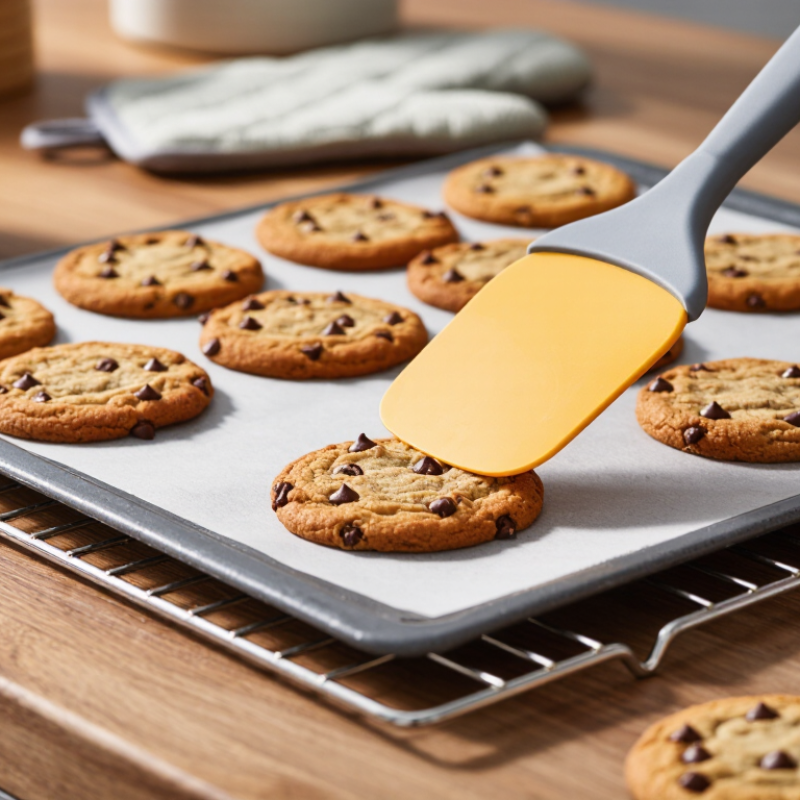
| Cookie-Lifting Design | A thin leading edge slides beneath cookies, while a broad blade supports them during transfer. | Choose a spatula designed for lifting cookies, with a blade wide enough to support the cookies you bake. | A soft scraping spatula may bend too much to lift large or heavy cookies securely. |
| Flexibility and Support | Silicone can flex around food and pan edges. Blade thickness and any internal reinforcement affect stiffness. | Look for a flexible edge combined with a supportive center, and lift cookies with a slow, level motion. | Excessive flexibility can allow warm cookies to fold or break during transfer. |
| Nonstick Bakeware Compatibility | A smooth, intact silicone surface is generally suitable for nonstick bakeware and is less likely to scratch coatings than a metal edge. | Keep the blade clean and slide it gently along the baking surface. | Trapped grit or exposed internal reinforcement can scratch coatings. Follow the bakeware care instructions. |
| Heat Resistance | Silicone utensils have product-specific temperature limits. The handle and joints may have different limits from the blade. | Check the stated heat rating before using the spatula with hot baking sheets or food. | Do not assume all silicone spatulas share one temperature rating. Avoid direct flames, heating elements, and prolonged contact with hot pans. |
| Transferring Freshly Baked Cookies | Many cookies are fragile immediately after baking and become firmer as they cool. | Follow the recipe's resting time, slide the blade fully beneath each cookie, and transfer it to a cooling rack. | The best transfer time depends on the recipe. Moving cookies too early can cause breakage. |
| Food-Contact Suitability | A utensil intended for food contact should be used within its stated temperature and care limits. | Select a spatula explicitly labeled for food use and inspect its blade, handle, and joints before use. | Replace the utensil if silicone is tearing, flaking, or separating, or if an internal core becomes exposed. |
| Routine Hand Washing | Warm water and dish detergent remove ordinary grease and food residue. A soft sponge helps protect the surface. | Wash after each use, clean around seams and handle connections, and rinse thoroughly. | Avoid sharp scraping tools and abrasive pads that can damage the silicone. |
| Dishwasher Cleaning | Dishwasher suitability depends on the entire utensil, including its handle, adhesives, and removable components. | Use a dishwasher only when the product instructions allow it, and follow any rack-placement guidance. | A silicone head does not automatically make a wooden handle or assembled utensil dishwasher-safe. |
| Stubborn Food Residue | Soaking can soften dried dough and baked-on residue before washing. | Soak the silicone portion in warm, soapy water, then gently clean with a soft sponge or brush. | Avoid soaking wooden handles or other components unless their care instructions permit it. |
| Seams and Removable Heads | Food and moisture can collect where a removable head joins its handle. | If designed for disassembly, separate the parts for cleaning and allow them to dry fully before reassembly. | Do not force apart a fixed head. Inspect joints for looseness or trapped residue. |
| Drying and Storage | Clean, dry storage helps prevent moisture from remaining in joints or enclosed spaces. | Air-dry thoroughly, then store flat or hang by the handle in a clean, dry location. | Keep the blade away from sharp utensils, and avoid storing it bent under heavy objects. |



 08045479132

 Send Inquiry


 Send Inquiry
 Send SMS

