| Open countertop display | On a sales counter or consultation table | Approximately 6–18 frames, depending on layout | Frames are easy to see and handle; useful for close-up browsing. | Keeps a curated selection within reach and makes side-by-side comparisons simple. | Products are readily accessible, so staff supervision may be appropriate. | Featured styles, fitting consultations, and small selections customers can try. |
| Wall-mounted frame display | On a wall behind or beside the sales area | Approximately 20–60 frames per section, depending on wall space and spacing | Uses vertical space to present many frames within a broad viewing area. | Frames can be grouped by style, material, color, or intended wearer. | Security depends on the mounting system and whether frames are freely removable. | Stores that want to present a wide assortment while keeping floor space clear. |
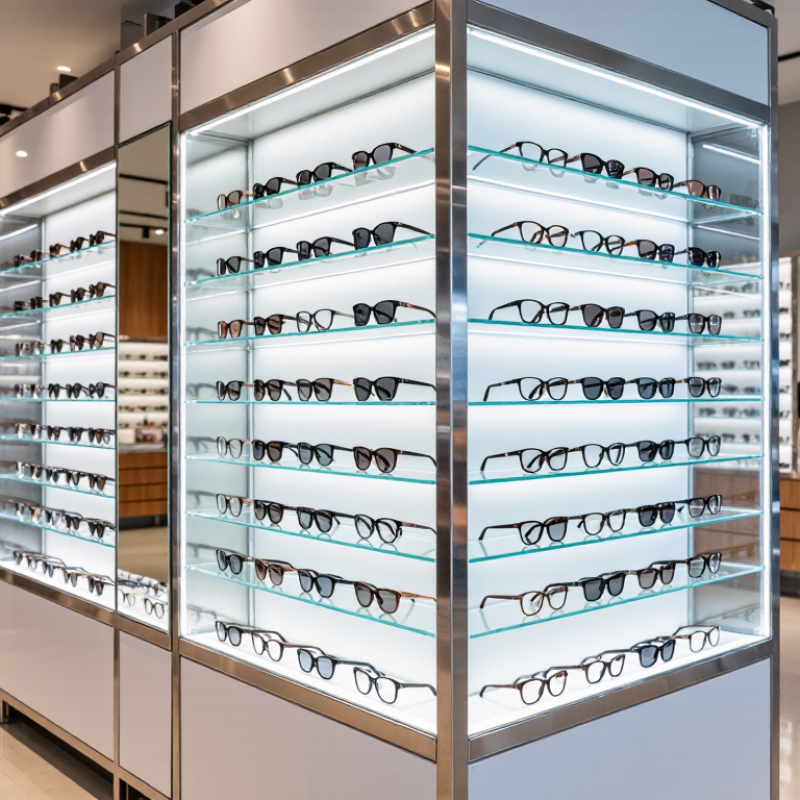
| Lockable glass cabinet | Against a wall, behind a counter, or in a supervised display area | Approximately 12–40 frames, depending on shelf count and cabinet size | Glass panels keep products visible while separating them from frequent handling. | Shelves can separate collections and make it easier to maintain a tidy presentation. | Lockable doors help limit access; staff assistance is needed to handle displayed frames. | Higher-value frames, limited editions, or products that need controlled access. |
| Rotating countertop stand | On a counter or freestanding table | Approximately 12–36 frames, depending on the number of arms or panels | Customers can view different sides by turning the stand. | Compact footprint keeps a selected group together and easy to browse. | Frames are generally accessible; placement within staff view can support oversight. | Compact stores, impulse browsing areas, or a focused selection of everyday frames. |
| Freestanding modular showcase | In an aisle, at a department boundary, or in a central display zone | Varies by module; capacity can be expanded by adding sections | Can be approached from one or more sides, depending on its design. | Adjustable sections help organize products into clear categories as inventory changes. | Open modules allow direct access; lockable modules can be chosen where needed. | Stores that need a flexible display layout or expect their assortment to change. |



 08045479132

 Send Inquiry


 Send Inquiry
 Send SMS

