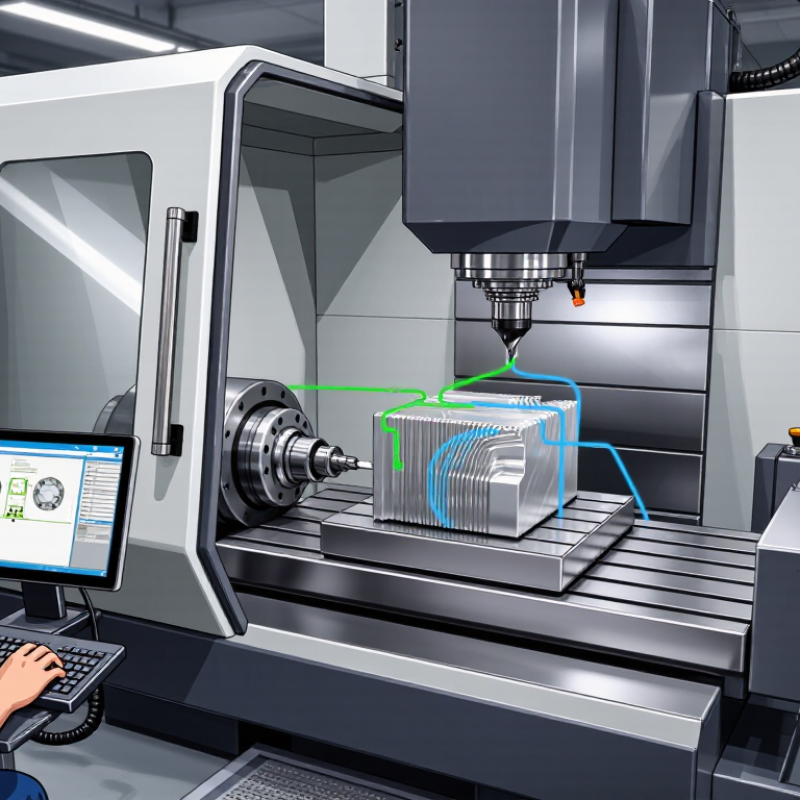
| Process Definition | CNC milling is a subtractive manufacturing process in which a computer-controlled rotary cutting tool removes material from a stationary or secured workpiece. | The programmed tool paths provide repeatable control over dimensions, profiles, holes, pockets, slots, and complex three-dimensional surfaces. |
| Machine Axes | Common configurations include 3-axis milling, while 4-axis and 5-axis machines add rotary movement for better access to angled or complex features. | Additional axes can reduce repositioning, improve feature alignment, and help produce complex parts in fewer setups. |
| Typical Dimensional Tolerance | Approximately ±0.025 mm to ±0.125 mm is common for many CNC-milled features, depending on material, machine condition, tool selection, geometry, and inspection method. | CNC milling is suitable for components that require controlled fits, consistent hole locations, and repeatable dimensional performance. |
| Surface Finish | Machined surface roughness commonly ranges from about Ra 0.8 to 6.3 µm, although tooling, cutting parameters, material, and finishing passes can produce different results. | Finishing passes and optimized cutting conditions can improve appearance, sliding performance, sealing surfaces, and dimensional consistency. |
| Compatible Materials | Frequently machined materials include aluminum alloys, steels, stainless steels, brass, copper, titanium, engineering plastics, and selected composite materials. | Material flexibility supports prototypes, tooling, machine components, enclosures, brackets, fixtures, and production parts across many industries. |
| Geometric Capability | CNC milling can produce flat surfaces, steps, contours, pockets, keyways, threads, drilled features, chamfers, and three-dimensional sculpted surfaces. | A single process can combine multiple feature types, reducing the need for separate operations and helping maintain feature-to-feature accuracy. |
| Repeatability | Once the program, workholding, tools, and inspection controls are validated, the same machining sequence can be repeated for multiple parts. | Repeatable production helps maintain consistent dimensions and reduces variation between batches compared with manually controlled machining. |
| Production Volume | CNC milling is practical for one-off prototypes, low-volume custom parts, pilot batches, and medium-volume production. | The same digital design data can be used for development and production, reducing the transition time between prototype and manufactured part. |
| Design Flexibility | Tool paths can be generated from CAD models and adjusted for changes in dimensions, materials, tolerances, or feature locations. | Design revisions can usually be implemented through digital program updates without creating dedicated hard tooling for every change. |
| Setup Requirements | Production requires workholding, tool selection, cutting parameters, coordinate setting, program verification, and appropriate inspection. | Careful setup planning is essential because workpiece alignment, tool wear, thermal effects, and fixturing directly influence final accuracy. |
| Material Utilization | CNC milling removes material from a larger blank, so chips and offcuts are generated during machining. | It can be less material-efficient than near-net-shape processes for heavily sculpted parts, but many metal chips can be collected and recycled. |
| Quality Control | Inspection may include calipers, micrometers, height gauges, gauges, coordinate measuring machines, and surface-finish instruments. | Measurement results can verify critical dimensions, geometric relationships, hole positions, and surface requirements before shipment. |
| Common Applications | Typical applications include precision brackets, housings, fixtures, molds, machine components, prototypes, medical-device parts, and aerospace structures. | The process is valuable where accuracy, repeatability, complex geometry, and traceable digital production data are important. |
| Main Advantages | High repeatability, broad material compatibility, efficient digital control, flexible part geometry, and the ability to produce accurate features in relatively small quantities. | These characteristics make CNC milling a strong choice when product quality and design adaptability are more important than achieving the lowest cost at extremely high volumes. |



 08045479132
 Send Inquiry

 Send Inquiry
 Send SMS
