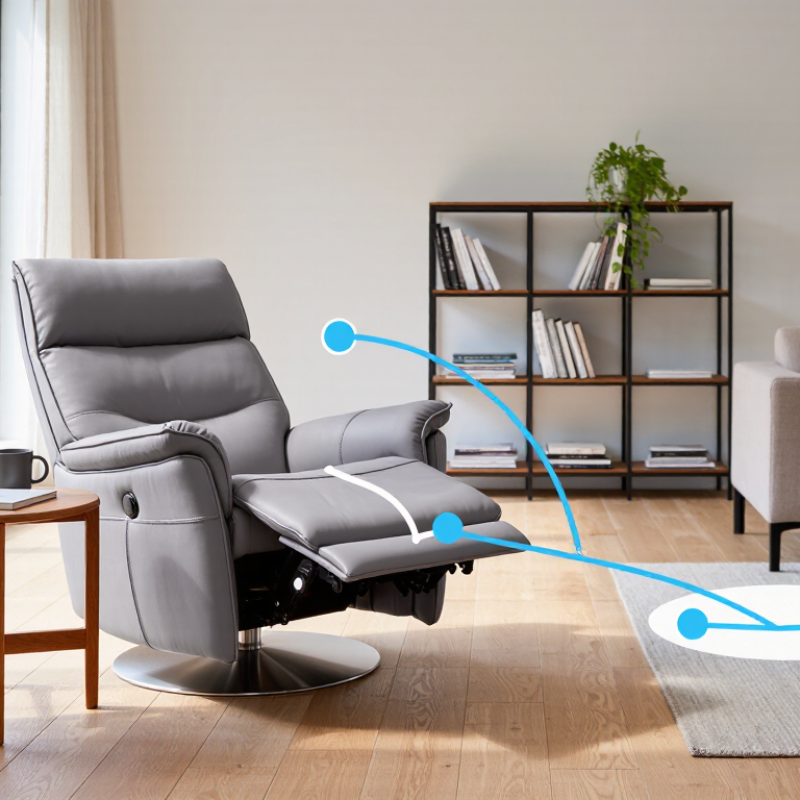
| Basic Definition | A padded armchair that reclines and rotates horizontally on a swivel base. | Combines the comfort of a recliner with flexible movement for conversation, reading, or viewing a screen. | Confirm that the chair includes both a reclining mechanism and a rotating base, as some recliners offer only one function. |
| Horizontal Rotation | Many residential models rotate through approximately 180° to 360°, depending on the base design. | Allows users to turn toward different areas of a room without moving the entire chair. | Leave enough clearance around the chair to prevent contact with tables, walls, lamps, or other furniture. |
| Reclining Positions | Common positions include upright sitting, partially reclined, and a deeper reclined position for relaxation. | Supports different activities such as sitting upright, watching television, reading, resting, and taking a short nap. | Manual models usually require a side lever or body pressure, while powered models require an electrical connection and controls. |
| Space Requirement | Typical chair widths are about 75–100 cm, with additional space needed for rotation and reclining. | Can provide versatile seating in living rooms, bedrooms, nurseries, offices, or reading corners. | Measure the room, doorway, elevator, and delivery path before purchase. Check the fully reclined depth, not only the upright depth. |
| Comfort Support | Usually includes a high back, padded armrests, a cushioned seat, and an adjustable footrest. | Can reduce pressure on the legs and provide a more supported posture during extended sitting. | Seat height, seat depth, lumbar support, and cushion firmness should match the user’s body size and comfort preference. |
| Common Upholstery | Frequently available in fabric, faux leather, leather, microfiber, or other upholstery materials. | Offers a range of appearances, textures, cleaning requirements, and price levels for different interiors. | Review the care instructions, stain resistance, breathability, and durability of the chosen material before use. |
| Manual vs. Power Operation | Manual versions use a lever or push-back action; powered versions use a motor and wired or rechargeable controls. | Manual chairs are generally simple to operate, while powered chairs can provide smoother and more precise adjustment. | Powered chairs need access to a suitable outlet and may be heavier. Keep electrical cables clear of walkways. |
| Weight Capacity | Capacity varies by construction; many household models support approximately 113–159 kg. | Provides a basic safety and suitability reference for selecting a chair for a particular user. | Always follow the manufacturer’s stated weight limit and consider the combined load of the user and any added pressure during reclining. |
| Base Stability | A wide metal or reinforced base helps support rotation and reduces unwanted movement. | Improves confidence when sitting down, standing up, or changing the chair’s direction. | Place the chair on a level, stable surface. Avoid loose rugs or uneven flooring that may interfere with movement. |
| Floor Compatibility | Suitable for many hard floors and carpets when the base is properly supported. | Allows the chair to be used in multiple rooms without requiring permanent installation. | Use a suitable floor protector where needed, especially on delicate wood, laminate, or polished surfaces. |
| Accessibility and Convenience | Swivel movement can make it easier to face a side table, doorway, window, or caregiver. | May reduce the need for twisting the body or repeatedly repositioning the chair. | People with limited mobility should select an easy-to-operate mechanism and ensure sufficient space for safe transfers. |
| Maintenance Needs | Routine care typically includes vacuuming upholstery, cleaning spills promptly, and checking moving parts. | Regular maintenance helps preserve appearance, smooth operation, and long-term usability. | Do not use harsh cleaners or lubricants unless they are approved for the specific upholstery and mechanism. |
| Best Room Applications | Common locations include living rooms, bedrooms, home offices, media rooms, and reading areas. | Its rotating and reclining functions make one chair useful for several household activities. | Choose a style and size that leave clear walking paths and complement the room’s existing furniture. |
| Primary Advantage | Combines directional flexibility, adjustable comfort, and dedicated support in one seating unit. | Can improve the usability of a room by allowing one seat to serve multiple orientations and purposes. | The best choice depends on available space, user dimensions, preferred operation, upholstery needs, and budget. |



 08045479132

 Send Inquiry


 Send Inquiry
 Send SMS

