| Grinding mechanism | Ceramic conical burrs are commonly used in manual grinders. | Provides a durable, non-electric component suitable for long-term product positioning. | Burr alignment and manufacturing precision should be checked before bulk purchase. |
| Heat during grinding | Manual operation generates no motor heat and normally produces little friction heat at typical hand-grinding speeds. | Supports a simple product benefit for coffee, camping, and travel channels. | Actual heat depends on burr design, grind setting, coffee dose, and grinding speed. |
| Electricity requirement | None; operation relies on a hand crank. | Simplifies use in outdoor markets and reduces electrical certification concerns in many sales regions. | Importers should still verify food-contact, packaging, and general product requirements for the destination market. |
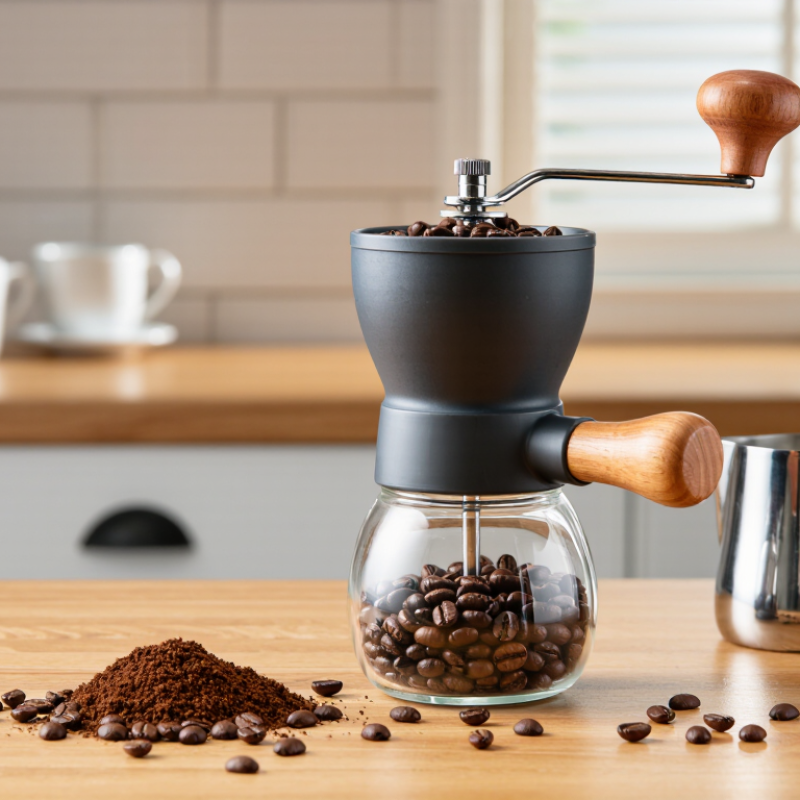
| Typical hopper capacity | Approximately 20–30 g for many compact manual models. | Matches common single-brew portions and makes the product easy to position for personal use. | Capacity varies by model; request a measured specification rather than relying only on product photographs. |
| Grind adjustment | Many models offer stepped adjustment for coarse, medium, and fine grinding. | A wider usable range can support pour-over, drip, French press, and some espresso-oriented applications. | Adjustment count alone does not prove performance; test particle consistency at several settings. |
| Portability | Compact models commonly measure about 15–20 cm in height and can fit in travel kits. | Creates opportunities for camping, office, travel, and gift-product assortments. | Confirm packed dimensions, protective packaging, and handle storage before calculating freight volume. |
| Product weight | Approximately 300–600 g for many compact stainless-steel or aluminum-bodied manual models with ceramic burrs. | Usually lighter and easier to ship than powered countertop grinders. | The body material, glass container, handle, and packaging can substantially change shipping weight. |
| Cleaning and maintenance | No motor or battery compartment; removable parts can generally be brushed and wiped. | Reduces the number of electrical components that may require after-sales support. | Ceramic burrs should be kept dry unless the manufacturer explicitly approves washing. |
| Noise profile | Usually quieter than powered grinders because there is no electric motor. | Useful for office, apartment, hotel, and early-morning-use product categories. | Hand-crank noise still varies with bearings, burr contact, housing, and the grinding surface. |
| Durability focus | Ceramic burrs resist rust, while the surrounding shaft, bearings, and housing determine overall service life. | Supports a longer-use product proposition when components are properly assembled. | Ceramic is hard but relatively brittle; drops and excessive lateral force may cause chipping or breakage. |
| Packaging efficiency | Compact individual packaging is feasible, with typical retail boxes often designed around the grinder and accessories. | Can support mixed cartons and smaller retail displays. | Use internal protection around ceramic burrs and glass parts to reduce transit damage. |
| Best wholesale channels | Kitchenware, coffee accessories, outdoor equipment, hospitality gifts, and lifestyle retail. | Broadens the potential customer base beyond dedicated coffee shops. | Select capacity, materials, and packaging according to each channel’s customer expectations. |
| Quality checks before ordering | Burr alignment, grind consistency, handle smoothness, retention, capacity, and drop-resistant packaging. | Reduces return risk and helps create consistent specifications across a wholesale shipment. | Approve a production sample and define measurable inspection criteria before confirming a bulk order. |



 08045479132
 Send Inquiry

 Send Inquiry
 Send SMS