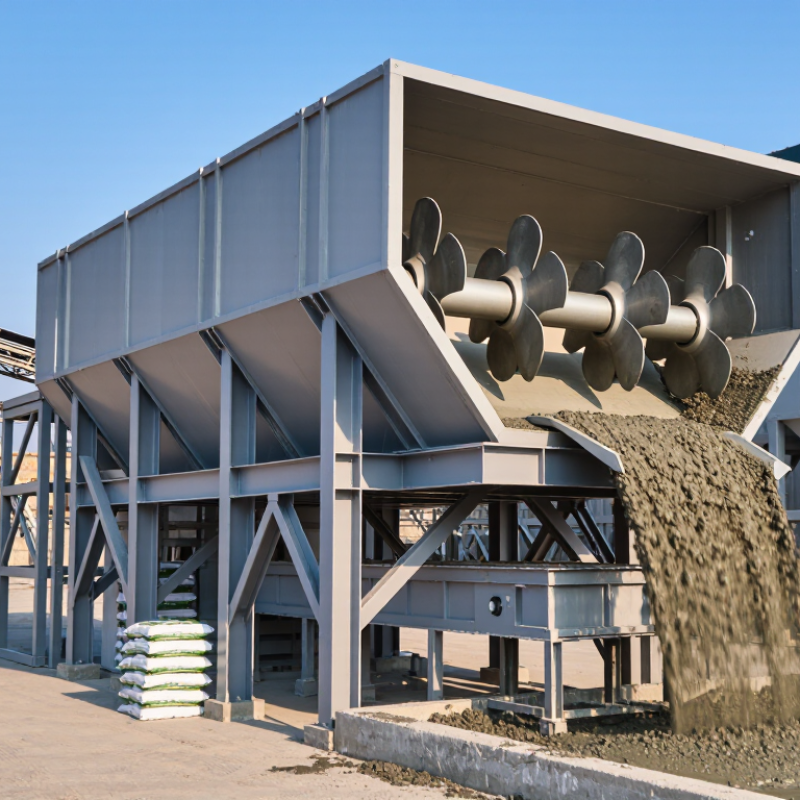
| Ready-Mix Concrete | Cement, aggregates, water, and chemical admixtures requiring consistent dispersion. | Plastic to flowable; commonly about 50–180 mm slump, depending on the mix design. | Counter-rotating shafts create strong three-dimensional circulation, helping distribute cement paste, moisture, and admixtures evenly. | Excellent |
| Precast Concrete Products | Controlled batches used for pipes, panels, blocks, curbs, sleepers, and other molded products. | Stiff to low-slump mixtures, often below approximately 75 mm slump. | High-intensity mixing supports uniform moisture and color distribution, which is important for repeatable product quality. | Excellent |
| Roller-Compacted Concrete (RCC) | Very low-moisture concrete containing cementitious materials and well-graded aggregates. | Zero-slump or near-zero-slump consistency. | The intensive mixing action can break up dry agglomerations and coat aggregate particles more effectively than low-intensity mixing. | Excellent |
| Self-Compacting Concrete (SCC) | High-fines, high-flow concrete requiring stable dispersion of powders, water, and superplasticizer. | Highly flowable; slump-flow testing is normally used instead of conventional slump. | Uniform mixing helps reduce local variations in paste composition, while the mix design and admixture dosage must still be carefully controlled. | Very Good |
| Fiber-Reinforced Concrete | Concrete containing steel, synthetic, glass, or other fibers that must be dispersed without excessive clumping. | Plastic, stiff, or low-slump, depending on the fiber type and dosage. | The intensive mixing pattern promotes fiber distribution; fiber feeding rate and sequence should be adjusted to the specific formulation. | Very Good |
| Colored and Architectural Concrete | Concrete with mineral pigments, special aggregates, or appearance-sensitive surface requirements. | Plastic to low-slump, depending on the finished product. | Consistent pigment and moisture dispersion can improve batch-to-batch color uniformity when the same materials and procedures are maintained. | Very Good |
| Mass Concrete and Large Civil Projects | Large aggregate volumes and production requirements for foundations, dams, bridges, and heavy infrastructure. | Usually low to medium slump, based on placement and compaction requirements. | Large production models can provide high output and uniformity, while the plant must be correctly sized for aggregate grading and batch demand. | Excellent |
| Dry-Mix and Semi-Dry Concrete | Low-water formulations used for blocks, paving units, dry-cast products, and similar applications. | Very stiff, zero-slump, or semi-dry. | Strong mechanical action is effective for blending low-moisture materials that may be difficult to homogenize in conventional drum mixers. | Excellent |
| Lightweight Aggregate Concrete | Concrete using expanded clay, shale, slate, or other lightweight aggregates with different absorption behavior. | Low to medium slump, with moisture conditioning often required. | Efficient circulation can improve paste distribution, but mixing energy and sequence should be controlled to limit aggregate damage or segregation. | Good with proper control |
| Small, Infrequent Batches | Low production volume with frequent formula changes or long idle periods. | Any consistency, depending on the project. | A twin shaft mixer may be technically capable, but its higher purchase, cleaning, and maintenance requirements can be difficult to justify for very small or irregular production. | Usually limited |



 08045479132

 Send Inquiry


 Send Inquiry
 Send SMS

