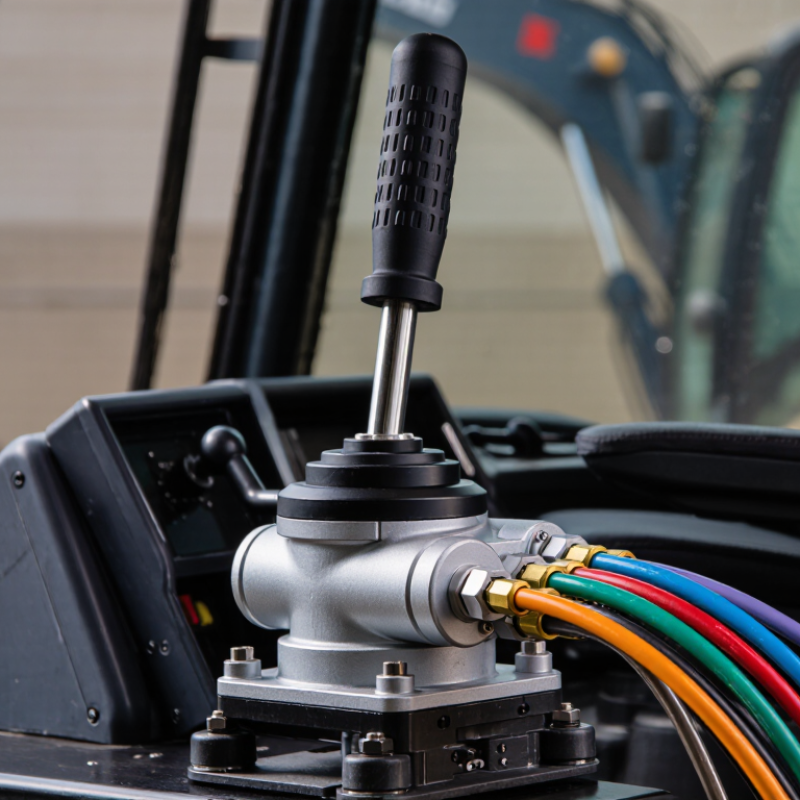
| Definition | A hand-operated control that uses hydraulic pressure to help command one or more machine functions. | Moving the lever changes a control signal. In a pilot-operated system, hydraulic pilot pressure acts on a main control valve spool. | It lets an operator control hydraulic functions from a conveniently positioned lever. |
| Control signal | The joystick may use hydraulic pilot pressure, mechanical linkage, or electrical signals, depending on its design. | Hydraulic pilot models meter pressure to the main valve; electrohydraulic models convert lever movement into electrical signals for a valve controller. | Identifying the signal type helps ensure compatibility with the machine’s control system. |
| Controlled functions | Common functions include lifting, lowering, tilting, swinging, and travel or steering control. | Each lever axis or direction is connected to a corresponding valve section or control channel. | One control can provide intuitive access to several machine movements. |
| Movement and response | Lever travel and valve response determine how gradually a function can be controlled. | Proportional control allows output to vary with joystick movement, subject to the valve and system design. | Gradual control can support accurate positioning and smoother operation. |
| Operator effort | Pilot-operated designs use hydraulic pressure to shift the main valve rather than relying solely on direct manual force at that valve. | The joystick sends a control pressure to the main valve’s pilot stage. | This arrangement can reduce the effort needed to operate larger hydraulic functions. |
| System compatibility | Important factors include the required pilot pressure, flow, port arrangement, number of axes, and valve configuration. | These requirements are specified by the machine and hydraulic circuit design. | Checking specifications before selection helps avoid poor response or installation mismatch. |
| Operating environment | Machines may operate in conditions involving vibration, dust, moisture, or temperature variation. | Housing, seals, mounting, and electrical protection (where applicable) should suit the intended environment. | Appropriate environmental protection supports dependable operation and service life. |
| Maintenance and safety | Inspection should follow the machine and component service instructions. | Check for leaks, damaged lines, loose mounting, unusual lever response, and correct neutral behavior. Relieve stored hydraulic pressure before servicing. | Regular checks help identify wear or faults; safe isolation reduces the risk of injury from pressurized fluid or unexpected movement. |
| When it is a good choice | A hydraulic regulation joystick is suitable when a machine needs hand-operated, controlled input to hydraulic functions. | The best design depends on the machine’s circuit, required control feel, operating environment, and service requirements. | Choosing to match the application can improve controllability, ergonomics, and system integration. |



 08045479132

 Send Inquiry


 Send Inquiry
 Send SMS

