| 1. Select a colony | A single bacterial colony carrying the plasmid of interest is used to start a culture. | Starting from one colony helps reduce the chance of mixing plasmids from different bacterial populations. | Use the appropriate host strain and growth conditions for the plasmid. Follow the laboratory’s containment and handling procedures. |
| 2. Grow the culture | The selected colony is grown in liquid medium, commonly with the relevant selection agent, to produce cells containing plasmid DNA. | The culture provides enough cells for plasmid extraction. | Culture conditions and yield vary with the host strain, plasmid copy number, plasmid size, and growth conditions. |
| 3. Harvest and lyse cells | Cells are collected and lysed. Many plasmid miniprep methods use alkaline lysis, followed by neutralization. | Careful lysis releases plasmid DNA while allowing much of the chromosomal DNA, protein, and cell debris to be removed. | Avoid vigorous mixing after lysis where the protocol advises against it, because sheared chromosomal DNA can contaminate the preparation. |
| 4. Purify plasmid DNA | Plasmid DNA is separated from cell components, often using a silica membrane or another DNA purification method, then eluted in a suitable buffer or water. | Purification reduces contaminants that can interfere with library preparation or sequencing. | Residual salts, alcohol, RNA, proteins, or genomic DNA may affect DNA measurements and downstream sequencing performance. |
| 5. Assess DNA quality | DNA amount and purity are measured. Fluorometric assays estimate double-stranded DNA concentration; absorbance measurements can provide additional purity information. | Accurate input assessment helps determine whether the sample is suitable for the selected library-preparation workflow. | For relatively pure DNA, an A260/A280 ratio near 1.8 is commonly expected. Absorbance ratios are approximate and should be interpreted alongside other quality checks. |
| 6. Prepare the sequencing library | Purified plasmid DNA is processed according to the sequencing platform and library protocol. Steps may include DNA repair, end preparation, adapter attachment, or other platform-specific operations. | The library format enables DNA molecules to be recognized and read by the sequencing instrument. | Input amount, fragment handling, and library steps differ by platform and protocol. Follow the current protocol for the chosen method. |
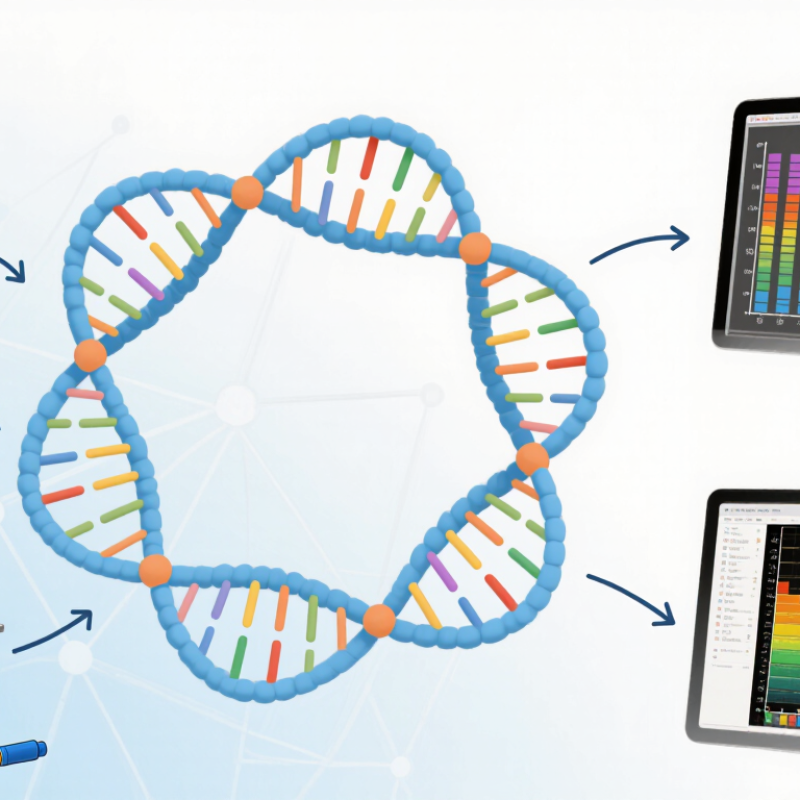
| 7. Sequence the DNA | Sequencing instruments read DNA fragments. Long-read approaches can often produce reads spanning most or all of a plasmid molecule; short-read approaches produce shorter reads that are assembled computationally. | Whole-plasmid sequencing aims to assess the complete plasmid sequence, including its backbone and insert. | Long reads can help resolve repeated or structurally complex regions. Short reads can offer high per-base accuracy, but repeats may complicate assembly. |
| 8. Assemble and review | Reads are assembled or aligned against an expected plasmid sequence, then reviewed for sequence differences and coverage across the construct. | Analysis can identify substitutions, insertions, deletions, and unexpected sequence changes within the regions supported by the data. | Check that reads support the full plasmid, including junctions and repeated regions. Coverage and quality requirements depend on the analysis goal and sequencing method. |
| 9. Interpret the result | The assembled sequence is compared with the intended design or reference sequence, and any differences are evaluated. | This provides evidence about whether the sequenced plasmid matches the expected construct. | A sequence result describes the DNA molecules represented in the submitted sample; it does not by itself confirm expression, function, or biological performance. |



 08045479132

 Send Inquiry


 Send Inquiry
 Send SMS

