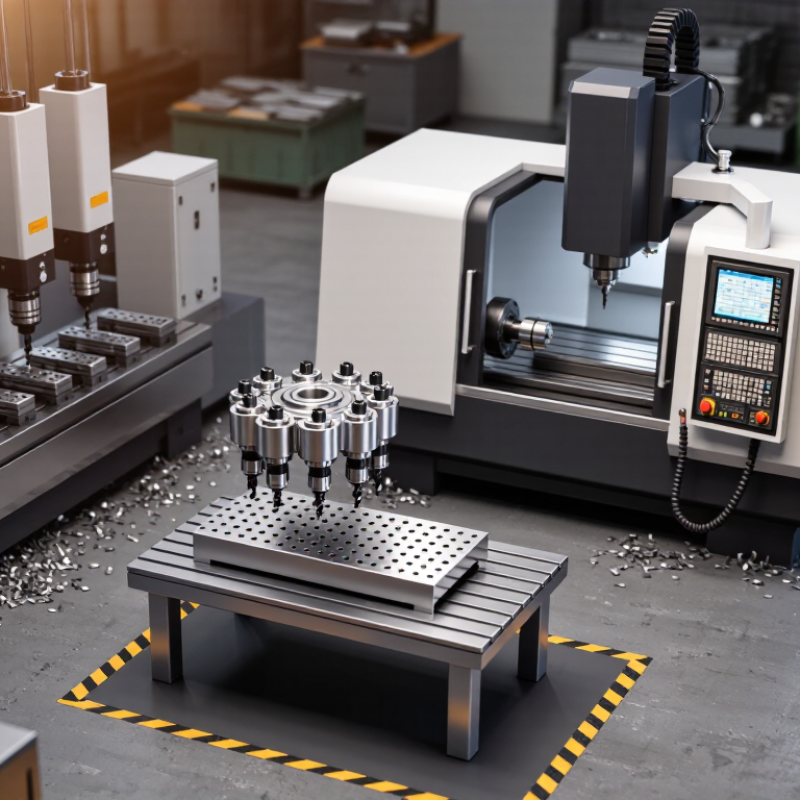
| Fixed multi-spindle drill | Several spindles are mounted at fixed center-to-center spacing in a common head and generally drill at the same time. | Often uses a manually positioned worktable and a common feed motion; CNC may be used for part positioning on some models. | Repeated holes with consistent spacing on high-volume parts, such as plates, panels, and components with standard hole layouts. | Can reduce cycle time when many holes must be drilled simultaneously; consistent spindle spacing supports repeatable production. | Fixed spacing limits flexibility. A different pattern may require a different head, tooling arrangement, or setup. |
| Adjustable multi-spindle drill | Spindle positions can be set within the head’s adjustment range; the spindles commonly operate together. | Spindle spacing is usually adjusted during setup. The machine may have manual, powered, or programmable work positioning. | Multiple holes whose spacing changes between product runs but remains within the head’s adjustment range. | Offers more setup flexibility than a fixed head while retaining simultaneous drilling for suitable patterns. | Changing the layout can require manual adjustment and verification. Adjustment range and spindle count depend on the machine design. |
| CNC multi-spindle drill | Multiple spindles work in a coordinated head or spindle assembly; they are not necessarily independently positioned. | CNC-controlled axes typically position the workpiece, table, or drilling head along programmed directions. The number and configuration of axes vary by machine. | Repeated parts with multiple hole locations, including patterns that require programmed positioning between drilling operations. | Program storage and controlled positioning can improve repeatability and reduce manual indexing for recurring jobs. | Confirm which axes are CNC-controlled and whether the spindles drill together or in sequence; “CNC” does not automatically mean each spindle moves independently. |
| CNC drilling center with a single spindle | One spindle drills holes individually, repositioning between locations. | CNC-controlled positioning commonly moves the table, workpiece, or head across programmed axes; additional rotary axes may be available on some configurations. | Complex, varied, or frequently changing hole patterns, especially when hole locations or drilling sequences differ across parts. | Flexible programming supports complex layouts without requiring a multi-spindle head matched to every pattern. | Because holes are generally drilled one at a time, cycle time may be longer than simultaneous drilling when many identical holes are required. |
| Gang drilling machine | Multiple drilling units are arranged in a row, often allowing a workpiece to move from one station to the next. | Stations may use manual or powered feeds; CNC positioning depends on the specific machine configuration. | Parts requiring several operations in a defined sequence, such as drilling different hole groups at successive stations. | Several operations can be organized along one production line, reducing repeated handling between stations. | It is generally designed around a planned process sequence, so substantial changes to part geometry may require station or tooling reconfiguration. |
| Dedicated multi-head production drilling system | Two or more drilling heads are arranged to work on separate areas or faces of a part, depending on the system layout. | May combine fixed stations with programmable workpiece positioning; automation and axis control are configuration-dependent. | High-volume parts with multiple hole groups that benefit from drilling at different locations or orientations in one production setup. | Can reduce handling and support repeatable production when the machine is configured for a stable part family. | Requires careful matching of head layout, tool access, workholding, and part geometry; a dedicated setup may be less adaptable to unrelated jobs. |



 08045479132

 Send Inquiry


 Send Inquiry
 Send SMS