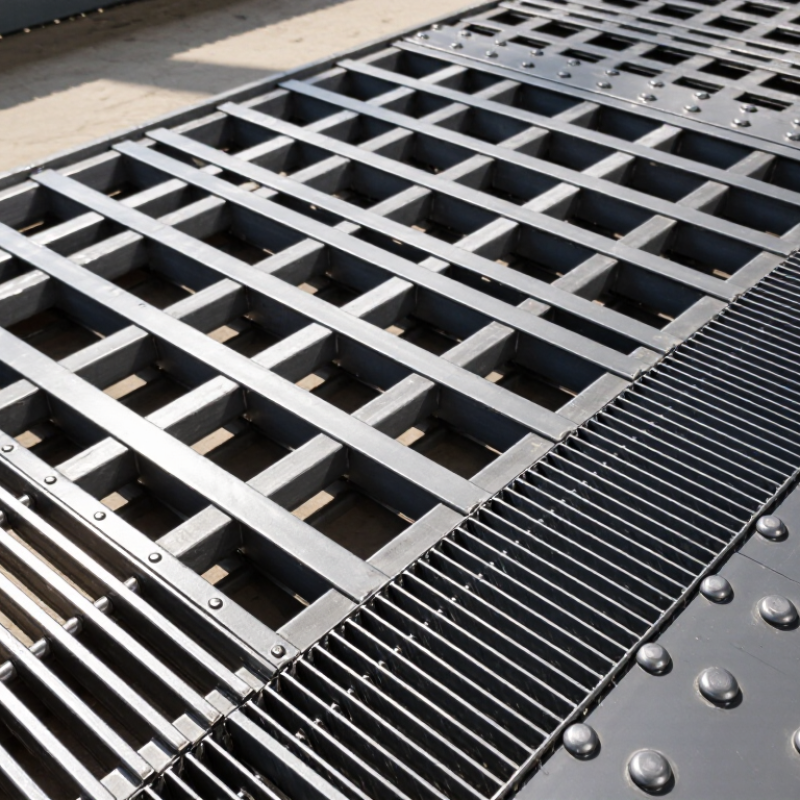
| Welded Steel Grating | Crossbars are resistance-welded to the bearing bars at their intersections. | Flat bearing bars are commonly spaced about 19–40 mm (¾–1½ in) on center; crossbar spacing varies by specification. | Rigid, durable construction with secure intersections. Available in a wide range of bar depths, spacings, and finishes. | Industrial floors, walkways, platforms, stair treads, and equipment areas. | Specify the bearing-bar size and spacing for the required span and load. Carbon steel grating may need a corrosion-protective finish, such as hot-dip galvanizing. |
| Pressure-Locked Grating | Crossbars and bearing bars are fitted together under pressure through aligned slots. Swage-locked grating is a common mechanically locked form in which the crossbars are deformed to secure the intersections. | Flat bearing bars are paired with crossbars inserted through slots; bar spacing is selected for the intended load and opening size. | Mechanical interlocking creates a consistent panel without welded intersections. Often chosen where a clean appearance or close spacing is preferred. | Walkways, platforms, screens, and architectural or industrial flooring. | Confirm the specific locking method and panel design with the fabricator. Load capacity depends on bearing-bar dimensions, span, and spacing. |
| Riveted Grating | Rivets mechanically join the bearing bars and crossbars, traditionally using a formed or bent crossbar arrangement. | Spacing and bar sizes are customized; some designs use a more flexible crossbar pattern than welded grating. | Mechanical connections can provide a degree of flexibility and resistance to repeated movement or vibration. | Some heavy-duty floors, bridges, and locations subject to dynamic service conditions. | Less commonly specified than welded grating in many applications. Check availability, connection details, and load data for the particular design. |
| Close-Mesh Grating | A close-mesh layout—not a separate joining method—made using welded or pressure-locked construction. | Smaller openings are achieved by reducing the spacing between bearing bars, crossbars, or both. | Helps limit the passage of small objects and provides a denser walking surface than standard open grating. | Maintenance platforms, walkways, mezzanines, and areas where smaller openings are required. | Smaller openings can increase material weight and reduce drainage or light transmission. Select the opening size to suit the site requirements. |



 08045479132

 Send Inquiry


 Send Inquiry
 Send SMS

