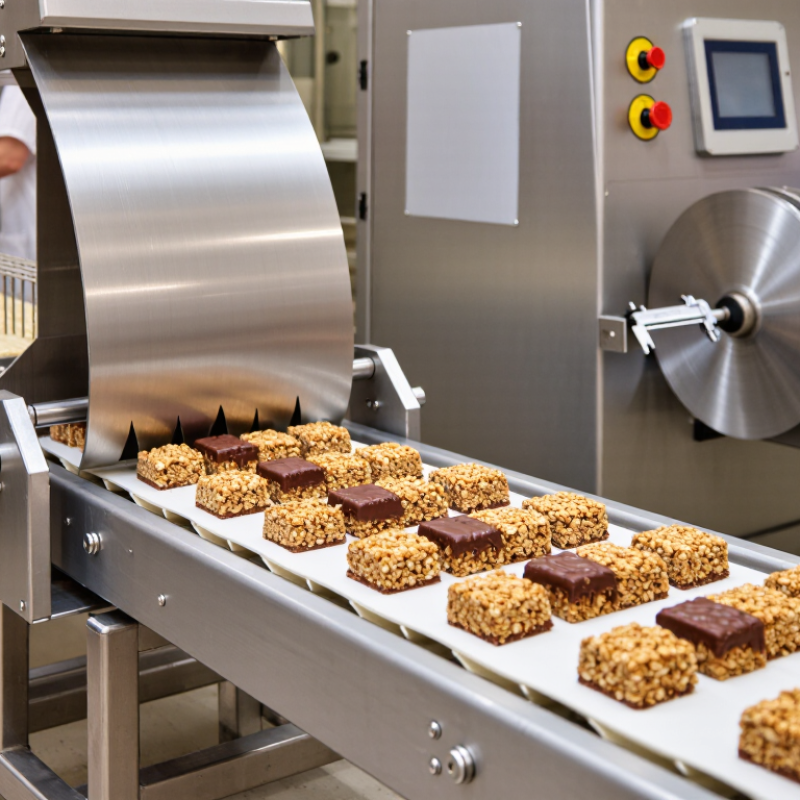
| Rotary blade cutter | A rotating blade cuts a continuous sheet or slab into portions as it moves through the machine. | Continuous; well suited to synchronized conveyor lines and multi-lane production. | Regularly shaped cereal, granola, and snack bars made from a consistent slab. | Supports high-throughput operation, repeatable portion length, and integration with upstream forming and downstream packaging equipment. | Blade speed and conveyor speed must be coordinated. Sticky, brittle, or chunky recipes may require adjustments to blade geometry and cutting settings. |
| Reciprocating guillotine cutter | A straight blade moves down through the product and retracts after each cut. | Intermittent or indexed; can also be integrated into automated lines. | Bars or slabs that need a straight crosscut, especially where cutting flexibility is important. | Simple cutting action and adaptable cut length; can handle products that are less suitable for a continuously rotating blade. | The repeated blade cycle can limit throughput compared with a well-matched continuous rotary system. |
| Ultrasonic cutter | A vibrating blade cuts through the product while reducing sticking and drag at the cutting edge. | Continuous or indexed, depending on line design. | Soft, sticky, layered, or coated bars that tend to deform or cling to conventional blades. | Can produce clean cuts with less product pull and buildup on the blade when the recipe and settings are suitable. | Requires specialized equipment and process setup; performance depends on product composition, temperature, and cut dimensions. |
| Wire cutter | Tensioned wires pass through a slab or product to create portions. | Usually indexed or batch-style, though automated configurations are available. | Soft or delicate products where a thin cutting element can help limit compression. | Thin wires can reduce the cutting footprint and may suit products that are easily crushed by a thicker blade. | Wires need regular inspection and tensioning; very hard inclusions or sticky mixtures can make cutting less consistent. |
| Rotary slitter | Parallel circular knives divide a continuous slab into long strips; a crosscutting unit can then form individual bars. | Continuous, typically used for longitudinal cutting before crosscutting. | Wide slabs that need to be divided into multiple lanes or bar widths. | Enables continuous lane formation and can be combined with rotary or guillotine crosscutting. | Knife spacing determines strip width. The slab must feed evenly to maintain consistent lanes and minimize edge waste. |



 08045479132

 Send Inquiry


 Send Inquiry
 Send SMS

