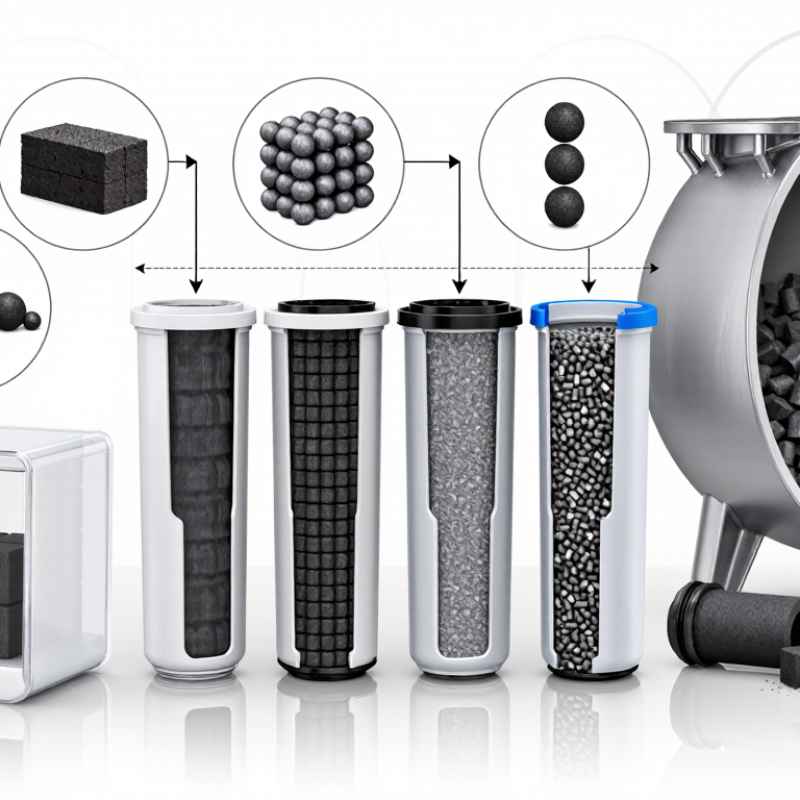
| Carbon Block | Fine activated-carbon particles are compressed and held together with a binder to form a solid block. | Point-of-use drinking-water systems, refrigerator filters, and under-sink cartridges. | Provides substantial contact between water and carbon. Depending on its design and rated pore size, it may also reduce some suspended particles. | Flow rate and pressure drop depend on block density, dimensions, and pore rating. It does not remove every contaminant; check performance claims for the specific cartridge. |
| Granular Activated Carbon (GAC) | Loose activated-carbon granules are contained in a cartridge or treatment vessel. | Water-filter pitchers, countertop systems, and larger treatment vessels. | Water passes through a bed of granules that can adsorb certain dissolved compounds, including chlorine-related taste and odor compounds. | Performance depends on contact time and water conditions. Poorly designed or exhausted beds can allow water to bypass the media. |
| Catalytic Carbon | Activated carbon is processed to improve catalytic activity for selected reactions. | Specialized water treatment, including systems designed to address chloramine under specified operating conditions. | Can be more effective than standard activated carbon for certain treatment goals when the system provides adequate contact time. | Results depend on the media, flow rate, water chemistry, and system design. Verify the tested reduction claims for the intended contaminant. |
| Impregnated Activated Carbon | Activated carbon is treated with an added substance to target particular compounds or treatment needs. | Specialized air or water applications where a standard carbon surface alone may not provide the desired treatment. | The added treatment can support removal or control of selected contaminants beyond the media’s general adsorption function. | There is no single performance profile for this category. The impregnant, application, and approved use must be checked carefully. |
| Activated Carbon Fiber or Cloth | Activated carbon is formed into a fibrous or cloth-like material rather than loose granules or a conventional block. | Specialized compact filters and certain air-treatment applications. | The thin, porous structure can offer accessible adsorption surfaces in a compact format. | Capacity, service life, and contaminant performance vary by material and construction; these products are not interchangeable with standard carbon cartridges. |



 08045479132

 Send Inquiry


 Send Inquiry
 Send SMS

