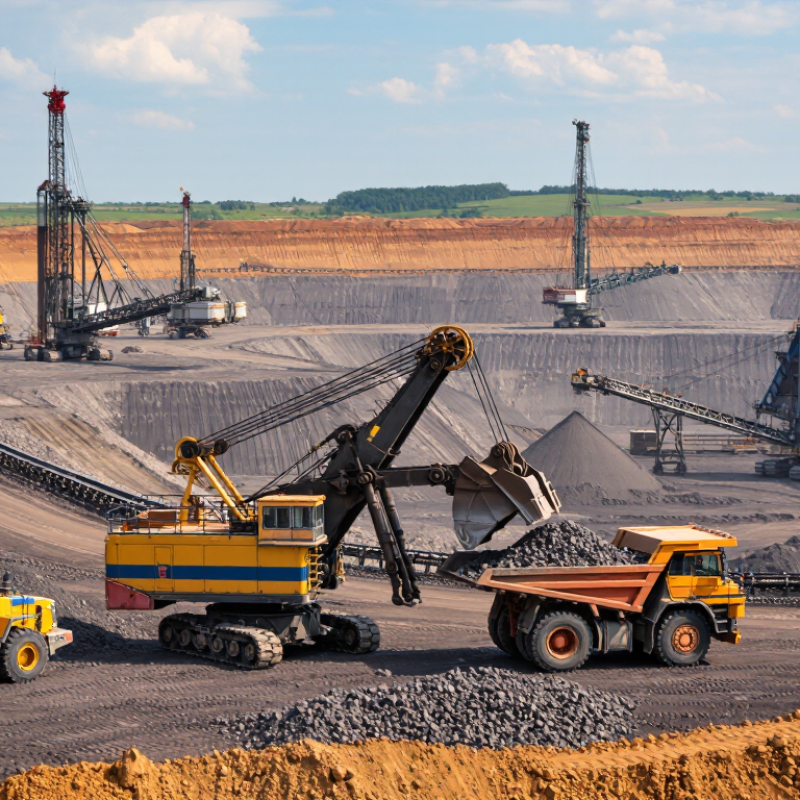
| Hydraulic Excavator | Breaks, digs, and loads blasted or excavated material. | Overburden removal and ore loading | Operating weights commonly range from approximately 20 to more than 800 metric tonnes; bucket capacities can range from about 1 to more than 60 m³, depending on class. | Hard rock, overburden, coal, copper ore, iron ore, and other materials requiring high breakout force. | Provides the primary digging and loading function at the pit face. Large hydraulic excavators can load haul trucks in several passes and support selective ore extraction. | Match bucket size, loading height, bench geometry, hydraulic power, ground pressure, and truck body volume to the mine plan. |
| Mining Haul Truck | Transports ore, waste rock, and overburden between the loading area and dump, crusher, or stockpile. | Material haulage | Rigid-frame haul trucks commonly cover payload classes from roughly 30 to more than 360 metric tonnes; operating speed is typically limited by payload, grade, and road conditions. | Large open-pit operations with established haul roads and significant movement distances. | Connects the pit to downstream processing and waste-disposal areas. Fleet availability and cycle time strongly influence total mine production. | Evaluate payload, fuel or energy consumption, braking systems, tire availability, uphill speed, turning radius, and compatibility with loading equipment. |
| Wheel Loader | Loads loose material, rehandles stockpiles, and feeds mobile or fixed crushing equipment. | Loading, stockpiling, and plant feeding | Common mining wheel loaders use buckets of approximately 3 to 40 m³, with operating weights ranging from about 15 to more than 250 metric tonnes. | Crushed ore, aggregate, coal, limestone, sand, and short-distance loading applications. | Offers fast mobility and flexible loading for stockpiles, blending areas, truck loading, and crusher-feed operations where excavation force is not the main requirement. | Consider bucket fill factor, breakout force, lift height, travel distance, tire durability, fuel efficiency, and operator visibility. |
| Blast-Hole Rotary Drill | Drills accurately spaced and sized holes for explosives or in-pit sampling. | Drilling and blasting | Surface rotary drills commonly cover hole diameters of approximately 150 to 450 mm, with drilling depths often reaching 15 to 60 m or more depending on the design. | Competent rock formations in large open-pit mines, quarries, and construction-material operations. | Creates the blast pattern that controls fragmentation, diggability, wall stability, and downstream loading and crushing performance. | Assess hole diameter range, mast reach, compressor capacity, dust suppression, automation, terrain mobility, and performance in the target rock type. |
| Bulldozer | Pushes overburden, spreads waste, maintains working areas, and constructs or repairs haul roads. | Site preparation and material management | Mining crawler dozers commonly range from approximately 150 to more than 900 kW, with blade capacities broadly ranging from about 10 to 70 m³ depending on blade type and material. | Rough terrain, compacted waste, loose overburden, dumps, benches, ramps, and road-maintenance work. | Maintains access and operating surfaces, supports truck and shovel productivity, pushes spillage, and helps prepare dumps and working benches. | Select blade configuration, ripper capability, undercarriage strength, traction, ground clearance, slope performance, and service access. |
| Motor Grader | Shapes, levels, crowns, and maintains haul roads and mine working surfaces. | Haul-road construction and maintenance | Typical mining motor graders use moldboards of approximately 3.7 to 7.3 m and engine outputs commonly ranging from about 130 to 350 kW. | Long haul roads, ramps, benches, drainage channels, and surfaces requiring accurate grading. | Improves road smoothness, drainage, tire life, vehicle speed, and braking safety, thereby reducing haul-cycle variation and operating costs. | Review moldboard reach, articulation, steering control, automatic grade control, frame strength, and suitability for the mine's road width. |
| Surface Miner | Cuts, crushes, and often loads or windrows material in a continuous operation without conventional drilling and blasting. | Selective mining and material extraction | Cutting widths commonly range from approximately 2.0 to 4.5 m, with cutting depths often adjustable from a few centimetres to about 0.8 m per pass, depending on machine design. | Coal, gypsum, limestone, bauxite, phosphate, and other relatively continuous, stratified, or moderately soft deposits. | Can improve selectivity and produce a more uniform feed size while reducing or eliminating blasting in suitable deposits. | Check cutting drum design, production rate, dust control, material hardness, transfer method, grade capability, and maneuverability. |
| Dragline Excavator | Removes large volumes of overburden and places waste at long reach using a suspended bucket. | Overburden stripping | Large draglines may use buckets of approximately 20 to more than 100 m³ and have working radii that can exceed 100 m, subject to machine configuration and mine geometry. | Large, relatively flat coal deposits and operations where overburden can be cast directly into adjacent mined-out areas. | Enables high-volume stripping and internal spoil placement, reducing the need for truck haulage in suitable overburden-removal layouts. | Evaluate boom length, bucket capacity, digging depth, ground conditions, electrical infrastructure, relocation requirements, and mine sequencing. |
| Bucket-Wheel Excavator | Continuously excavates soft to moderately consolidated material with a rotating bucket wheel and transfers it to a conveyor system. | Continuous overburden and lignite mining | Large systems can achieve theoretical excavation rates of several thousand to more than 10,000 m³ per hour, depending on material, wheel size, and system design. | Large-scale lignite, brown coal, clay, sand, and other continuous deposits with relatively uniform geology. | Supports continuous mining and conveyor transport, reducing dependence on truck fleets and enabling high-volume movement over stable mine layouts. | Require detailed assessment of deposit continuity, mine geometry, material strength, conveyor integration, electrical supply, and system availability. |
| Water Truck | Applies water to haul roads and active areas for dust suppression and surface conditioning. | Environmental control and road management | Mining water tanks commonly range from approximately 20,000 to more than 200,000 litres; spray coverage and cycle time depend on road width, climate, and traffic. | Dry, windy, or high-traffic surface mines where airborne dust can affect visibility, safety, compliance, and equipment maintenance. | Controls dust on haul roads, improves visibility, supports regulatory compliance, and helps maintain safer and more stable road surfaces. | Consider tank capacity, pump and spray-bar output, water-source distance, nozzle control, chassis durability, and local water-management requirements. |



 08045479132
 Send Inquiry

 Send Inquiry
 Send SMS