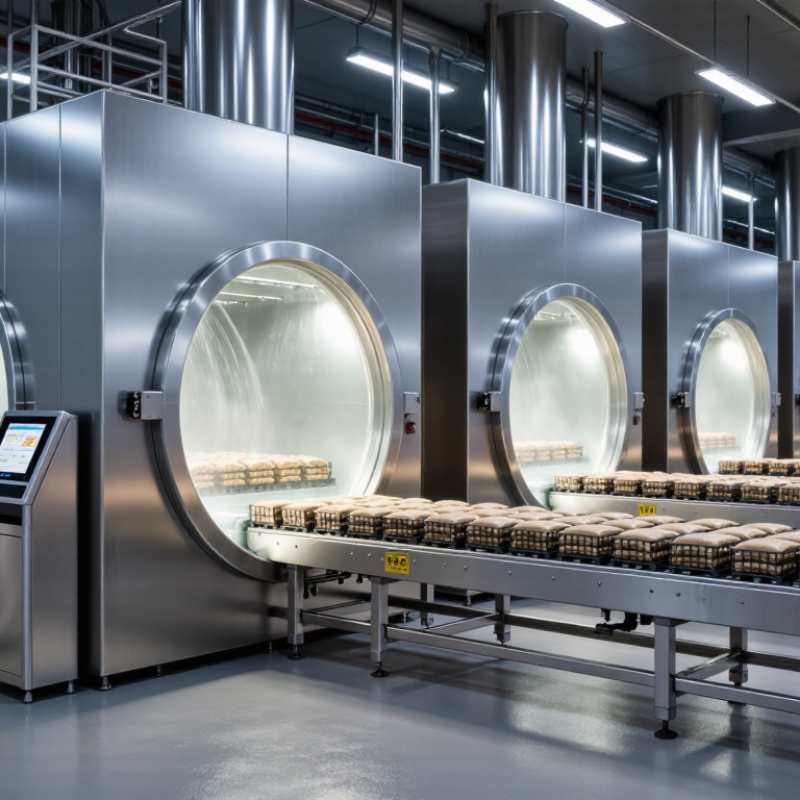
| Definition | Side-spray retort | A batch retort that distributes heated water over the product load through spray nozzles, commonly arranged along the sides of the vessel. | Nozzle layout, spray coverage, load arrangement, and evidence of temperature distribution testing. |
| Heating system | Water circulation and heating | A pump recirculates process water through the spray system. Water is heated directly or through a heat exchanger, depending on the equipment design. | Heating method, pump capacity, flow monitoring, heat-exchanger design, and cleaning access. |
| Typical operating sequence | Loading to cooling | The vessel is loaded and closed; air is removed or controlled as required; the load is heated, held for the scheduled process, and then cooled under controlled conditions. | Documented cycle stages, automatic controls, alarms, recipe management, and batch records. |
| Pressure control | Counterpressure | When processing flexible pouches or other pressure-sensitive packages, compressed air may be used to balance internal package pressure during heating and cooling. | Pressure-control accuracy and compatibility with the package, seal, and product process. |
| Product safety | Time and temperature | There is no single time-and-temperature schedule suitable for every food. The required process depends on product properties, container size and material, loading pattern, and the validated process. | Process-authority review, calibrated sensors, temperature-distribution and heat-penetration study requirements, and traceable records. |
| Package compatibility | Containers and loading | Retorts may be configured for suitable cans, glass containers, trays, or flexible pouches. Compatibility depends on vessel design, baskets or racks, package limits, and process conditions. | A trial using the intended package, loading pattern, and product; package deformation and seal-integrity checks. |
| Construction and compliance | Pressure vessel and controls | The pressure vessel, instrumentation, safety devices, and control system should be designed and supplied in accordance with applicable local regulations and the intended installation requirements. | Applicable certificates, vessel documentation, safety-valve records, instrument calibration, and inspection or service support. |
| Supplier evaluation | Capability and lifecycle support | A suitable supplier should be assessed on engineering fit, documented testing, workmanship, controls, commissioning, training, spare parts, and after-sales service—not on a generic ranking alone. | Request a technical proposal against your product, package, target capacity, utilities, applicable standards, and validation plan. |



 08045479132

 Send Inquiry


 Send Inquiry
 Send SMS

