| PIR Motion Sensor Street Light | Passive infrared sensing detects changes in infrared radiation emitted by moving people, vehicles, and animals. | Human movement Vehicle movement Body heat changes | Common outdoor detection distances are approximately 5–12 m, depending on lens design, mounting height, temperature, and walking direction. | Low standby power consumption; simple control logic; cost-effective; generally resistant to radio interference. | Performance can decrease when the target and background have similar temperatures. Detection is usually less reliable through walls, glass, dense vegetation, or in very hot weather. | Maintains a low standby level and raises brightness when a moving heat source enters the detection zone. | Residential roads, pedestrian paths, parks, entrances, and low-speed access roads. | Check detection angle, lens coverage, mounting height, ambient temperature range, false-trigger control, and animal-detection behavior. |
| Microwave Radar Sensor Street Light | Active microwave sensing transmits radio waves and analyzes reflected signals caused by movement or changes in distance. | People Vehicles Direction of movement Speed changes | Typical outdoor ranges are approximately 8–20 m for lighting control; the actual range depends on frequency, antenna pattern, mounting position, and configured sensitivity. | Works in darkness and many weather conditions; can detect movement before a person reaches the light; often supports wider-area coverage than PIR. | May detect movement through some non-metallic materials and can be affected by reflections, nearby moving objects, or incorrect sensitivity settings. | Switches or dims the lamp according to detected movement, direction, or traffic activity. | Roads, parking areas, industrial yards, tunnels, logistics zones, and locations requiring early detection. | Review operating frequency, interference management, detection-zone adjustment, local radio regulations, and mounting orientation. |
| mmWave Radar Sensor Street Light | High-frequency millimeter-wave radar measures reflected signals to identify motion, distance, and in some systems the presence of relatively stationary targets. | Motion Presence Distance Traffic flow | Common configured detection zones range from approximately 10–30 m, with the final range determined by antenna design, software settings, and installation height. | Fine motion sensitivity; capable of multi-zone detection; supports more detailed traffic or occupancy information than basic motion sensors. | Usually costs more than basic PIR; requires careful commissioning; metal structures and complex surroundings can create reflections or dead zones. | Provides gradual dimming, presence-based control, zone-based lighting, or traffic-responsive brightness. | Smart roads, urban corridors, intersections, parking facilities, and projects requiring data-rich control. | Evaluate detection resolution, privacy requirements, cybersecurity, edge-processing capability, communication protocol, and local spectrum compliance. |
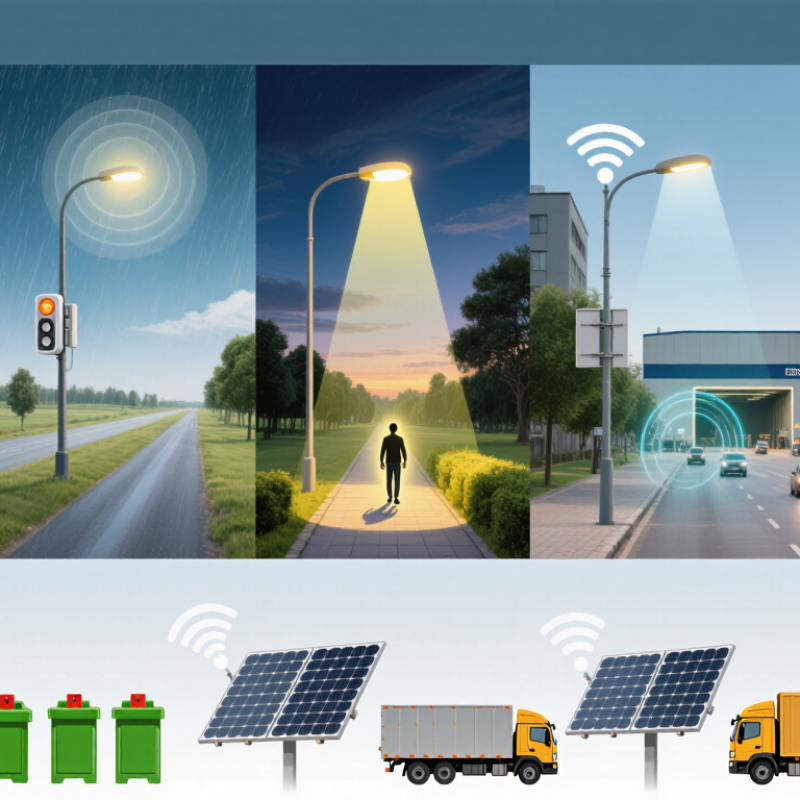
| Photocell or Ambient-Light Sensor Street Light | Measures surrounding illuminance and compares it with a programmed threshold for dusk-to-dawn operation. | Daylight level Dusk Dawn Overcast conditions | Controls operation across the full outdoor daylight cycle rather than using a fixed motion-detection distance; threshold settings are commonly selected around local night/day requirements. | Automatic seasonal operation; simple installation; reduces daytime energy waste; does not require a moving target. | Can be affected by direct lamp glare, nearby building lights, dirt on the sensor window, snow, or poor placement. It does not detect movement. | Turns the light on at low ambient illuminance and off after daylight returns, often with a built-in time delay to prevent rapid switching. | General street lighting, rural roads, public squares, campuses, and solar street lights. | Check sensor orientation, shielding from the lamp itself, illuminance threshold, time delay, ingress protection, and cleaning access. |
| Ultrasonic Motion Sensor Street Light | Emits ultrasonic sound waves and detects changes in the reflected echo caused by nearby objects or movement. | Nearby movement Object presence Distance changes | Outdoor detection is commonly limited to approximately 3–8 m because wind, rain, temperature, and open-air conditions can reduce effective range. | Can detect objects without relying on heat contrast; useful for short-range and controlled detection zones. | Wind, rain, airflow, soft surfaces, obstructions, and temperature changes can affect sound transmission and accuracy. Less suitable for exposed, long-distance road detection. | Raises brightness when an object enters a short-range zone and returns to a lower level after a delay. | Covered walkways, building entrances, sheltered parking areas, service lanes, and compact pedestrian zones. | Confirm weather exposure, acoustic environment, target distance, sensor protection, mounting direction, and minimum target size. |
| Camera-Based Vision Sensor Street Light | Uses an image sensor and software algorithms to analyze visual changes, object categories, movement, or traffic conditions. | People Vehicles Bicycles Traffic conditions | Typical useful distances can range from approximately 10–50 m or more, depending on lens angle, image resolution, lighting level, weather, and analytics software. | Supports classification, counting, occupancy analysis, incident detection, and advanced adaptive-lighting strategies. | Performance may decline in glare, fog, heavy rain, snow, darkness, obstruction, or poor camera alignment. Requires careful privacy, data-security, and maintenance planning. | Adjusts brightness or lighting zones according to classified road users, traffic volume, or detected events. | Smart-city corridors, intersections, transport hubs, security-sensitive sites, and data-driven traffic management. | Assess privacy compliance, data storage, processing location, night vision, image quality, network bandwidth, cybersecurity, and maintenance requirements. |
| Environmental Sensor Street Light | Combines one or more sensors that measure environmental conditions and may integrate with a lighting controller. | Temperature Humidity Rain Air quality Flood or water level | Detection range depends on the measured variable: temperature and humidity are local measurements, while rain, air-quality, or water-level sensing depends on sensor placement and calibration. | Supports weather-responsive lighting, asset protection, environmental monitoring, and combined smart-infrastructure functions. | Environmental measurements do not directly identify a person or vehicle. Sensors require calibration, protection from contamination, and suitable placement for representative readings. | Can increase brightness during severe weather, flooding risk, or reduced visibility when integrated with appropriate control rules. | Flood-prone roads, coastal areas, tunnels, industrial sites, smart campuses, and municipal monitoring networks. | Verify measured parameters, calibration interval, operating temperature, enclosure rating, sensor placement, data protocol, and local environmental regulations. |
| Multi-Sensor Adaptive Street Light | Combines ambient-light sensing with PIR, radar, camera, or environmental inputs through a local or networked lighting controller. | Daylight Motion Traffic Weather System status | Overall coverage is determined by the individual sensors; a typical installation may combine daylight control with motion zones of approximately 5–30 m. | More accurate control; supports layered safety strategies; can reduce energy use while maintaining higher brightness when activity or risk is detected. | Higher system complexity, installation cost, commissioning effort, and interoperability requirements. Incorrect sensor priority rules may cause unwanted switching. | Uses schedules, daylight thresholds, motion levels, traffic conditions, and environmental events to select different brightness levels. | Smart highways, urban districts, airports, large campuses, public infrastructure, and energy-optimization projects. | Confirm controller logic, sensor compatibility, interoperability standards, communication reliability, fail-safe behavior, maintenance access, and total lifecycle cost. |



 08045479132
 Send Inquiry

 Send Inquiry
 Send SMS