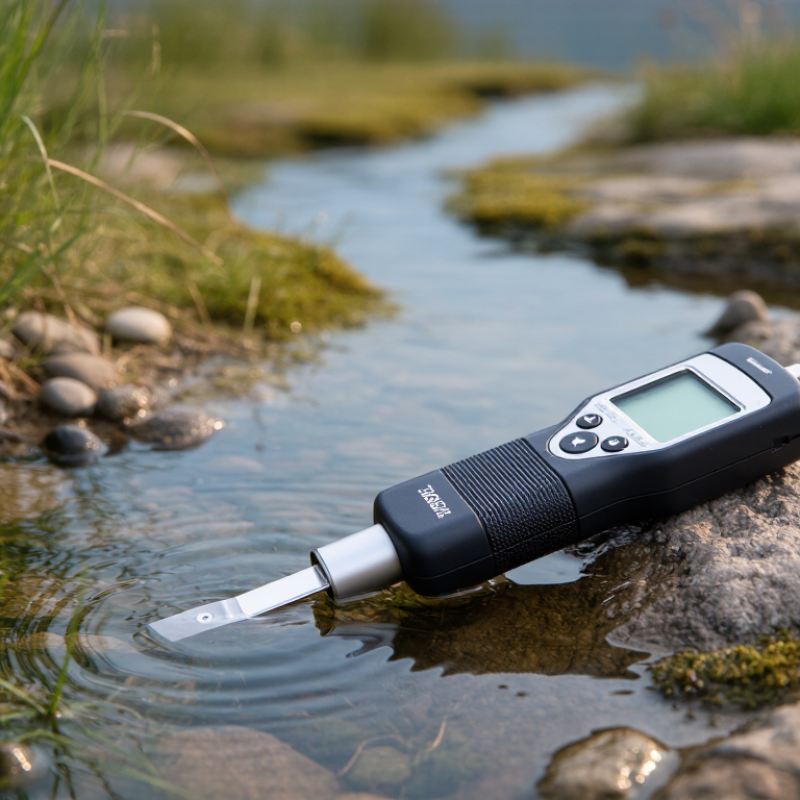
| Portable conductivity salinity meter | Freshwater through seawater; many models cover approximately 0–70 ppt | Model-dependent; commonly displays salinity in 0.1 ppt increments | Field checks of seawater, aquaculture systems, brackish water, and environmental samples | Look for automatic temperature compensation and a range appropriate to the samples being tested. Rinse the probe between samples. |
| Benchtop conductivity meter with salinity mode | Depends on the probe and settings; often suitable for freshwater to high-salinity samples | Typically offers finer display resolution than basic field meters; accuracy depends on calibration and instrument specifications | Laboratory testing, repeated measurements, and quality-control work | Requires calibration with suitable conductivity standards. Use a salinity scale or conversion method appropriate to the application. |
| Digital refractometer | Commonly designed for seawater or brine ranges; check the instrument’s stated scale | Often displays salinity in 0.1 ppt increments; stated accuracy varies by model | Quick checks of aquarium water, seawater, and prepared brines | Uses refractive index rather than electrical conductivity. Keep the prism clean and follow the instrument’s temperature and calibration instructions. |
| Optical refractometer | Depends on the scale; many seawater models cover approximately 0–100 ppt | Scale divisions are commonly around 1–2 ppt, so readings are less precise than many digital instruments | Low-cost, occasional checks where approximate salinity is sufficient | Requires a clear sample and careful visual reading. Temperature and calibration can affect results. |
| Multiparameter water-quality meter with conductivity probe | Probe-dependent; may cover freshwater, brackish water, or seawater ranges | Varies by probe and meter; may report conductivity, temperature, and calculated salinity | Field surveys where salinity is measured alongside parameters such as temperature, pH, or dissolved oxygen | Confirm that the probe supports the required salinity range and that its salinity calculation matches the reporting method needed. |
| Hydrometer or specific-gravity instrument | Usually intended for aquarium or seawater measurements; range depends on the scale | Typically provides an approximate specific-gravity reading rather than a direct high-resolution salinity result | Basic aquarium monitoring and educational demonstrations | Results depend on temperature and correct handling. It is generally less convenient for precise field or laboratory measurements. |



 08045479132

 Send Inquiry


 Send Inquiry
 Send SMS

