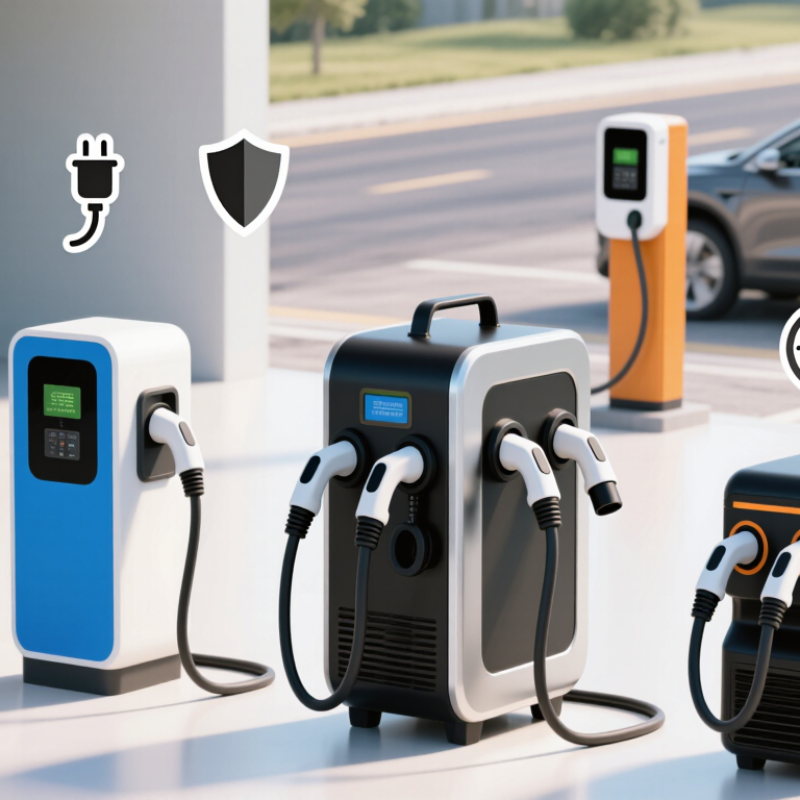
| Portable AC EVSE | A movable charging cable-and-control unit that supplies AC power to an EV. The vehicle’s onboard charger converts that AC power to DC for the battery. | Common configurations range from about 2.3 kW at 230 V/10 A to 7.4 kW at 230 V/32 A. Three-phase 400 V/16 A units can provide about 11 kW. | A compatible, properly rated outlet or other AC supply; it does not usually contain an energy-storage battery. | Home, workplace, or travel charging where a suitable power outlet is available. | Check the supply circuit, plug type, current setting, protective functions, and vehicle connector. Charging power may be limited by the outlet or the vehicle’s onboard charger. |
| Portable DC charger | A relocatable DC charging unit that supplies DC power directly to the vehicle battery through its charging system. | Equipment varies widely; mobile units are often designed in the tens-of-kilowatts range. Actual output depends on the unit, supply, and vehicle. | Typically requires a suitably rated electrical supply. Higher-power models may need dedicated site infrastructure and are not equivalent to a household plug-in charger. | Temporary charging sites, service operations, and locations where a fixed charger is unavailable. | Confirm input requirements, connector compatibility, vehicle charging limits, installation conditions, and applicable electrical standards. |
| Battery-buffered mobile charger | A mobile charging system with an internal battery that stores energy and later delivers it to an EV. Some designs also recharge from the grid between uses. | Battery energy and charging output are product-specific; these are not standardized ratings and should be checked against the product specification. | Internal battery, with grid or other charging input depending on the design. | Events, roadside support, depots, and temporary locations with limited grid capacity. | Compare usable energy, recharge time, DC or AC output, transport requirements, and the number of vehicle sessions available between recharges. |
| Portable EVSE vs. portable power station | A portable EVSE controls and protects the connection to an EV; a portable power station stores electricity. A power station can charge an EV only if its output, connector, and charging interface are suitable. | Power-station capacity is generally stated in watt-hours or kilowatt-hours; EVSE output is generally stated in kilowatts. | EVSE needs a compatible power source. A power station supplies stored energy within its rated output limits. | Choosing the right equipment for travel, backup use, or off-grid applications. | Do not assume that a household battery generator can directly charge every EV. Verify continuous output, grounding and protection, connector compatibility, and the vehicle’s minimum charging requirements. |
| Connector and standards check | Charging interfaces and requirements vary by market and charging mode. | Not a power rating. | Depends on the product and installation. | Product selection, importing, and use across different regions. | For China, check the applicable GB/T connector and safety requirements. Other markets may use different connector systems. Relevant standards include IEC 61851-1 for EV conductive charging systems and IEC 62752 for in-cable control and protection devices used in Mode 2 charging. |



 08045479132

 Send Inquiry


 Send Inquiry
 Send SMS

