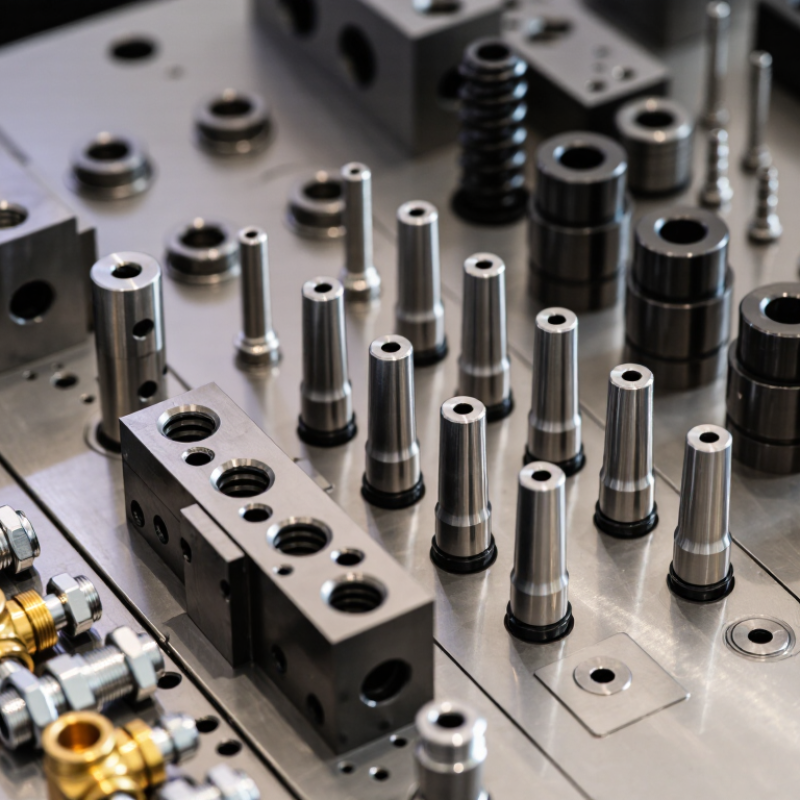
Global sourcing of Moulding Components demands more than comparing prices on a spreadsheet. Each insert, ejector pin, guide pillar, cooling fitting, and cavity component affects production stability. A small tolerance error can create flash, uneven cooling, or repeated machine stoppages.
Dr. David Kazmer, a professor of plastics engineering and author of Injection Mold Design Engineering, has emphasized this practical principle: “The mold is the heart of the injection molding process.” His view remains highly relevant for international buyers. Components should be assessed through material certificates, heat-treatment records, dimensional reports, and supplier process controls. A polished catalogue is not enough.
This guide examines the Top 10 Moulding Components for Global Sourcing. It considers performance, compatibility, replacement availability, and total ownership cost. Steel grade matters. So do surface hardness, corrosion resistance, and machining accuracy. Even packaging deserves attention when components cross oceans. A damaged guide bush can delay a complete mould trial.
The lowest quotation may be misleading. Sometimes, it excludes inspection, coating, tooling adjustments, or spare parts. That mistake is common. I have seen sourcing plans focus on unit cost while ignoring lead-time risk and technical communication. Those gaps can become expensive after shipment.
Reliable sourcing also requires drawings with clear datums, revision control, and measurable acceptance criteria. Suppliers should explain deviations before production, not after delivery. Still, no checklist eliminates every problem. Materials vary, production conditions change, and assumptions sometimes fail. This article offers a practical framework, but buyers must validate each component against their mould design and manufacturing environment.
Top 10 Moulding Components for Global Sourcing
Moulding components are shaped parts produced through processes such as injection moulding, compression moulding, or extrusion. In global sourcing, the term usually covers functional and decorative parts used in larger assemblies.
Typical examples include housings, covers, bezels, trays, brackets, clips, seals, grommets, inserts, and protective caps.
The scope includes material selection, mould design, dimensional control, surface finish, packaging, and inspection requirements.
Common materials include engineering plastics, elastomers, and reinforced compounds. Each material affects strength, temperature resistance, shrinkage, and recycling options.
Buyers should define tolerances, colour references, wall thickness, and expected service conditions before requesting quotations. A small change in draft angle can affect tooling cost. It can also delay production. That detail is easy to overlook.
Tips: Request production samples before approving large orders. Compare measured dimensions with approved drawings. Check flash, sink marks, warpage, and surface scratches under consistent lighting. Confirm whether the quoted price includes tooling, maintenance, inspection, and export packaging.
A perfect sourcing plan is rare. Practical teams leave room for design revisions and unexpected material variation. They also document every approval clearly, even when the part appears simple.



 08045479132
 Send Inquiry

 Send Inquiry
 Send SMS
