| What an SDS Plus hammer drill is | A rotary hammer designed for drilling in materials such as concrete and masonry, using a compatible SDS Plus accessory connection. | It combines rotation with a hammering action. It is not the same as a standard drill that relies only on a mechanical impact mechanism. |
| How the hammer mechanism works | In a common electro-pneumatic design, a motor drives a piston that compresses air. The air moves a striker, which transfers impact energy to the bit through an intermediate component. | Impact energy, impact rate, and drilling performance depend on the complete tool design and should be checked in the manufacturer’s technical documentation. |
| SDS Plus shank | The SDS Plus system uses a nominal 10 mm bit shank with four longitudinal grooves. Two open grooves transmit rotation, while two closed grooves help retain the bit. | Confirm accessory compatibility before purchase. SDS Plus, SDS Max, and other shank systems are not interchangeable. |
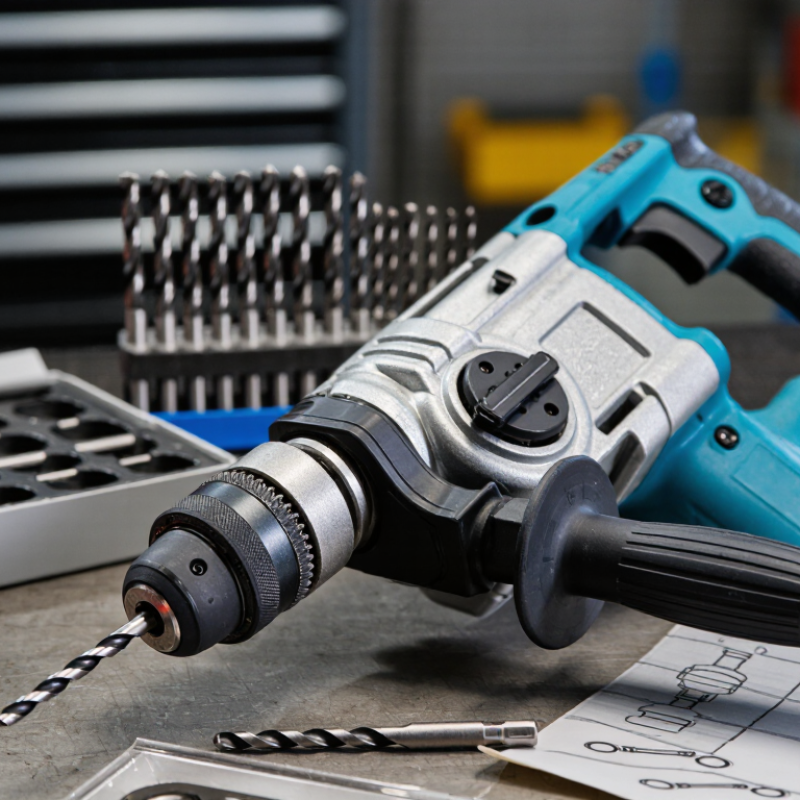
| Bit changing | SDS Plus accessories are typically inserted into the tool holder and retained by its locking mechanism; a separate chuck key is not normally required. | Follow the tool’s instructions when fitting or removing bits. Check that accessories are correctly seated and suitable for the tool and application. |
| Operating modes | Many models offer rotation-only and rotary-hammer modes. Some also provide hammer-only operation for light chiselling. | Mode availability varies by model. Buyers should verify the switch positions and permitted applications rather than assume every tool includes all three modes. |
| Typical applications | Common uses include drilling anchor holes in concrete or masonry and, on models with hammer-only mode, limited chiselling work. | Choose the tool and accessory for the material, hole size, duty cycle, and task. Follow the rated capacity and operating limits stated by the manufacturer. |
| Capacity and performance | Maximum drilling diameter, rated input power, impact energy, and no-load speed are model-specific specifications, not fixed characteristics of the SDS Plus system. | Compare published test conditions and specifications. Do not treat a maximum diameter as a recommended continuous drilling size. |
| Safety features to check | Depending on the design, a tool may include features such as an auxiliary handle, a depth stop, overload protection, or a safety clutch. | Check which features are included in the offered configuration. Use appropriate eye, hearing, and respiratory protection for the work environment. |
| Manufacturer evaluation | Assess technical documentation, product consistency, quality-control procedures, spare-parts availability, and after-sales support. | Request model-specific datasheets, applicable conformity documents, warranty terms, and sample inspection details before placing an order. |
| Export and sourcing checks | Electrical ratings, plug type, packaging, labeling, and documentation can vary by destination market and order configuration. | Confirm destination-country requirements, voltage and frequency compatibility, included accessories, lead times, and shipping terms in writing. |



 08045479132

 Send Inquiry


 Send Inquiry
 Send SMS

