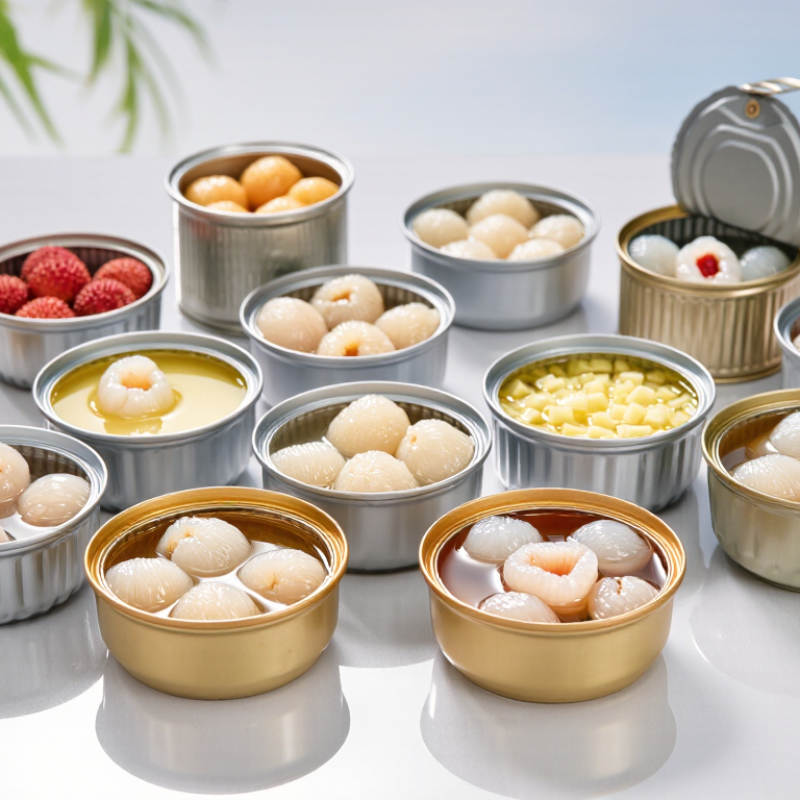
| 1 | Whole Peeled Lychee with Seed | Whole fruits with the outer skin removed; the seed remains inside.
Premium appearance | Light syrup, medium syrup, or water. | - Uniform whole-fruit appearance and size.
- Clean, intact flesh with limited bruising and discoloration.
- Seed should remain substantially intact and easy to identify.
- Control of drained weight, fill weight, vacuum, seam integrity, and commercial sterility.
| - HACCP-based food-safety system.
- Food-safety certification schemes recognized by the buyer or retailer may be requested.
- Halal or Kosher certification may be required for specific markets.
| - Product name must state that the lychees contain seeds.
- Ingredient list, net contents, drained weight, lot code, date marking, country of origin, and storage instructions.
- Nutrition declaration and importer details must follow the destination market.
| Retail fruit cups, dessert toppings, hotel buffets, and premium foodservice. |
| 2 | Whole Peeled and Pitted Lychee | Whole peeled fruits with the seed removed.
Ready to eat | Light syrup, fruit juice, or water with permitted acidity regulators where applicable. | - Complete seed removal with minimal flesh loss.
- Whole shape, firm texture, clean color, and low incidence of crushed fruit.
- No hard seed fragments or foreign matter.
- Microbiological safety and thermal-process controls must be documented.
| - HACCP plan and validated thermal process.
- Good Manufacturing Practices and traceability records.
- Organic certification only when the product and processing meet the importing market’s organic rules.
| - Use a clear description such as “Peeled and Pitted Lychees.”
- Declare all ingredients, including syrup, juice, acidulants, or additives.
- State drained weight where required by the importing jurisdiction.
| Retail cans, cocktail service, bakery fillings, and ready-to-eat applications. |
| 3 | Lychee Halves | Peeled fruit cut into two pieces, usually pitted.
Uniform cut | Light syrup, heavy syrup, juice, or water. | - Consistent half size and cut surface.
- Firm but tender texture without excessive fragmentation.
- Limited browning, leakage, skin remnants, and mechanical damage.
- Consistent drained weight and fruit-to-medium ratio.
| - HACCP or equivalent preventive food-safety controls.
- Third-party laboratory testing may cover microbiology, pesticide residues, heavy metals, and additives.
- Retailer-specific ethical or environmental audits may apply.
| - Declare the cut form and packing medium.
- List the percentage of lychee where required for emphasized ingredients.
- Include allergen information according to destination-country rules, even though lychee is not generally a major regulated allergen.
| Desserts, cakes, fruit salads, catering, and restaurant preparation. |
| 4 | Lychee Quarters or Slices | Peeled and pitted fruit divided into quarters or sliced into smaller pieces.
Value format | Syrup, fruit juice, or water. | - Defined cut size and acceptable proportion of small pieces.
- Good color retention and resistance to excessive softening.
- Minimal skin, seed, stem, and foreign-material defects.
- Accurate drained-weight and piece-count specifications when stated in the contract.
| - Food-safety management certification may be requested by major buyers.
- Residue compliance must meet the maximum residue limits of the destination market.
- Packaging materials should be suitable for food contact.
| - Identify the product as quarters, slices, or pieces.
- Declare sweeteners, acidity regulators, preservatives, and other permitted additives.
- Include net quantity, drained weight, lot identification, and best-before or use-by information as applicable.
| Industrial desserts, bakery products, smoothies, toppings, and foodservice packs. |
| 5 | Diced Canned Lychee | Small, standardized cubes or diced fruit, usually pitted.
Foodservice | Light syrup, juice, water, or formulated dessert syrup. | - Specified cube dimensions and tolerance range.
- Low percentage of puree, fines, and oversized pieces.
- Firm texture suitable for mixing and portioning.
- Stable color and flavor after processing and storage.
| - HACCP-based controls, batch traceability, and process records.
- Supplier testing for pesticide residues and contaminants should match the buyer’s risk assessment.
- Nutrition and additive declarations must comply with the importing market.
| - Use a precise product description such as “Diced Lychees in Syrup.”
- Declare size grade or cut specification when used as a purchasing requirement.
- Foodservice labels should include handling, storage, and once-opened instructions.
| Ice cream, yogurt, bakery fillings, bubble tea, sauces, and catering. |
| 6 | Lychee Pieces and Irregular Fruit | Non-uniform pieces created during trimming or processing.
Cost-efficient | Syrup, juice, or water. | - Contract-defined percentage of pieces, fragments, and puree.
- No objectionable fermentation, off-odors, mold, or foreign matter.
- Controlled color and texture despite the less uniform appearance.
- Accurate solids, drained weight, and container fill.
| - GMP, sanitation controls, and traceability are essential.
- Buyer may require certificates of analysis for each lot.
- Claims such as organic, halal, or non-GMO require appropriate substantiation where used.
| - Label as “Lychee Pieces” or another accurate standardized description.
- Avoid “whole” or “premium” claims if the fruit is visibly irregular.
- Declare all processing aids or additives that require labeling in the destination market.
| Sauces, fillings, purees, beverages, jams, and industrial food manufacturing. |
| 7 | Lychee in Light Syrup | Whole, halved, sliced, or diced lychee packed in a lower-solids sugar syrup.
Mainstream retail | Water and sugar; acidity regulators or antioxidants may be used where permitted and declared. | - Buyer should specify soluble-solids target, commonly measured in degrees Brix.
- Balanced sweetness, natural lychee aroma, firm texture, and clear syrup.
- Control of container vacuum, seam quality, leakage, corrosion, and commercial sterility.
- Color and sensory quality should remain acceptable through the stated shelf life.
| - Compliance with the destination country’s food-additive and sugar-labeling rules.
- HACCP or a recognized food-safety certification may be required by importers.
- Packaging must meet food-contact and migration requirements.
| - State “in Light Syrup” when this is the commercial identity.
- Provide sugar and nutrition information in the format required by the destination market.
- Declare added sweeteners and acidity regulators by their legally accepted names.
| Supermarkets, household consumption, desserts, cocktails, and catering. |
| 8 | Lychee in Juice or No-Added-Sugar Medium | Lychee packed in fruit juice or in water without added sugar, subject to the exact formulation.
Health-positioned | Lychee juice, another declared fruit juice, water, or a blend of these. | - Verify the actual formulation and absence of added sugar through specifications and testing.
- Control juice authenticity, soluble solids, acidity, flavor, and color.
- Fruit should remain firm, clean, and free from excessive breakage.
- Claims must be supported by formulation and analytical records.
| - Nutrition and health-related claims are regulated differently by market.
- Laboratory verification may be needed for sugar, juice content, and declared nutrients.
- Organic status requires certification under the importing market’s organic scheme.
| - Use “No Added Sugar” only when the formulation and destination-country rules permit the claim.
- Do not imply “sugar-free” unless the product meets the applicable legal threshold.
- Declare the juice source, ingredients, nutrition information, net quantity, and drained weight.
| Health-oriented retail, lunchbox products, fruit salads, and premium foodservice. |
| 9 | Flavored or Infused Canned Lychee | Lychee packed with a declared flavor profile, such as rose, citrus, ginger, or another permitted flavor.
Specialty product | Flavored syrup, juice, water, or a combination of these. | - Flavor should be consistent, clean, and appropriate for the declared description.
- Use only permitted flavorings, colors, preservatives, and acidity regulators.
- Verify allergen and cross-contact risks associated with added ingredients.
- Maintain commercial sterility and package integrity.
| - Regulatory review of flavorings and additives is essential before importation.
- Halal or Kosher review may be needed for flavor carriers or processing aids.
- Supporting technical documentation should identify each added flavoring and additive.
| - Flavoring must be clearly identified in the product name or ingredient list.
- Declare colors, preservatives, sweeteners, and other additives where required.
- Marketing claims must not mislead consumers about the natural composition of the fruit.
| Premium beverages, cocktails, gift products, desserts, and specialty retail. |
| 10 | Certified Organic Canned Lychee | Whole, pitted, halved, sliced, or diced lychee processed and packed under an approved organic system.
Certification-dependent | Organic syrup, organic juice, or water, depending on the certified formulation. | - All agricultural and processing inputs must comply with the applicable organic standard.
- Prevent commingling with non-organic product through segregation and documented traceability.
- Verify ingredient status, cleaning procedures, storage controls, and mass-balance records.
- Organic certification does not replace food-safety, microbiological, or commercial-sterility controls.
| - Valid certification from an authorized body recognized in the destination market.
- Separate organic certificates may be required for export, processing, or import documentation.
- HACCP or recognized food-safety certification may still be requested by the buyer.
| - Use the organic claim and logo only as permitted by the destination jurisdiction.
- Identify the certifier or control body where legally required.
- Ensure the ingredient list, country of origin, lot code, net quantity, drained weight, and organic status are consistent with certification records.
| Organic supermarkets, natural-food distributors, premium retail, and specialty foodservice. |



 08045479132

 Send Inquiry


 Send Inquiry
 Send SMS

