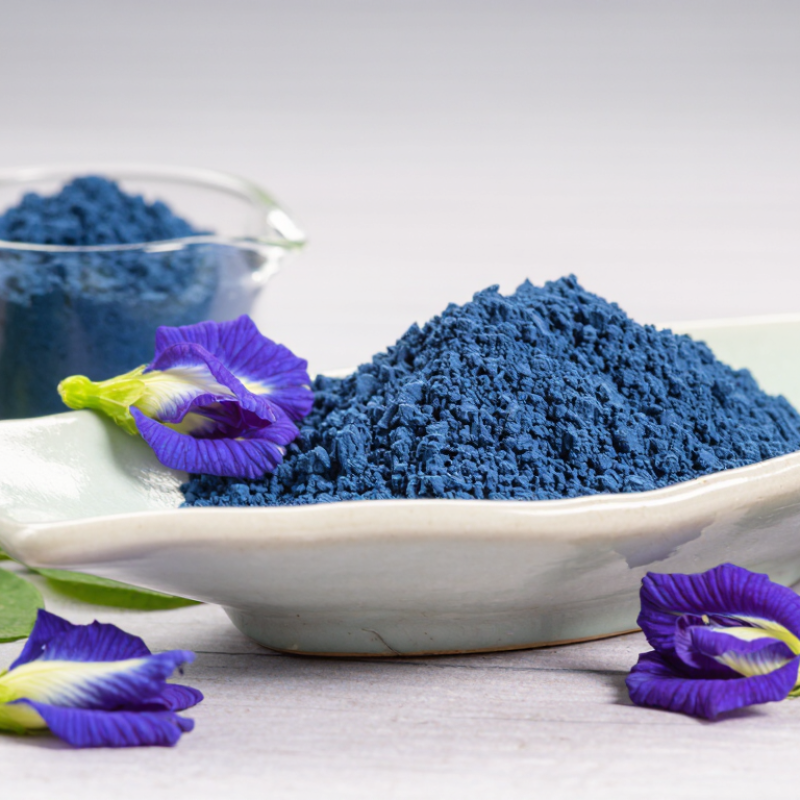
| Botanical identity | Butterfly pea powder should be derived from Clitoria ternatea flowers. Confirm whether the product is made from blue flowers, white flowers, or a blended material. | Color intensity, anthocyanin profile, flavor, and end-use suitability can vary according to flower type and processing method. | Botanical specification, product specification sheet, photograph of raw material, and representative sample. |
| Product form and particle size | Common commercial formats include whole dried flowers, coarse cut material, and powder. Powder specifications may be stated by sieve size, such as 60–100 mesh, depending on the application. | Fine powders disperse more easily in beverages and extracts, while coarser materials may be preferred for tea infusions. | Particle-size or sieve analysis, appearance specification, and application sample. |
| Moisture control | A practical purchasing specification is often set at no more than 8–10% moisture, subject to the supplier’s validated process and the buyer’s regulatory requirements. | Lower, controlled moisture helps reduce caking, microbial growth, and quality loss during storage and transport. | Certificate of analysis, moisture test method, production batch number, and retention-sample policy. |
| Color and anthocyanin consistency | Require a defined color description and, when relevant, a quantitative anthocyanin or color-value range. Color may shift with pH, light, heat, oxygen, and storage time. | A stable color profile is important for beverage, bakery, confectionery, and natural-color applications. | Color-value test, anthocyanin test where applicable, reference sample, and storage-stability information. |
| Microbiological safety | Set acceptance limits for total plate count, yeast and mold, coliforms, Escherichia coli, and Salmonella according to the destination market and intended use. | Dried botanical powders can be exposed to environmental contamination during harvesting, drying, milling, and packing. | Recent microbiological certificate of analysis from an accredited or qualified laboratory. |
| Pesticide and contaminant controls | Request pesticide-residue testing against the limits applicable in the importing country. Heavy metals, aflatoxins, foreign matter, and adulterants should also be assessed when required. | Import authorities and food manufacturers may apply different maximum limits and testing expectations. | Multi-residue pesticide report, heavy-metal report, aflatoxin report where relevant, and risk-assessment statement. |
| Processing claims | Clarify whether the powder is conventional, organically produced, irradiated, steam-treated, freeze-dried, or spray-dried. Do not treat “natural” as a regulated certification claim. | Processing and certification status can affect labeling, customs clearance, buyer approval, and product positioning. | Valid certificate where a claim is made, process flow chart, allergen statement, and non-GMO statement if required. |
| Primary packaging | Typical bulk formats include food-grade inner liners inside kraft paper bags, woven sacks, or fiber drums. Common commercial pack sizes range from approximately 5 kg to 25 kg. | Moisture, oxygen, light, puncture resistance, and pallet stability influence shelf life and transport loss. | Packaging specification, food-contact declaration, net-weight tolerance, sealing method, and packaging photographs. |
| Shelf life and storage | Shelf life is commonly declared around 18–24 months when unopened and stored in a cool, dry, dark environment; the exact period must be supported by the supplier’s stability data. | Heat, humidity, light, and oxygen can accelerate color fading, oxidation, and caking. | Shelf-life statement, storage conditions, production date, expiry or best-before date, and stability information. |
| Minimum order quantity | Small trial orders may be available from approximately 5–25 kg, while standard export orders are often quoted by pallet, metric ton, or container quantity. | Order volume directly affects unit price, packaging format, production scheduling, and freight efficiency. | Written quotation showing minimum order, price basis, payment terms, sample policy, and validity period. |
| Production lead time | For stocked material, dispatch may be possible within several business days. Custom milling, testing, private labeling, or new production commonly requires approximately 2–6 weeks, subject to capacity. | Lead time affects inventory planning, promotional launches, and the risk of air-freight substitution. | Production schedule, cutoff dates, batch-release procedure, and confirmed ready-to-ship date. |
| Trade terms and landed cost | Compare EXW, FCA, FOB, CIF, or DDP quotations only after confirming what freight, insurance, customs clearance, duties, taxes, and destination delivery include. | The lowest product price may not produce the lowest landed cost after import charges and local handling. | Incoterms® 2020 term, commercial invoice, packing list, freight quotation, and duty classification confirmation. |
| Customs classification | Botanical powders may be classified differently depending on composition, processing, intended use, and national tariff rules. Confirm the applicable HS code with the importer or customs broker before shipment. | Incorrect classification can cause delays, reassessment of duty, or additional documentary requirements. | Product description, ingredient statement, customs ruling where available, commercial invoice, and packing list. |
| Export documentation | A standard shipment file may include commercial invoice, packing list, bill of lading or air waybill, certificate of origin, certificate of analysis, and any required health or phytosanitary document. | Document requirements vary by destination, product classification, packaging, and whether the powder is imported as food, an ingredient, or a botanical product. | Destination-country import checklist approved by the buyer’s customs broker or regulatory team. |
| Freight mode | Ocean freight is generally more economical for palletized or containerized bulk orders. Air freight is faster and may suit samples, urgent replenishment, or small shipments. | The selected mode changes freight cost, transit risk, carbon footprint, and inventory requirements. | Shipment dimensions, gross weight, pallet count, cargo readiness date, and freight quotation with validity. |
| Palletization and container utilization | Confirm bags or drums per pallet, pallet dimensions, gross weight, stackability, and whether pallets are treated or compliant with destination requirements. | Accurate loading data prevents unexpected dimensional charges, cargo damage, and inefficient use of container space. | Pallet map, packing list, gross and net weights, dimensions, and applicable wood-packaging compliance statement. |
| Supplier quality system | Prioritize traceable batch coding, documented sanitation procedures, calibrated testing equipment, complaint handling, and a defined product-recall process. | A documented quality system improves consistency and makes it easier to investigate nonconforming shipments. | Audit questionnaire, food-safety certification where applicable, traceability test, recall procedure, and recent corrective-action records. |
| Pre-shipment approval | Approve a representative sample and written specification before placing a bulk order. For repeat shipments, compare the new batch against the approved reference. | Pre-shipment approval reduces disputes over color, odor, particle size, moisture, and packaging condition. | Signed specification, approved sample, batch-specific certificate of analysis, and inspection or release checklist. |



 08045479132
 Send Inquiry

 Send Inquiry
 Send SMS
