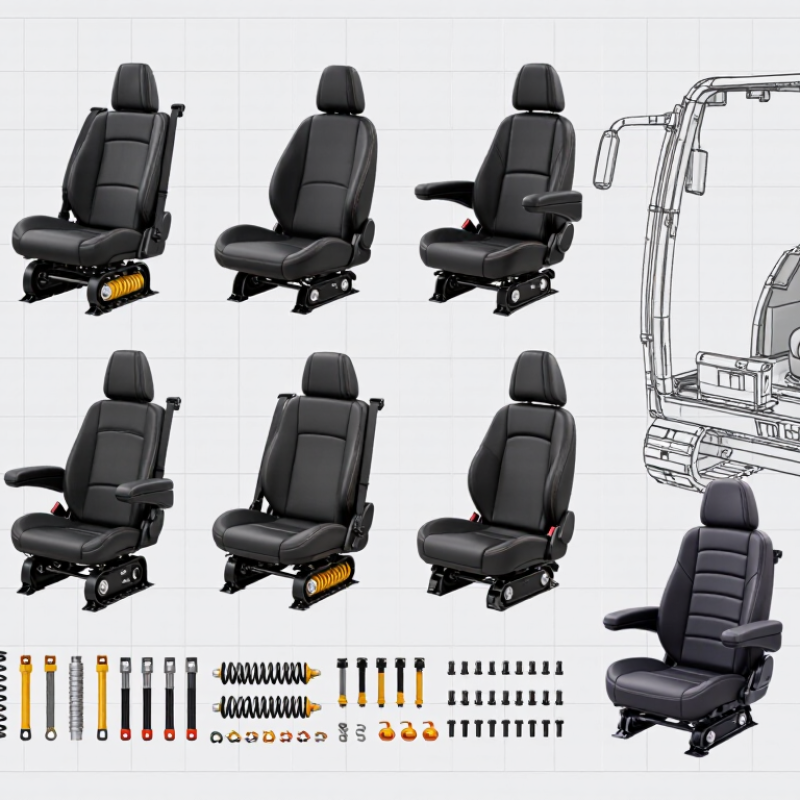
| 1 | Fixed Mechanical Seat | Non-suspended pan with padded backrest; simple and space-efficient for compact excavator cabs. | Fore/aft slide: approximately 120–180 mm; backrest angle: approximately 10–20°. | Usually a two-point lap belt; some installations use a retractable belt if approved by the seat and cab design. | Check belt webbing, buckle release, anchorage strength, belt routing, retractor function, and interference with seat movement. | Confirm the restraint is appropriate for the excavator risk assessment and does not reduce safe access, visibility, or control operation. | 400–450 mm | 50–120 kg |
| 2 | Low-Profile Compact Seat | Reduced cushion height and narrow side bolsters for limited cab space and improved entry clearance. | Fore/aft slide: approximately 100–160 mm; limited backrest adjustment. | Two-point lap belt is common; belt length must suit the compact cushion and operator range. | Verify the belt lies low across the pelvis, locks correctly, releases quickly, and remains accessible in the confined cab. | Check that the seat, belt, pedals, levers, and emergency exits maintain required ergonomic and safety clearances. | 380–430 mm | 45–105 kg |
| 3 | Mechanical Suspension Seat | Scissor or linkage suspension with adjustable spring preload to reduce vibration transmitted through the seat. | Suspension setting: approximately 50–120 kg; fore/aft slide: 120–180 mm. | Integrated two-point belt or approved retractable belt mounted to the seat or cab structure. | Test the complete seat-and-belt installation through the full suspension travel; confirm no belt loading or snagging occurs. | Verify vibration isolation does not compromise operator retention, control reach, or stable seating during machine movement. | 420–480 mm | 50–130 kg |
| 4 | Air Suspension Seat | Pneumatic suspension with compressor or external air supply; suitable for operators needing finer weight adjustment. | Air adjustment commonly covers approximately 50–130 kg; fore/aft slide: 120–180 mm. | Two-point or three-point belt, depending on the approved seat design and cab restraint layout. | Check air-system integrity, suspension travel, belt anchorage, buckle operation, and compatibility between seat and restraint components. | Confirm the air system cannot create an unsafe seat position and that all controls remain reachable at the lowest and highest settings. | 440–500 mm | 55–140 kg |
| 5 | High-Back Operator Seat | Extended backrest with lumbar support and shoulder-area coverage for longer operating periods. | Backrest angle: approximately 10–25°; lumbar adjustment: approximately 20–50 mm where provided. | Two-point lap belt is typical; a three-point restraint requires dedicated upper anchorage and clearance. | Ensure the backrest, belt webbing, buckle, upper guide, and anchorage are compatible and do not obstruct torso movement. | Check rearward clearance, emergency egress, visibility, and the operator’s ability to maintain a normal operating posture. | 440–500 mm | 55–140 kg |
| 6 | Seat with Adjustable Armrests | Height-, width-, or angle-adjustable armrests designed to support control-intensive excavator operation. | Armrest height: approximately 40–80 mm; fore/aft adjustment: approximately 30–70 mm. | Usually a two-point lap belt; the buckle must remain reachable with both armrests lowered. | Verify belt access, buckle release, belt routing, and absence of contact between the belt and adjustable armrest hardware. | Check that armrests do not restrict emergency release, control movement, entry, or exit from the operator station. | 430–490 mm | 50–135 kg |
| 7 | Seat with Integrated Joystick Console | Seat-mounted or closely coupled control console that moves with the operator’s seating position. | Console or armrest adjustment: approximately 40–100 mm; seat slide: approximately 100–160 mm. | Two-point belt is common; the restraint must not foul joysticks, wiring, or console movement. | Inspect belt routing throughout console adjustment and seat travel; confirm buckle release remains unobstructed. | Verify controls remain within safe reach, unintended activation is prevented, and the restraint does not interfere with machine operation. | 430–500 mm | 50–135 kg |
| 8 | Swivel Seat | Limited-angle rotating base that can assist with rearward observation or reduced-twist working positions. | Typical swivel range: approximately 10–30°; fore/aft slide: approximately 100–160 mm. | Two-point belt is typical; belt and buckle must remain secure and accessible in every permitted swivel position. | Verify anchorage orientation, belt locking, buckle access, webbing twist, and restraint performance across the complete swivel range. | Confirm the swivel cannot create an unsafe operating orientation or reduce visibility, control access, or emergency egress. | 420–480 mm | 50–130 kg |
| 9 | Heated Suspension Seat | Mechanical or air suspension combined with an electrically heated cushion and/or backrest for cold climates. | Suspension setting: approximately 50–130 kg; heating typically has low/high settings. | Two-point or three-point belt according to the approved installation; wiring must be protected from belt hardware. | Check restraint components separately from electrical heating; inspect cable routing, buckle release, webbing, and anchorage integrity. | Verify electrical components do not impair restraint operation, emergency exit, or safe use in the intended environmental conditions. | 440–500 mm | 55–140 kg |
| 10 | Heavy-Duty Suspension Seat | Reinforced frame, durable upholstery, and robust suspension for demanding cycles, rough ground, and extended service. | Suspension setting: approximately 60–150 kg; fore/aft slide: approximately 120–200 mm. | Two-point or three-point restraint only when the complete seat, belt, and cab anchorage arrangement is approved together. | Verify rated load, belt anchorage, buckle durability, retractor operation, suspension travel, and compatibility of replacement parts. | Confirm the complete operator protective system remains suitable for the excavator application, access arrangement, visibility, and foreseeable movement hazards. | 450–520 mm | 60–150 kg |



 08045479132
 Send Inquiry

 Send Inquiry
 Send SMS
