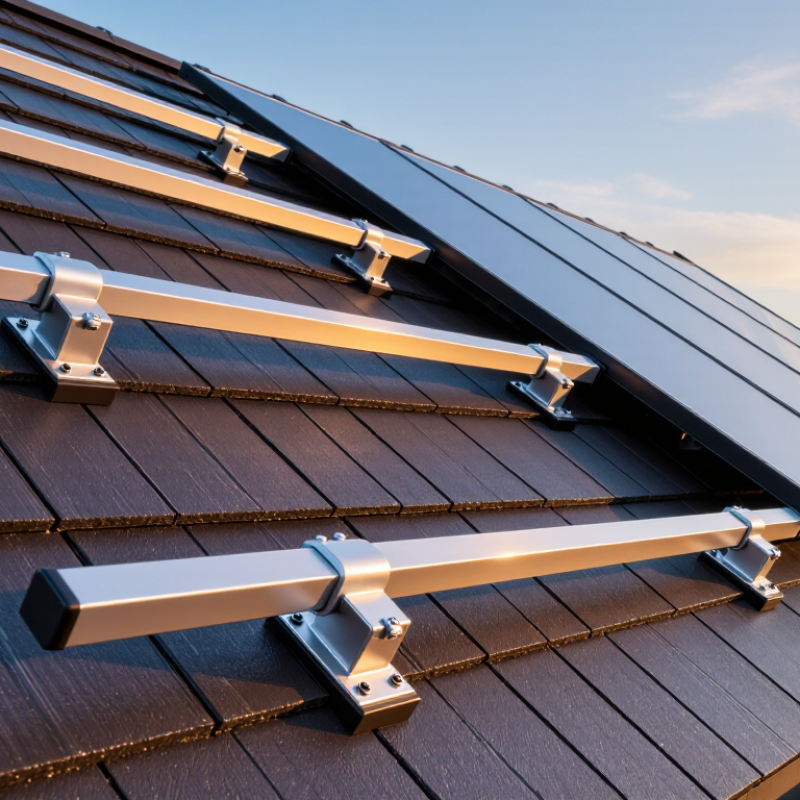
| Standard extruded aluminum rail | Pitched composition-shingle roofs and many tile roofs when paired with suitable roof attachments. | Flexible for portrait or landscape layouts; useful when rows need consistent alignment across several attachment points. | Provides a continuous mounting line, accommodates a range of clamp positions, and can help bridge between roof attachment points. | Rail span and attachment spacing must suit the roof structure, local wind and snow loads, and module installation requirements. | Roof flashing or tile-compatible attachments connect to rafters or other approved structural members; rails attach above the roof surface. |
| Lightweight or low-profile aluminum rail | Residential pitched roofs where a compact mounting profile is desirable and the selected system is approved for the site conditions. | Works well for relatively regular, uninterrupted panel rows; layout flexibility depends on the rail’s span and clamp range. | Can reduce mounting-system material and visual height compared with heavier rail profiles. | A lighter profile is not automatically suitable for every roof or load condition; confirm allowable spans and attachment requirements. | Uses roof-specific flashing, brackets, or other approved attachments, with rail sections secured according to the system design. |
| Heavy-duty aluminum rail | Roofs or project locations that require a rail profile designed for higher structural demands, subject to engineering and system limits. | Useful for larger arrays or layouts where attachment spacing and rail spans need careful structural coordination. | A deeper or more substantial profile may provide greater stiffness than a lighter rail of similar design. | Actual capacity depends on rail geometry, alloy, support spacing, connections, and site loads; a heavy-duty label alone does not establish capacity. | Attached to structural roof points using compatible, load-rated roof mounts and fasteners. |
| Shared-rail or common-rail layout | Suitable roof types depend on the compatible attachment system; often used on regular pitched-roof arrays. | Adjacent panel rows or columns may share a rail line where the module and mounting-system instructions allow it. | Can reduce the number of separate rail runs and simplify alignment in compact, repetitive arrays. | Requires compatible module dimensions, clamp zones, and end and mid-clamp arrangements; shared rails are not suitable for every module layout. | Rails are supported by roof attachments placed according to the project’s structural design. |
| Rail system for standing-seam metal roofs | Standing-seam metal roofs where seam-compatible clamps are approved for the roof profile and material. | Accommodates portrait or landscape arrays when rail direction, seam spacing, and panel orientation align. | Seam clamps can attach without penetrating the roof covering when used as specified, helping preserve the roof surface. | Clamp compatibility is specific to seam shape and dimensions; clamp installation must follow the roof and mounting-system requirements. | Seam clamps grip the standing seams; aluminum rails attach to the clamps where a railed configuration is used. |
| Rail system for corrugated or trapezoidal metal roofs | Corrugated or trapezoidal metal roofs with compatible brackets or roof attachments designed for the specific profile. | Best suited to layouts that can follow the roof’s corrugation pattern and available structural support locations. | Profile-matched attachments can provide a stable interface between the roof and aluminum rails. | Attachment choice, sealing, and fastener placement must match the roof profile and structural support; not all brackets fit all sheets. | Profile-specific brackets or mounts secure to the roof structure; rails attach to the mounts above the roof sheet. |
| Tile-roof rail configuration | Concrete or clay tile roofs using attachments designed to work with the tile type and underlying roof structure. | Useful for varied pitched-roof layouts, including arrays where tile courses influence attachment placement. | Rails provide a level mounting plane above an uneven tile surface and allow panel positioning across roof courses. | Tile should not carry the array’s structural load; roof attachments must be properly flashed or otherwise detailed to manage water entry. | Tile hooks or flashed roof attachments connect to structural members; rails mount to the attachments above the tiles. |



 08045479132
 Send Inquiry

 Send Inquiry
 Send SMS