China Top 10 Digital Inspection Microscopes for Quality Control?
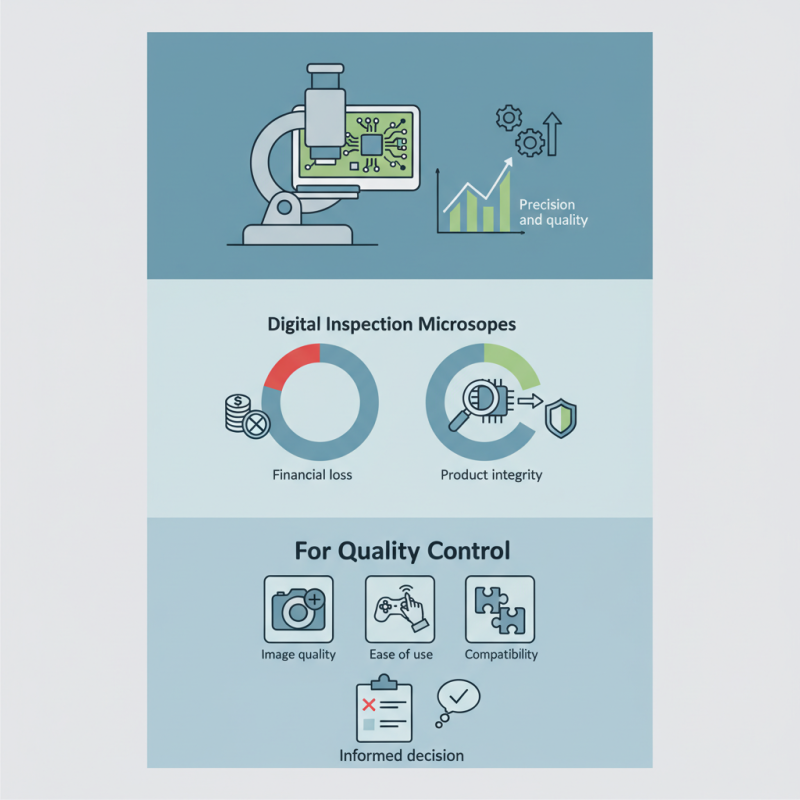
In today's manufacturing landscape, the demand for precision and quality control is paramount. Digital Inspection Microscopes have emerged as vital tools in achieving these goals. According to a report by Markets and Markets, the digital microscope market is projected to grow at a CAGR of 8.3% from 2021 to 2026, illustrating its increasing importance in various industries.
These advanced devices provide high-resolution imaging, essential for inspecting components and materials. In sectors like electronics and pharmaceuticals, even minor defects can lead to significant financial losses. A study by Smithers emphasized that up to 20% of production costs can be attributed to quality-related issues. This highlights the need for reliable inspection methods, underscoring the role of Digital Inspection Microscopes in safeguarding product integrity.
Despite their advantages, selecting the right model can be challenging. There are numerous options available, each with unique features. Buyers must consider factors such as image quality, ease of use, and compatibility with existing systems. Not every microscope meets the rigorous demands of quality control, and a poorly chosen device can lead to inaccuracies. Awareness of these pitfalls is crucial for industry professionals aiming to enhance their quality standards.
Overview of Digital Inspection Microscopes in Quality Control
Digital inspection microscopes play a crucial role in quality control across various industries. These tools enhance precision and accuracy in inspecting small components. With their high-resolution imaging capabilities, they allow operators to identify defects and irregularities easily. This high level of detail is essential for meeting stringent quality standards. However, their effectiveness depends on proper usage and regular calibration.
Operators must be trained to use these microscopes effectively. Misinterpretation of images can lead to incorrect assessments. It’s vital to understand the equipment's limitations. For instance, certain models may struggle with specific materials or surface types. Also, lighting conditions significantly affect image quality. Ensuring optimal lighting can improve defect detection significantly.
Moreover, a common oversight is neglecting to maintain the equipment. Regular cleaning and software updates are essential. Dust or outdated software can lead to inaccurate results. Continuous training and awareness are necessary for users. Only then can the full potential of digital inspection microscopes be realized in quality control processes.
China Top 10 Digital Inspection Microscopes for Quality Control
| Model |
Max Magnification |
Resolution |
Field of View |
Lighting Type |
Price Range (CNY) |
| Model A |
500x |
1.0 µm |
10 mm |
LED |
5000 - 8000 |
| Model B |
1000x |
0.5 µm |
8 mm |
Halogen |
8000 - 12000 |
| Model C |
2000x |
0.2 µm |
5 mm |
LED |
10000 - 15000 |
| Model D |
800x |
0.8 µm |
12 mm |
LED |
4000 - 6000 |
| Model E |
1500x |
0.3 µm |
7 mm |
Ring Illuminator |
9000 - 13000 |
| Model F |
1200x |
0.4 µm |
6 mm |
LED |
6000 - 9000 |
| Model G |
2500x |
0.1 µm |
4 mm |
LED |
15000 - 20000 |
| Model H |
400x |
1.5 µm |
15 mm |
Fluorescent |
3000 - 5000 |
| Model I |
1800x |
0.25 µm |
9 mm |
LED |
8000 - 11000 |
| Model J |
3000x |
0.15 µm |
3 mm |
LED |
20000 - 25000 |
Key Features for Evaluating Top Digital Inspection Microscopes
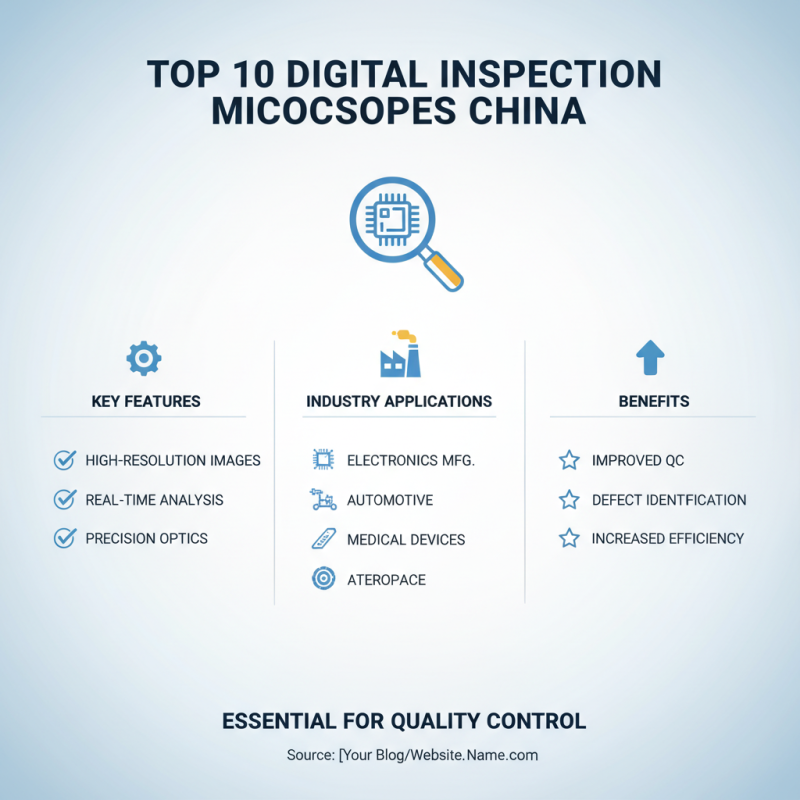
When selecting a digital inspection microscope for quality control, several key features should be considered. First, look for high-resolution imaging. This is crucial for detecting minute defects. Microscopes with at least 5MP resolution are preferable for detailed inspections. Additionally, consider the magnification range. A versatile microscope usually offers magnification from 10x to 2000x. This flexibility allows users to inspect various samples effectively.
Another important feature is user-friendly software. Intuitive software can enhance productivity. It should support image capture and analysis easily. Look for real-time measurements and comparison features. These tools can simplify the workflow during quality assessment.
Tips: Always check the build quality. Ensure the microscope is durable for repeated use. Also, consider the lighting options. LED illumination can provide consistent lighting conditions for accurate inspections. Inadequate lighting may cause misinterpretation of results, leading to errors. Regular calibration of the microscope is necessary for maintaining accuracy. It's an often-overlooked step, but critical for quality control processes.
Comparative Analysis of Performance Among Leading Models
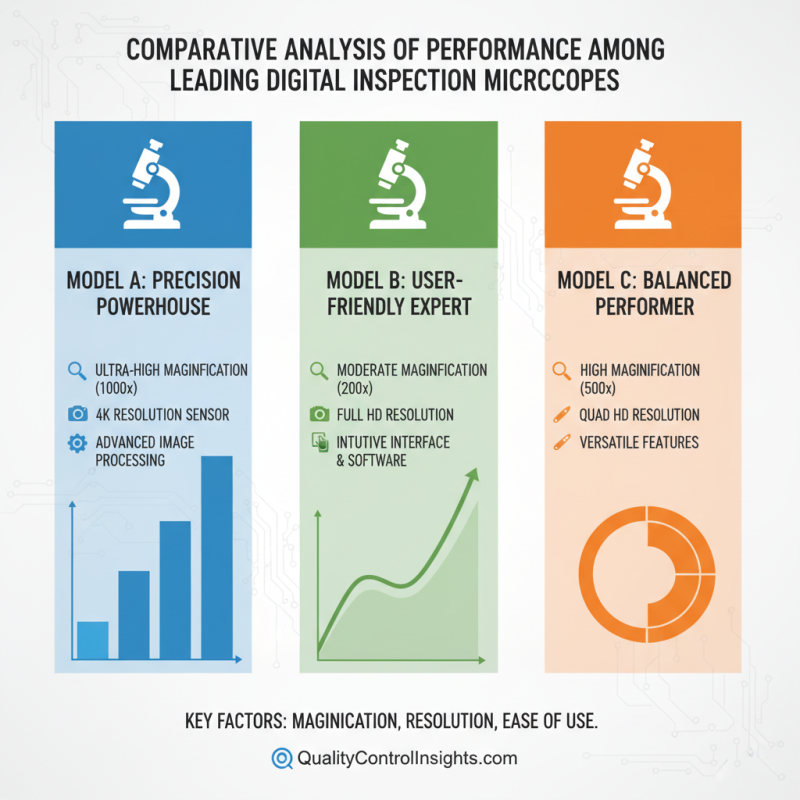
In the world of quality control, digital inspection microscopes play a crucial role. These devices allow for detailed imaging and precision measurements, making them essential for various industries. Leading models differ in features, such as magnification power, resolution, and user interfaces. Some boast advanced image processing capabilities, while others focus on ease of use.
Magnification levels can go up to several hundred times, granting users a close view of materials. The resolution is vital for detecting minute defects. However, higher specifications often come with increased complexity. Not all operators possess the required training. Additionally, certain models can be quite sensitive to lighting conditions, affecting image clarity.
User feedback highlights that while some microscopes excel in technical specs, their software can be unintuitive. Reliability also varies significantly among different models. It's important to assess not just the features but also customer support and service availability. A thorough understanding of these aspects can lead to more informed decisions in selecting the right microscope for quality control.
Future Trends in Digital Inspection Microscopy for Quality Assurance
The future of digital inspection microscopy in quality assurance shows promising trends. As industries push for higher standards, digital microscopes are evolving. Enhanced image resolution and automation are becoming essential. These advancements allow for precise measurements and faster inspections. Companies prioritize efficiency, reducing operational costs without sacrificing quality.
New technologies are emerging. Artificial intelligence is now part of the inspection process. Machine learning algorithms analyze images rapidly. They detect anomalies that human eyes might miss. This integration boosts accuracy and reliability. However, reliance on technology introduces challenges. Equipment can malfunction, leading to unexpected downtime.
The industry is also exploring portability. Compact, handheld devices offer flexibility in various environments. Technicians can perform inspections on-site, enhancing productivity. Yet, these devices must maintain high-quality standards. Ensuring consistency in results is vital. As digital inspection microscopy matures, organizations must address these evolving demands.
Top 10 Digital Inspection Microscopes for Quality Control
This chart shows the performance metrics of the top digital inspection microscopes based on resolution, magnification, and price. The data reflects the growing trend towards high-quality imaging technology in quality assurance processes.



 08045479132




 Send Inquiry

 Send Inquiry
 Send SMS