| 1 | Clear absorptive-substrate lens | A filtering material incorporated into the lens substrate selectively reduces transmission in specified wavelength regions. | Usually appears clear or nearly clear; the amount of filtering depends on the material and product design. | Request the finished lens’s spectral-transmittance data and identify the wavelength range used for any stated reduction. |
| 2 | Clear filter-coated lens | A surface coating modifies spectral transmission while retaining a relatively clear appearance. | May show a colored reflection, but reflection color alone does not establish how much light is transmitted or filtered. | Ask for spectral-transmittance results for the finished lens, not just a coating description or reflection photograph. |
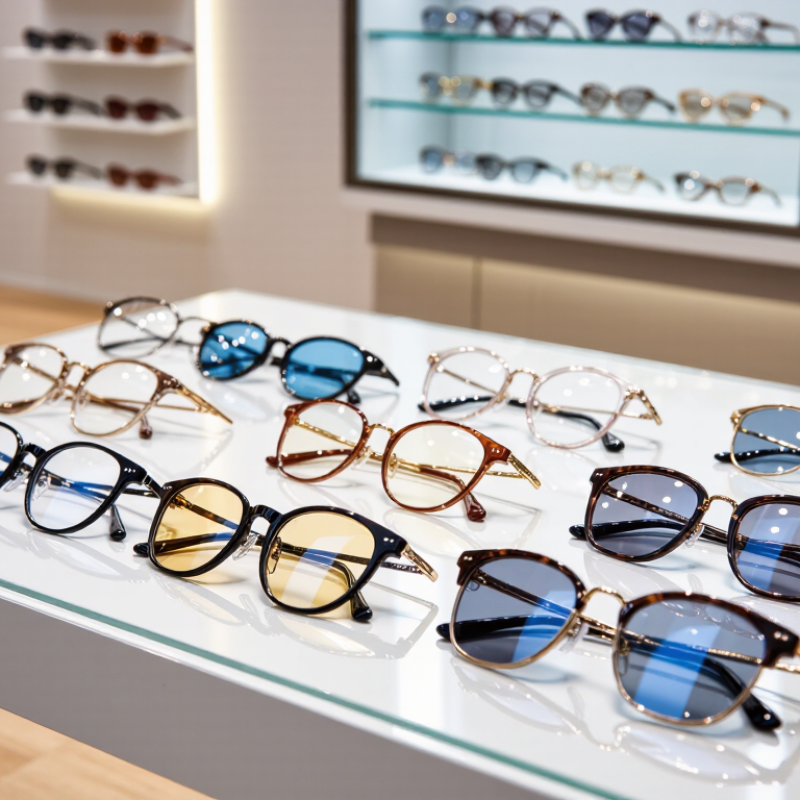
| 3 | Light-yellow tinted lens | A mild tint reduces transmission across part of the visible spectrum; the precise effect varies by tint and lens. | Has a noticeable warm or pale-yellow appearance and may alter color perception. | Compare measured spectral-transmittance data with the untinted reference lens and check the stated visible-light properties. |
| 4 | Amber or orange-tinted lens | A stronger warm tint reduces transmission in selected visible wavelengths; it is not necessarily a narrow-band filter. | Clearly colored; the tint can change the appearance of colors and is generally more noticeable than a clear filter. | Request wavelength-by-wavelength transmission data and confirm that the tint is suitable for the intended lighting conditions. |
| 5 | Brown-tinted lens | Broad visible-spectrum tinting can reduce overall light transmission; blue-region transmission depends on the specific lens. | Commonly used as a sunglass tint; the actual darkness and spectral profile vary between products. | Check spectral transmittance and the applicable sunglass category or use requirements separately from blue-filter marketing claims. |
| 6 | UV-protective lens with a blue-violet filter | Combines ultraviolet attenuation with a separate, claimed reduction in a specified portion of the visible spectrum. | May be clear or tinted; UV protection and visible blue-violet filtering are different transmission properties. | Check UV and visible spectral-transmittance results separately. Do not treat a UV-blocking claim as proof of visible blue-light filtering. |
| 7 | Anti-reflective lens with a blue-filter feature | An anti-reflective treatment reduces reflections; any additional blue-region filtering depends on the coating design and must be measured. | Often appears clear, sometimes with colored residual reflections. Appearance alone cannot quantify transmission. | Ask for the transmission spectrum of the completed lens and clarify whether the claim concerns transmitted light, reflected light, or both. |
| 8 | Photochromic lens with a blue-filter claim | The lens darkens in response to light exposure. Its transmission can change with activation, temperature, and test conditions. | Typically clearer indoors and darker outdoors, with performance dependent on the lens and exposure conditions. | Request transmission data in both clear and activated states, with test conditions stated; do not assume the two states have identical spectra. |
| 9 | Polarized tinted lens with a blue-filter claim | Polarization reduces certain reflected glare; it does not, by itself, specify blue-region spectral transmission. | Usually a sunglass lens. Tint, polarization, and spectral filtering are separate characteristics. | Verify polarization and spectral-transmittance claims independently, and check suitability for the intended outdoor use. |
| 10 | Prescription or plano lens with a blue-filter option | The same filtering options may be offered in prescription lenses or non-prescription (plano) lenses; prescription status does not determine filtering performance. | Available in different prescriptions, materials, tints, and coatings. | Request test results for the relevant finished lens configuration, including its material, tint, coating, and lens state. |



 08045479132

 Send Inquiry


 Send Inquiry
 Send SMS

