| 1 | Pressure Range and Accuracy | Choose a model whose rated range covers the target pressure of your tyres. A useful general range for passenger vehicles is up to approximately 100–150 PSI, with pressure accuracy clearly stated by the manufacturer. | The inflator must reach the required pressure without operating continuously at its maximum limit. Better accuracy helps prevent underinflation, overinflation, uneven wear, and reduced fuel efficiency. | Check the vehicle, motorcycle, bicycle, or equipment manufacturer’s recommended pressure first. Do not treat the inflator’s maximum PSI rating as the correct operating pressure. |
| 2 | Automatic Pressure Control | Prioritize a preset-pressure function with automatic shut-off when the selected pressure is reached. The target should be adjustable in small increments, preferably in 1 PSI or 0.1 bar steps. | Automatic control reduces the risk of overinflation and allows more consistent results than manually stopping the pump while monitoring the gauge. | Set the desired value, start the inflator, and confirm that it stops automatically. The control should remain easy to operate while wearing gloves or in low light. |
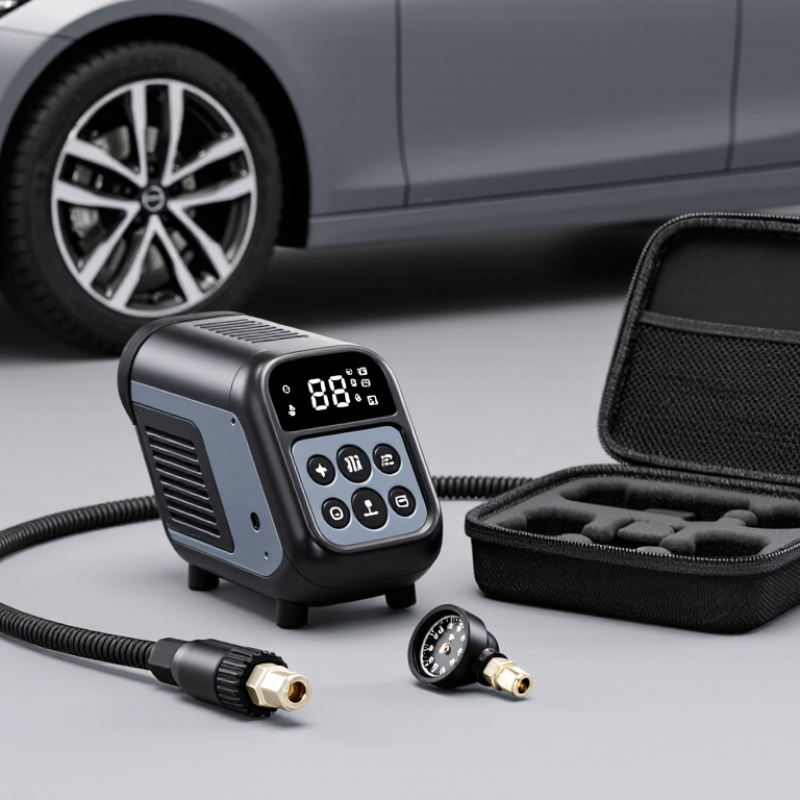
| 3 | Display and Measurement Units | Look for a readable digital display showing at least PSI and bar. kPa is also useful for users who follow metric specifications. Backlighting and large characters improve visibility. | Clear units help prevent setting errors. A bright, high-contrast screen is especially important at night or when the tyre valve is in a shadowed position. | Confirm that the unit can be changed without complicated menus. Compare the displayed reading with a separate, calibrated pressure gauge when accuracy is important. |
| 4 | Safety Protection | Select an inflator with overheat protection, overload protection, short-circuit protection, and automatic shut-off. A visible battery or thermal warning indicator is an added benefit. | Portable compressors draw high electrical current and can become hot during operation. Protection features reduce the risk of damage, burns, battery failure, or unsafe operation. | Read the operating instructions for maximum continuous run time and required cooling intervals. Stop using the unit if the housing, cable, or battery becomes unusually hot or damaged. |
| 5 | Power Source and Runtime | Compare battery capacity, charging time, and supported power options. A rechargeable lithium-ion battery is convenient; a 12-volt vehicle connection can provide a useful backup. | Runtime determines whether the inflator can handle several tyres or a low-pressure emergency without frequent recharging. Actual performance varies with tyre size, starting pressure, temperature, and battery condition. | Check whether the quoted runtime is measured under a defined load. Confirm the charging connector, cable length, battery status indicator, and whether the battery is replaceable or integrated. |
| 6 | Hose, Valve Compatibility, and Airflow | Look for a secure threaded or locking tyre chuck, a flexible hose, and adapters for common valves such as Schrader and Presta. Airflow should be stated separately from maximum pressure. | A reliable connection prevents air leakage and makes inflation easier. Higher airflow generally reduces inflation time, while maximum pressure alone does not indicate how quickly a tyre will inflate. | Verify that the chuck fits the intended valve and that adapters can be stored onboard. For larger tyres, compare inflation-time claims using a similar starting pressure and tyre size. |
| 7 | Ergonomics, Lighting, and Maintenance | Choose a stable handle, non-slip grip, hose storage, LED work light, and an easy-to-clean air filter or intake area. A compact case is useful for vehicle storage. | Good ergonomics reduce handling errors, while an LED light improves valve visibility during roadside use. Clean airflow helps protect the pump and maintain performance. | Check the unit’s weight, noise information, control layout, and storage method. Keep the intake vents clear, avoid moisture, and allow the device to cool according to the manual. |



 08045479132

 Send Inquiry


 Send Inquiry
 Send SMS

