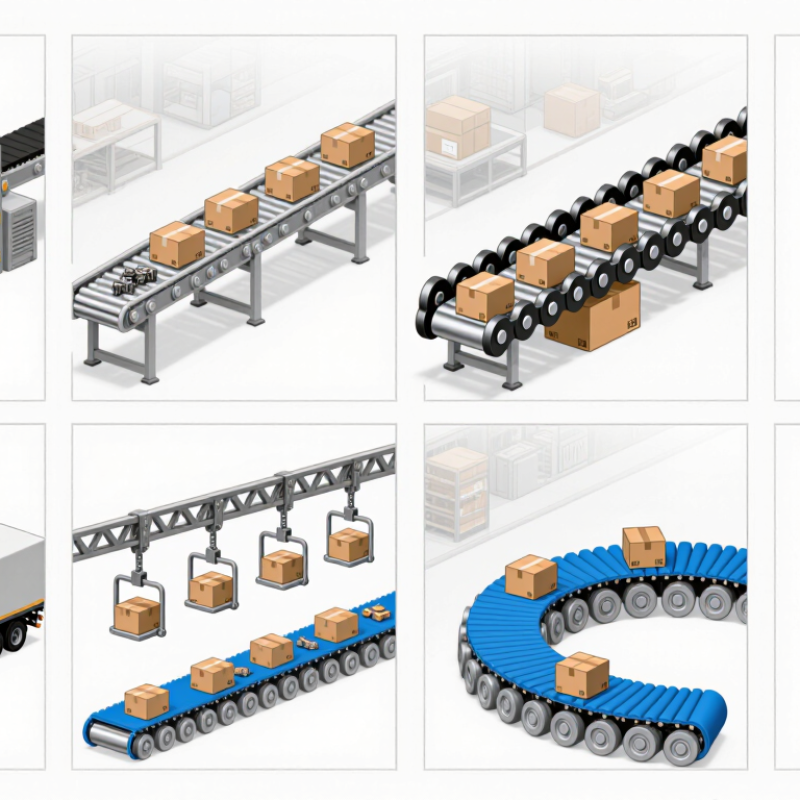
| Belt Conveyor | A continuous belt travels over pulleys and support rollers, carrying material along a fixed route. | Cartons, parcels, packaged goods, aggregates, grain, and other bulk materials, depending on belt design. | Production lines, packing areas, distribution centers, and bulk-material transfer. | Suitable for straight or inclined routes within the belt’s traction and load limits. Outdoor use may require weather-resistant components. | Versatile, handles a wide range of load sizes, and can move materials over relatively long distances. | Specify belt material, width, speed, incline, load, transfer points, and whether spillage or product contact is a concern. |
| Gravity Roller Conveyor | Loads roll along free-turning rollers under gravity or when pushed manually. | Rigid, flat-bottomed items such as cartons, totes, trays, and suitable pallets. | Accumulation zones, packing stations, short transfers, and manual picking lines. | Typically used on level or gently sloped routes. Requires loads with a stable base and sufficient rigidity to bridge roller gaps. | Simple, does not require a drive motor, and can be configured for flexible layouts. | Check item weight, base dimensions, roller spacing, slope, and the need for braking or controlled accumulation. |
| Powered Roller Conveyor | Motor-driven rollers or drive belts move and may accumulate individual unit loads. | Cartons, totes, bins, and pallets when rollers and frame are rated for the load. | Sortation, order fulfillment, assembly lines, and automated transfers between work areas. | Useful where controlled movement or accumulation is needed. Drive zones and controls should match the load and operating rate. | Supports automated flow and can provide controlled starts, stops, and accumulation. | Confirm load dimensions and weight, throughput, zone logic, controls, noise requirements, and maintenance access. |
| Chain Conveyor | One or more driven chains carry, drag, or support loads using attachments or a suitable conveyor bed. | Heavy pallets, fixtures, metal parts, and other robust loads suited to the chain and attachment design. | Assembly, manufacturing, pallet handling, and heavy-duty transfer operations. | Can serve demanding industrial environments; exposure to dust, moisture, heat, or chemicals must be checked against component materials. | Designed for durable, positive movement of heavy or rugged loads. | Assess load support, chain pitch, attachment type, lubrication, guarding, noise, and the need for regular inspection. |
| Slat Conveyor | Linked slats form a continuous carrying surface driven by chains. | Rigid products, containers, components, and items that need a more continuous support surface than rollers provide. | Packaging, bottling, assembly, and transfer of products between processing steps. | Can be designed for straight, curved, or inclined paths. Slat and chain materials should suit the washdown or ambient environment. | Provides stable support and can accommodate defined product spacing and route layouts. | Consider product contact, slat gaps, turning radius, cleaning needs, and resistance to wear or corrosion. |
| Screw Conveyor | A rotating helical screw moves bulk material through a trough or enclosed tube. | Powders, grains, granules, and other flowable bulk solids compatible with the screw and casing. | Metering, conveying, mixing, or feeding materials in processing and storage systems. | Often used over relatively short routes. Performance depends on material flowability, moisture, abrasiveness, and conveying orientation. | Enclosed conveying can help contain dust, and the design can integrate feeding or metering functions. | Check material properties, required capacity, screw speed, wear, cleanout access, and risk of material degradation. |
| Bucket Elevator | Buckets attached to a belt or chain lift material vertically and discharge it at the head. | Free-flowing bulk solids such as grain, pellets, and selected powders or granules. | Vertical transfer between storage, processing, and bulk-handling equipment. | Requires a suitable feed and discharge arrangement. Dust control, alignment, and access for inspection are important. | Moves bulk material vertically while using a relatively compact floor footprint. | Match bucket type and spacing to material behavior, capacity, lift height, abrasion, and dust-control requirements. |
| Vibrating Conveyor | Controlled vibration advances material along a trough or deck. | Bulk solids, parts, or products suited to vibration and the selected trough surface. | Feeding, screening, sorting, cooling, and transferring material between process stages. | Useful in process lines where vibration is acceptable. The frame and supports must be designed to manage dynamic forces. | Can combine conveying with functions such as screening or product distribution. | Check material fragility, noise, vibration isolation, required capacity, and any effect on nearby equipment. |
| Pneumatic Conveyor | Airflow carries bulk material through a pipeline in dilute-phase or dense-phase systems. | Compatible powders, granules, and pellets; material suitability depends on particle size, density, and fragility. | Enclosed transfer between silos, hoppers, process equipment, and other locations. | Can route through pipes around obstacles. System performance depends on distance, bends, air supply, and material characteristics. | Enclosed routing can reduce open transfers and make complex layouts possible. | Evaluate air consumption, filtration, pipe wear, product damage, dust controls, and material-specific conveying behavior. |
| Overhead Conveyor | A suspended track carries trolleys or carriers above the floor, manually or with a powered drive. | Hanging parts, garments, components, and loads that can be securely supported by carriers. | Assembly, finishing, garment handling, and movement between workstations while keeping floor space clear. | Route and support structure must accommodate load, turns, elevation changes, and any process-area conditions. | Uses overhead space and can link multiple work areas without occupying the main floor route. | Confirm building structure, carrier design, load security, clearances, maintenance access, and safe operator interaction. |



 08045479132

 Send Inquiry


 Send Inquiry
 Send SMS

