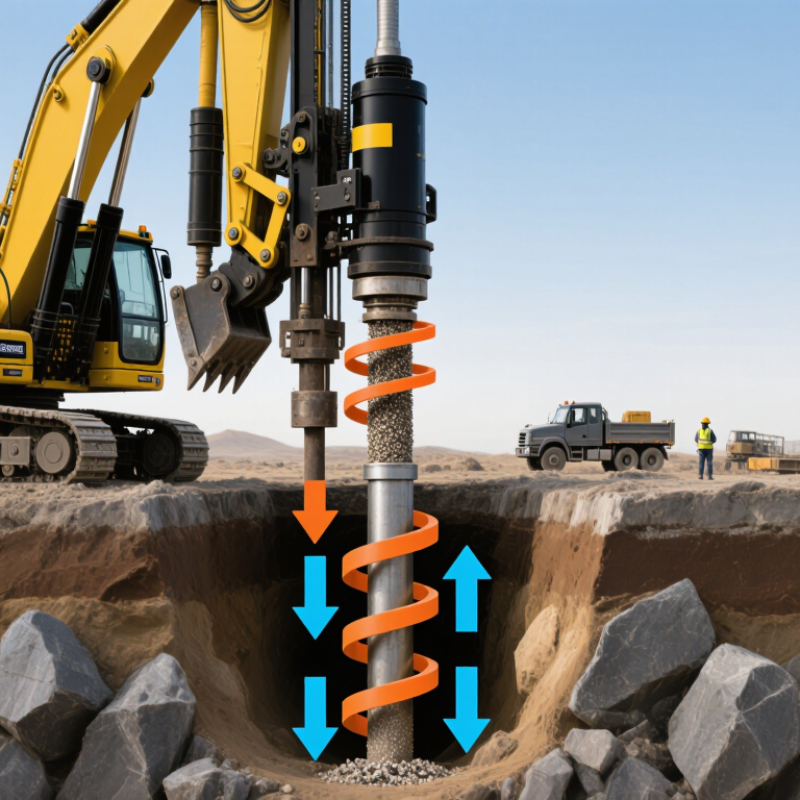
| 1. Drill setup | A drill rig turns and advances a string of dual-wall drill rods. Each rod has an outer tube and an inner sample tube. | The inner tube forms a relatively contained route for rock cuttings to travel back to the surface. | The dual-wall design separates the returning sample stream from the air path used to operate and flush the drill. |
| 2. Bit and hammer break rock | At the bottom of the hole, a percussion hammer repeatedly strikes the bit. Rotation helps distribute the impacts across the cutting face. | The bit crushes and fractures the rock into small fragments known as cuttings. | This percussive action is suited to drilling hard, competent formations, although performance depends on ground conditions and equipment. |
| 3. Compressed-air circulation | Compressed air travels down the annular space between the outer rod and the inner tube, supplying the down-the-hole hammer and helping clear the bit. | Air lifts the newly broken cuttings into the opening at the bit and directs them into the inner sample tube. | Keeping cuttings moving helps prevent them from accumulating around the bit. |
| 4. Reverse-circulation return | Unlike conventional circulation, where drilling fluid commonly returns up the space outside the drill string, RC cuttings return through the inner tube. | The air-and-cuttings stream travels up the inner tube to the surface. | The enclosed return path helps reduce mixing with material from the upper part of the hole, but does not guarantee a contamination-free sample. |
| 5. Surface separation | At the surface, the return stream commonly passes through a cyclone, which slows the airflow and separates most solid cuttings from the air. | Separated cuttings fall into a collection system, while air exits through the designated dust-control equipment. | Correct setup and maintenance help produce a steady, representative sample stream and manage dust. |
| 6. Sample collection | Cuttings are directed into a splitter or collection container and commonly placed into labeled sample bags at recorded depth intervals. | The collected material represents crushed rock brought from the bit; it is not an intact cylindrical core. | Samples can be logged and analyzed, with interval length and handling procedures set by the drilling program. |
| 7. Drilling continues | As the hole deepens, additional dual-wall rods are connected and the drilling, air circulation, and sample collection cycle continues. | Each sample is associated with its recorded depth interval so changes in the cuttings can be compared down the hole. | The method provides rapid geological samples while requiring careful depth control, sample handling, and dust management. |



 08045479132

 Send Inquiry


 Send Inquiry
 Send SMS

