| Primary Polymer | HDPE, LLDPE, PVC, or flexible polypropylene (FPP). HDPE is commonly selected for high chemical resistance; LLDPE generally provides greater flexibility. | The polymer affects chemical compatibility, flexibility, weldability, service life, and suitability for settlement-prone ground. | Request the resin identification, technical data sheet, safety data sheet, and chemical-resistance statement. |
| Nominal Thickness | Common project specifications range from approximately 0.75 mm to 3.00 mm. Landfill, mining, and high-load containment systems often require 1.50 mm or greater. | Thickness influences puncture resistance, durability, installation handling, and long-term containment performance. | Review thickness tolerances and test results in accordance with ASTM D5199 or ISO 9863-1. |
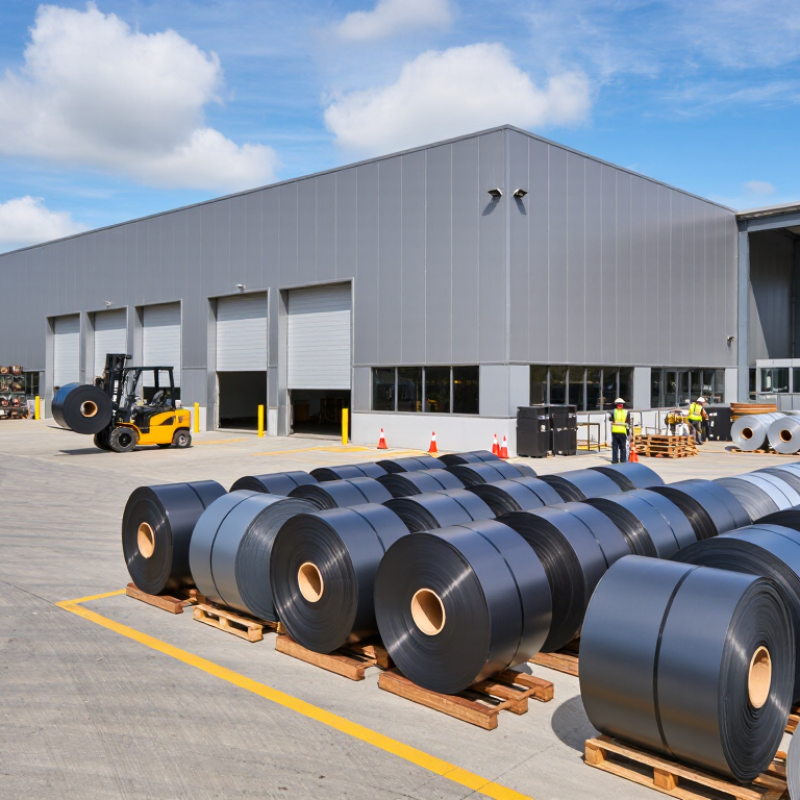
| Available Roll Width | Typical roll widths are approximately 5 m to 10 m, depending on material, thickness, production line, and transport limitations. | Wider rolls can reduce the number of field seams, installation time, and potential leakage paths. | Confirm finished roll width, length, core size, roll weight, loading method, and allowable dimensional tolerance. |
| Surface Configuration | Smooth, single-textured, or double-textured surfaces are commonly available. Textured surfaces are used where higher interface friction is required. | Surface texture affects slope stability, soil interaction, drainage-layer performance, and installation behavior. | Request texture height, coefficient-of-friction data, and interface shear testing for sloped applications. |
| Density | Typical HDPE geomembrane density is approximately 0.94 g/cm³ or higher; exact values depend on resin formulation and product standard. | Density helps confirm polymer composition and supports quality-control comparison between production batches. | Check batch test reports using ASTM D1505 or ISO 1183-1. |
| Tensile Strength and Elongation | Values vary by polymer and thickness. HDPE products commonly show high tensile strength with elongation at break often above 600%; flexible materials may have substantially higher elongation. | These properties indicate the liner’s ability to withstand handling, thermal movement, settlement, and construction stresses. | Request machine-direction and cross-machine-direction results under ASTM D6693 or ISO 527-3. |
| Puncture Resistance | Puncture resistance increases with thickness and material formulation; project specifications should define a minimum value rather than relying only on nominal thickness. | Adequate puncture resistance protects against damage from subgrade irregularities, aggregate, equipment, and installation traffic. | Review ASTM D4833 or equivalent test results and confirm subgrade protection requirements. |
| Tear Resistance | Required tear resistance depends on thickness, polymer type, and site conditions. Higher values are generally specified for demanding construction environments. | Tear resistance helps limit propagation of cuts or damage during deployment and anchoring. | Request machine-direction and cross-machine-direction results using ASTM D1004 or the project’s specified method. |
| Carbon Black and UV Protection | Black polyolefin geomembranes commonly contain approximately 2% to 3% carbon black, subject to the applicable specification and formulation. | Proper UV stabilization is important when exposed liner remains uncovered during construction or operation. | Verify carbon-black content and dispersion through ASTM D1603, ASTM D5596, or an equivalent approved method. |
| Oxidative Induction Time | OIT requirements vary by specification, stabilizer package, and exposure condition. Results should be evaluated together with high-pressure OIT where required. | OIT testing provides an indication of antioxidant protection and resistance to thermal oxidation during service. | Request standard OIT and high-pressure OIT reports using ASTM D3895 and ASTM D5885 where applicable. |
| Seam Strength | Factory and field seams should be assessed for peel and shear strength. Acceptance criteria must follow the project specification and selected welding method. | The quality of welded seams is often as important as the sheet properties for overall leak prevention. | Review ASTM D6392 results, welding-procedure qualifications, and field destructive and non-destructive test plans. |
| Permeability and Leakage Control | Geomembranes are designed as low-permeability barriers; actual performance depends on polymer type, thickness, defects, seams, penetrations, and installation quality. | A low-permeability sheet alone cannot compensate for poor subgrade preparation, defective seams, or untested penetrations. | Confirm project-specific permeability requirements and include electrical leak-location testing where appropriate. |
| Chemical Compatibility | Compatibility depends on the exact chemical, concentration, temperature, exposure time, and polymer formulation. No single liner is suitable for every chemical service. | Chemical attack can cause swelling, softening, embrittlement, stress cracking, or loss of mechanical properties. | Provide the complete chemical list and request immersion-testing data or a documented compatibility assessment. |
| Quality Management | A suitable manufacturer should operate documented incoming-material, in-process, finished-product, calibration, traceability, and non-conformance procedures. | Consistent quality management reduces batch variation and supports claims, inspections, and international project audits. | Request a current quality-management certificate, factory quality manual, calibration records, and sample batch traceability. |
| Third-Party Testing | Independent laboratory verification is commonly used for critical projects, especially mining, landfill, wastewater, and potable-water applications. | Independent testing improves confidence that reported values are representative of the delivered product. | Check laboratory accreditation, test date, sample identification, applicable method, and chain-of-custody documentation. |
| Packaging and Export Logistics | Export rolls should be protected from moisture, contamination, crushing, sharp edges, and prolonged uncontrolled UV exposure during storage and transit. | Correct packaging reduces transit damage and simplifies unloading, storage, and site handling. | Confirm roll labels, packing list, container loading plan, moisture protection, handling instructions, and Incoterms. |
| Technical and Installation Support | Support may include shop drawings, panel layouts, welding guidance, installer training, site assistance, repair procedures, and commissioning documentation. | Technical support helps control installation risks and ensures the selected liner is used within its design limitations. | Include response times, language capability, warranty conditions, site-support scope, and responsibilities in the contract. |



 08045479132

 Send Inquiry


 Send Inquiry
 Send SMS

