| Relevant manufacturing expertise | Experience producing the specific breaker type and application you need, such as miniature, molded-case, air, or residual-current circuit breakers. | Years of relevant production experience, technical documentation, application references, and evidence of engineering and quality-control capabilities. | Experience with comparable products and operating conditions can help reduce design, selection, and implementation risks. |
| Product range and ratings | Options that match the required voltage, current, pole configuration, frequency, breaking capacity, and installation method. | Current product catalogue, datasheets, rated characteristics, dimensional drawings, and stated operating limits. | Correct ratings and compatibility are essential; a broad catalogue alone does not guarantee suitability for a particular application. |
| Standards and certifications | Products tested or certified to standards relevant to their intended market and product category. | Valid certificates and test reports. Commonly relevant standards include IEC 60898-1 for household and similar installations, IEC 60947-2 for low-voltage circuit breakers, and UL 489 for molded-case circuit breakers in applicable markets. | Applicable standards provide defined requirements for safety and performance. Confirm that the certificate covers the exact product model and rating. |
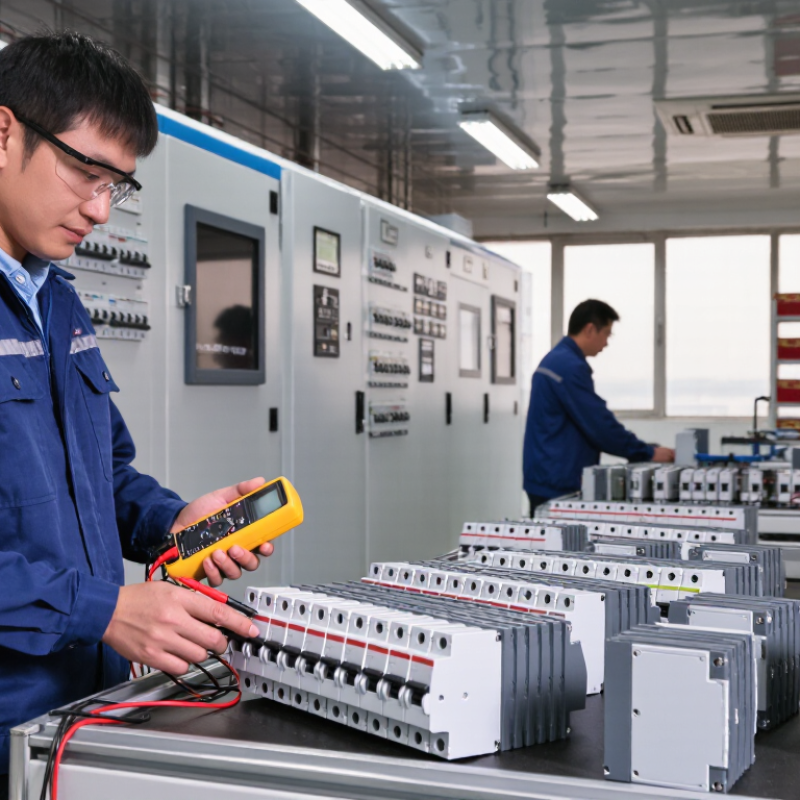
| Quality management | Documented procedures for incoming materials, production inspections, final testing, and corrective actions. | Quality-management system certificate, its scope and validity, inspection plans, traceability records, and sample test documentation. | A quality system can support consistent production, but it does not replace product-specific testing or certification. |
| Customization and engineering support | Ability to assess technical requirements, identify compatible products, and explain any limits on customization. | Application engineering support, response process, technical questionnaires, drawings, and written confirmation of proposed specifications. | Clear engineering communication helps avoid mismatches between the breaker, the electrical system, and installation requirements. |
| Testing and performance data | Transparent information on rated current, voltage, breaking capacity, trip characteristics, and environmental conditions. | Product datasheets, type-test reports where applicable, routine-test records, and clear identification of test standards and conditions. | Comparable, model-specific data makes it easier to assess whether a product meets the project’s technical requirements. |
| Supply capability and lead time | Production capacity and delivery arrangements appropriate to the order volume and project schedule. | Written lead-time estimates, order and delivery terms, production-capacity information, and details of spare-parts availability. | Verifying supply commitments early can help limit schedule and maintenance risks. |
| Warranty and after-sales support | Clearly stated warranty coverage, technical support channels, and a process for handling product issues. | Written warranty terms, service contact details, troubleshooting guidance, and product replacement or repair procedures. | Accessible support can help maintain equipment and resolve issues throughout the product’s service life. |
| Responsible comparison | Compare equivalent breaker types, ratings, test bases, certification scope, and commercial terms. | A side-by-side checklist using the same application requirements and current, verifiable documentation for every candidate. | Certification requirements vary by product and market. Verify current documents with the relevant certification body and consult a qualified electrical professional for product selection. |



 08045479132
 Send Inquiry

 Send Inquiry
 Send SMS