| Air-cooled design | Scroll compressor | Commonly used in packaged chillers. Multiple compressors can provide staged capacity and some operating redundancy. | Compare the number of circuits, minimum stable capacity, part-load performance, and whether a compressor failure would reduce or stop cooling. |
| Air-cooled design | Screw compressor | Often used for larger packaged chiller capacities. Capacity can be controlled by compressor unloading or, on some models, variable-speed operation. | Review the certified performance map, turndown, sound data, and efficiency at the expected operating conditions rather than comparing compressor type alone. |
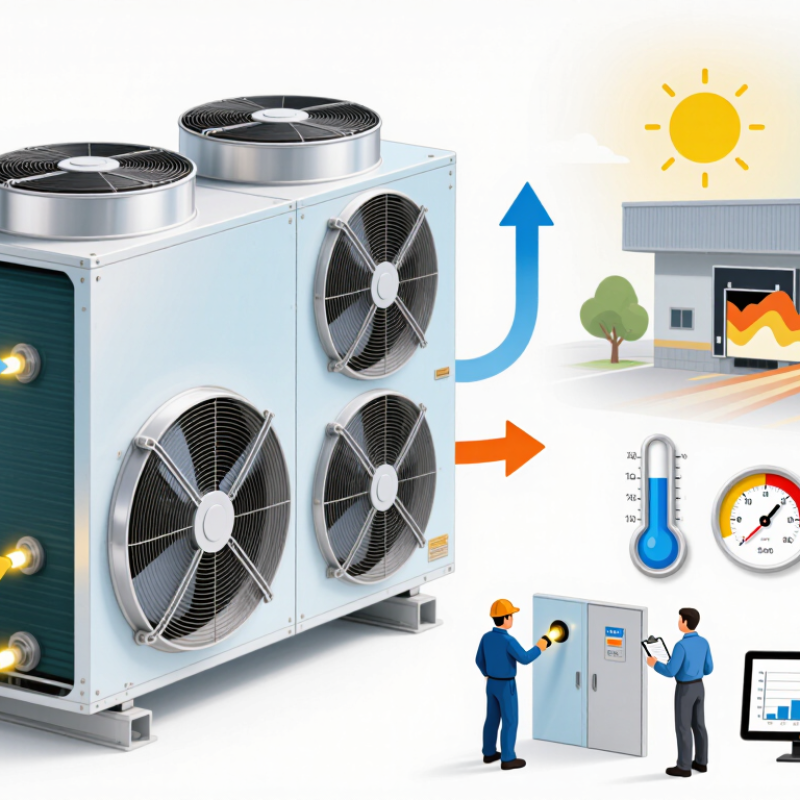
| Heat rejection | Condenser coil and fans | Air-cooled chillers reject heat through a refrigerant-to-air condenser coil. Outdoor air temperature affects condensing conditions and available capacity. | Check capacity at the local design dry-bulb temperature, airflow clearance, fan sound, coil access, and the manufacturer's required service space. |
| Refrigerant | R-410A | ASHRAE safety class A1; high GWP. Its GWP is 2,088 using the IPCC Fourth Assessment Report 100-year values. | Confirm equipment availability, applicable refrigerant rules, service support, and long-term refrigerant plan in the installation jurisdiction. |
| Refrigerant | R-32 | ASHRAE safety class A2L; GWP 675 on the same IPCC Fourth Assessment Report basis. A2L refrigerants are lower-toxicity, mildly flammable refrigerants. | Check the equipment's approved charge, installation and safety requirements, and local code requirements for A2L refrigerants. |
| Refrigerant | R-454B | ASHRAE safety class A2L; GWP 466 on the same IPCC Fourth Assessment Report basis. Suitability depends on equipment design and approval. | Verify that the complete chiller is designed and listed for this refrigerant; do not assume refrigerants are interchangeable. |
| Refrigerant | R-513A | ASHRAE safety class A1; GWP 631 on the same IPCC Fourth Assessment Report basis. It is used in some chiller designs as a lower-GWP alternative to R-134a. | Check the manufacturer's certified capacity and efficiency for R-513A and confirm that the design is specifically intended for it. |
| Refrigerant | R-1234ze(E) | ASHRAE safety class A2L; GWP 6 on the IPCC Fourth Assessment Report basis. It is used in some chiller applications. | Confirm the chiller's operating envelope, safety provisions, servicing capability, and applicable local requirements. |
| Efficiency rating | Full-load COP or kW/ton | COP is cooling output divided by electrical input. For the same operating point, kW/ton = 3.517 ÷ COP; a lower kW/ton indicates less input power per ton of cooling. | Compare ratings at the same leaving-fluid temperature, outdoor air temperature, glycol concentration, and included auxiliary loads. |
| Efficiency rating | IPLV / NPLV | AHRI Standard 550/590 provides methods for rating water-chilling packages, including part-load metrics. IPLV uses prescribed rating conditions; NPLV uses specified nonstandard conditions. | Use the applicable certified rating and verify that its conditions reasonably match the project. A part-load metric is not a guarantee of annual energy use. |
| System selection | Operating profile and installation | Annual energy use depends on load profile, ambient conditions, setpoints, controls, and auxiliary power—not just a single efficiency value. | Size for the calculated design load, assess part-load hours, check electrical service and sound limits, and allow for coil cleaning and maintenance access. |
| Data notes: Refrigerant safety classes follow ASHRAE Standard 34 designations. GWP figures shown use the IPCC Fourth Assessment Report 100-year values and are provided for comparison; values and applicable refrigerant requirements can vary by reporting basis and jurisdiction. Obtain certified chiller ratings and confirm current local regulations before purchase. |



 08045479132

 Send Inquiry


 Send Inquiry
 Send SMS

