| Basic Definition | A hollow or foam-filled buoyant unit manufactured primarily from high-density polyethylene (HDPE). | The floater displaces water. The upward buoyant force counteracts the weight of the floater, attached equipment, and any supported load. | Floating docks, pontoons, aquaculture systems, utility platforms, marine walkways, and temporary work platforms. |
| Buoyancy Principle | Net buoyancy depends on displaced water volume minus the weight of the floater and attached components. | Freshwater provides approximately 9.81 kN of buoyant force per cubic metre of displaced water before the floater's own weight and safety allowance are deducted. Saltwater provides slightly more because it is denser. | Suitable for lakes, rivers, reservoirs, coastal waters, and sheltered marine areas when the design load and local conditions are correctly evaluated. |
| Material Density | Approximately 0.93–0.97 g/cm³ for solid HDPE, depending on grade and additives. | HDPE is less dense than water, which helps it float. Hollow or rotationally molded designs achieve high displacement with relatively low structural weight. | Useful where low weight, buoyancy, impact resistance, and ease of handling are important. |
| Manufacturing Methods | Common methods include rotational molding, extrusion, blow molding, and fabricated sheet construction. | Rotational molding can produce seamless hollow units. Fabricated sheet designs can be configured for larger pontoons, chambers, or custom flotation modules. | Modular dock systems, floating barriers, pipe supports, navigation structures, and custom marine platforms. |
| Typical Form Factors | Cylindrical floats, rectangular pontoons, cube-shaped modules, pipe floats, and custom buoyancy chambers. | Shape affects stability, waterline area, connection layout, draft, and resistance to waves or current. | Rectangular modules are common for docks; cylindrical units are often used for booms, pipelines, and buoyancy supports. |
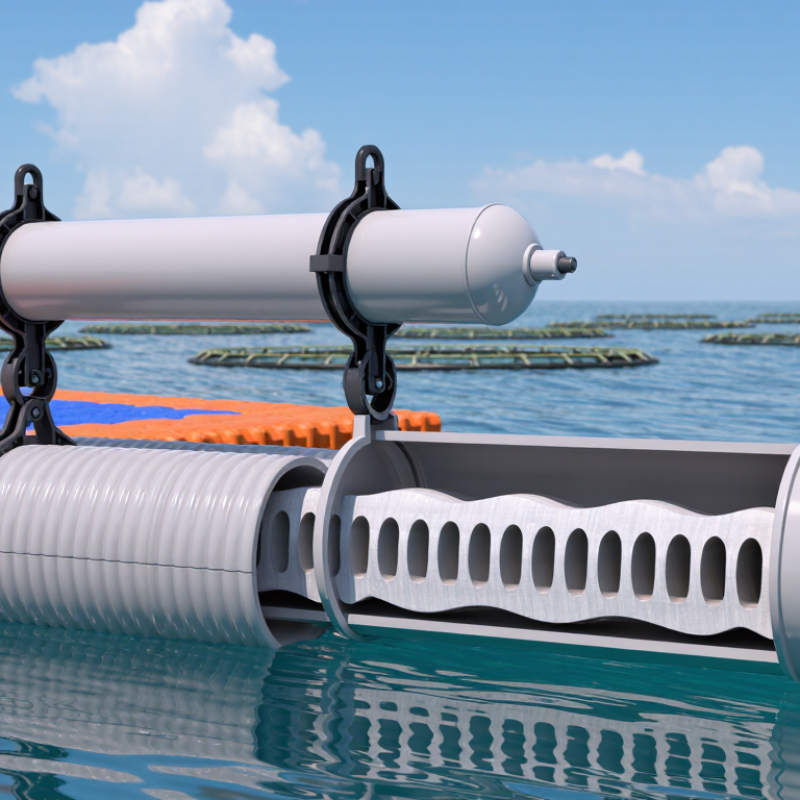
| Typical Wall Construction | Single-wall hollow construction or double-wall construction with internal ribs, chambers, or foam filling. | Internal geometry improves stiffness and helps limit deformation. Multiple sealed chambers can provide additional operational redundancy. | Double-wall or multi-chamber designs are beneficial for public access docks, work platforms, and systems exposed to impact or uneven loading. |
| Material Strength | Commercial HDPE grades commonly have tensile yield strengths in the approximate range of 20–35 MPa. | Strength is influenced by resin grade, wall thickness, temperature, molding quality, UV stabilizers, and the direction and duration of loading. | Appropriate for moderate structural and impact loads when supported by proper design calculations and connection details. |
| Operating Temperature | Common service ranges are approximately −40°C to 60°C, subject to design, loading, and material grade. | HDPE remains tough at low temperatures but softens as temperature rises. Long-term loads should be reduced or reviewed at elevated temperatures. | Cold freshwater environments, temperate coastal areas, and warm climates; prolonged exposure to hot surfaces or high-temperature fluids requires engineering review. |
| UV and Weather Resistance | Good resistance when UV-stabilized grades and suitable pigments are used. | UV stabilizers slow surface degradation caused by sunlight. Unstabilized HDPE can become brittle or lose surface performance after long outdoor exposure. | Outdoor docks, aquaculture cages, floating solar support systems, marinas, and long-term exposed installations. |
| Water and Moisture Resistance | Very low water absorption, generally below 0.1% by weight for HDPE. | Low moisture uptake helps the material retain buoyancy and dimensional stability in continuously wet environments. | Freshwater and saltwater applications, including submerged or splash-zone service. |
| Chemical Resistance | Generally resistant to water, salts, dilute acids, dilute alkalis, and many common chemicals. | Resistance depends on concentration, temperature, exposure time, stress level, and the specific chemical. Strong oxidizers and some hydrocarbons require compatibility checking. | Wastewater facilities, aquaculture operations, agricultural reservoirs, chemical handling areas, and industrial water systems after material review. |
| Impact Resistance | High impact toughness compared with many rigid plastics, particularly at low temperatures. | HDPE can absorb impact energy and deform without shattering. Sharp objects, repeated impacts, and unsupported spans can still cause damage. | Floating barriers, boat landing areas, work platforms, docks, and installations exposed to floating debris or occasional contact. |
| Load Capacity | Varies widely; it is determined by external dimensions, displacement volume, net buoyancy, structure, connectors, and safety factors. | Rated capacity must include dead load, live load, wave action, wind, current, equipment, people, and uneven loading. Reserve freeboard should be maintained. | Passenger docks, maintenance platforms, floating bridges, pipe crossings, and equipment-support platforms. |
| Stability and Freeboard | Controlled by width, length, center of gravity, waterplane area, load distribution, and remaining height above water. | A wider platform generally offers greater initial stability. Concentrated loads can cause trim, heel, or local immersion even when total buoyancy is adequate. | Pedestrian docks, boarding platforms, floating work areas, and platforms carrying pumps, generators, or other equipment. |
| Connection Systems | Bolted flanges, molded connectors, stainless-steel hardware, hinges, ropes, chains, or flexible couplings. | Connections transfer shear, tension, impact, and wave-induced movement between modules and anchoring systems. Hardware should be compatible with the marine environment. | Modular pontoons, floating walkways, marina fingers, fish-farm service platforms, and temporary floating structures. |
| Anchoring and Mooring | Possible systems include piles, chains, ropes, deadweights, guide cables, and articulated mooring assemblies. | The anchoring arrangement limits drift and controls movement caused by wind, current, waves, tides, and changing water levels. | Reservoirs, rivers, sheltered bays, marinas, aquaculture sites, and floating infrastructure near shore. |
| Common Applications | Floating docks, pontoons, walkways, booms, buoys, pipeline supports, aquaculture platforms, and floating solar structures. | HDPE floaters provide distributed buoyancy and can be assembled into modular systems that are easier to transport, install, and replace. | Residential and commercial waterfronts, ports, fish farms, wastewater plants, irrigation reservoirs, and construction sites. |
| Freshwater Performance | Reliable buoyancy in lakes, rivers, ponds, reservoirs, and canals when properly sized and anchored. | Freshwater has a lower density than seawater, so a slightly larger displaced volume may be required for the same supported load. | Floating irrigation intakes, recreational docks, water-treatment facilities, and reservoir service platforms. |
| Marine Performance | Suitable for sheltered and moderate marine conditions when designed for saltwater, wave, tidal, and corrosion exposure. | HDPE itself does not rust, but metal fasteners, anchors, hinges, and other attached components require corrosion-resistant selection and maintenance. | Marinas, coastal walkways, aquaculture farms, floating barriers, and nearshore service platforms. |
| Limitations | Not automatically suitable for severe waves, high-speed currents, heavy point loads, high temperatures, or incompatible chemicals. | Excessive loading, poor anchoring, fatigue, abrasion, UV degradation, and thermal expansion can reduce service life or stability. | Open-ocean installations, high-energy rivers, industrial chemical exposure, and heavy-duty platforms require site-specific engineering. |
| Inspection and Maintenance | Periodic inspection of shells, seams, welds, connectors, anchors, freeboard, and signs of deformation or leakage. | Cleaning prevents buildup from algae, sediment, and marine growth. Damaged modules and corroded hardware should be repaired or replaced promptly. | All permanent outdoor installations, especially public docks, aquaculture systems, and platforms exposed to waves or debris. |
| Environmental Considerations | Long service life and recyclability are potential advantages, but damaged plastic must be collected and managed responsibly. | Proper design, installation, inspection, and end-of-life recycling help reduce plastic loss and environmental impact. | Projects in environmentally sensitive waterways, protected coastal areas, reservoirs, and aquaculture zones. |



 08045479132

 Send Inquiry


 Send Inquiry
 Send SMS

