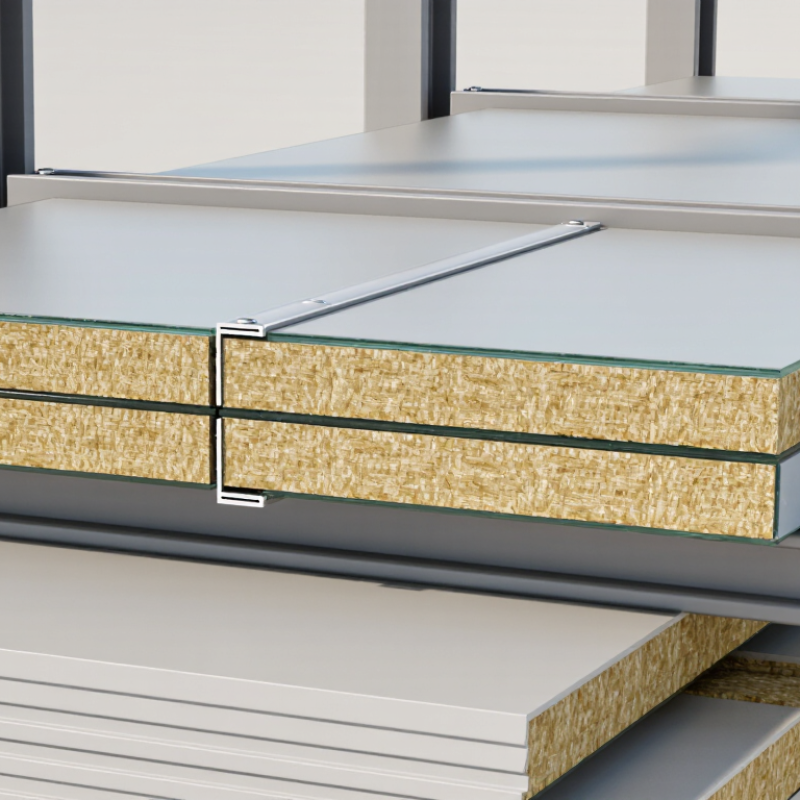
| Panel composition | Glass magnesium boards with a rock wool insulation core | — | The MgO-based facing boards provide a rigid, impact-resistant surface, while the mineral wool core contributes thermal, fire, and acoustic insulation. |
| Common overall thickness | 50–150 | mm | The required thickness depends on the target U-value, fire-rating specification, acoustic objective, span, and support spacing. |
| Rock wool core density | 80–150 | kg/m³ | Higher density can improve dimensional stability, resistance to airflow, and mechanical performance, but it also increases panel weight. |
| Thermal conductivity of rock wool core | 0.035–0.045 | W/(m·K) | Typical design values vary with density, temperature, moisture, and test method. Lower conductivity indicates better insulation. |
| Approximate thermal resistance of 100 mm core | 2.2–2.9 | m²·K/W | Calculated approximately as thickness divided by conductivity; board layers, joints, fasteners, and thermal bridges reduce the installed value. |
| Approximate U-value of 100 mm panel | 0.32–0.43 | W/(m²·K) | Indicative whole-panel range based on the core conductivity and typical surface resistances; project calculations should include joints and fixings. |
| Reaction to fire of mineral wool core | Usually Euroclass A1 | Classification | Stone wool is generally non-combustible when tested as a suitable product. The classification of the complete sandwich panel must be verified separately. |
| Glass magnesium board fire behavior | Non-combustible formulations are available | — | Fire performance depends on formulation, thickness, reinforcement, joints, adhesives, and surface finishes; product certification is required for compliance. |
| Fire-resistance rating | Project-specific; commonly 30–120 minutes for tested assemblies | min | Integrity, insulation, and load-bearing ratings apply only to the tested construction, including panel thickness, supports, fasteners, joints, and penetrations. |
| Sound absorption coefficient, NRC | Approximately 0.70–1.00 when the mineral wool is exposed or used behind a perforated lining | NRC | A closed MgO-faced panel does not automatically provide this absorption level. Surface perforation, cavity depth, and mounting arrangement are critical. |
| Sound transmission performance | Typically better than a single thin board; exact Rw/STC must be tested | dB | Mass, airtightness, panel joints, flanking paths, core thickness, and resonance control govern airborne sound insulation. No universal rating applies to every panel. |
| Core compressive strength | 40–120 | kPa | Typical range for rigid rock wool products at specified deformation; the declared value depends strongly on density and test standard. |
| Glass magnesium board thickness | 5–12 | mm per face | Thicker facings generally improve surface rigidity and impact resistance but increase mass and may affect cutting and installation. |
| Approximate panel mass | 15–30 | kg/m² | Indicative for common thicknesses and densities. Actual mass must be checked for structural handling, lifting, and support design. |
| Dimensional stability | Low thermal movement; joints still require allowance | — | Rock wool is dimensionally stable, but moisture, temperature changes, board movement, and building settlement can affect joints and finishes. |
| Moisture resistance | Good when edges and joints are correctly sealed | — | Rock wool is water-repellent in many building products, but prolonged water exposure can reduce thermal performance. MgO boards require compatibility and moisture-control detailing. |
| Typical applications | Interior partitions, exterior walls, roofs, cleanrooms, industrial buildings, and acoustic enclosures | — | Selection must be based on the required fire, thermal, acoustic, structural, moisture, hygiene, and installation performance of the complete assembly. |



 08045479132
 Send Inquiry

 Send Inquiry
 Send SMS