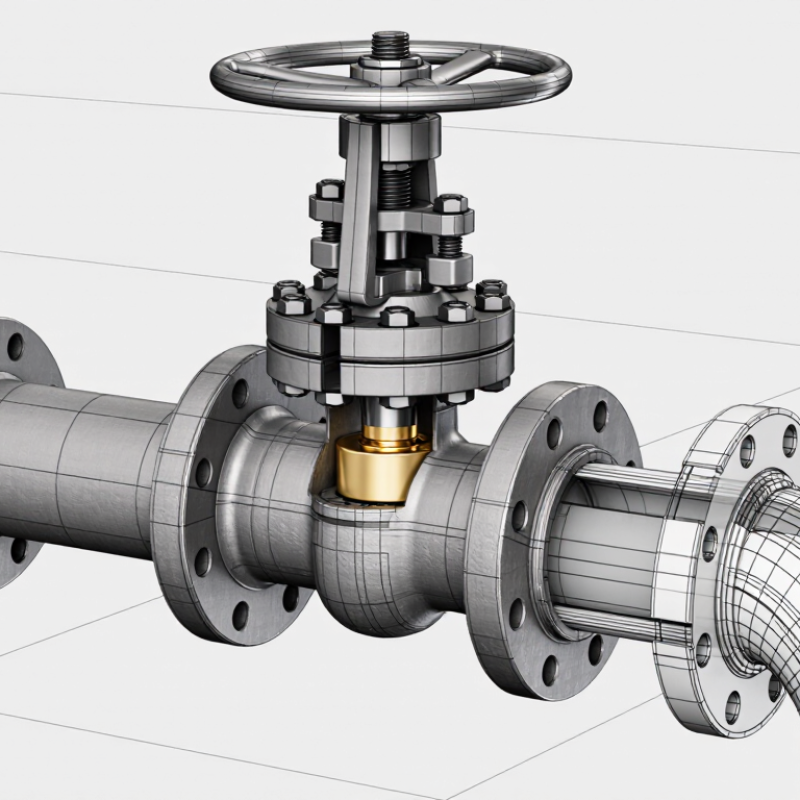
| Definition | A flanged globe valve is a linear-motion valve with flanged end connections, designed to start, stop, or regulate fluid flow. | Its closing element moves vertically toward or away from a stationary seat. The flanges are bolted to mating pipe flanges with a gasket between them. | It is commonly selected where reliable isolation and accurate throttling are required. |
| Main Components | Body, bonnet, stem, handwheel or actuator, disc or plug, seat, packing, and gasket. | The body contains the flow passage; the bonnet supports the stem; packing limits leakage around the moving stem; the seat provides the sealing surface. | Material selection depends on fluid chemistry, temperature, pressure, erosion risk, and applicable piping standards. |
| Working Principle | Turning the handwheel or operating the actuator moves the stem and disc along the valve axis. | When the disc approaches the seat, the flow area decreases. When it lifts away, the flow area increases. Flow direction is typically arranged beneath the disc for many services, but the manufacturer’s flow-direction marking should be followed. | The valve should be operated gradually to reduce the risk of pressure surges and excessive seat wear. |
| Flow Control Capability | Globe valves generally provide better throttling control than gate valves. | The changing opening between the disc and seat allows the flow rate to be adjusted over a useful operating range. | For precise automatic control, a properly sized control valve with a suitable trim and actuator may be more appropriate. |
| Typical Applications | Steam, hot water, cooling water, compressed air, process fluids, and utility services. | Common installation points include boiler feed systems, steam lines, water-treatment systems, heating circuits, chemical-process piping, and general industrial utilities. | The valve must be compatible with the fluid, pressure class, temperature range, pipe size, and required flow coefficient. |
| Flanged Connection | The valve is connected to the pipeline using bolted flanges and a gasket. | Flanged connections simplify removal for inspection or maintenance and are available in standardized pressure and dimensional ratings. | Correct flange alignment, gasket selection, bolt tightening, and torque sequence are essential to prevent leakage and mechanical stress. |
| Pressure and Temperature Rating | Performance is determined by the valve design, material, pressure class, temperature, and applicable standard. | A valve rated for a specific pressure at ambient temperature may have a lower allowable pressure at elevated temperature. The pressure-temperature table must be checked before selection. | Never select a valve based only on nominal pipe size; verify the complete rating and service conditions. |
| Key Benefits | Good throttling performance, dependable shutoff, robust construction, and straightforward maintenance access. | The linear stem movement provides predictable operation, while the replaceable or serviceable seat and packing can support maintenance programs. | Suitable for systems where flow regulation is more important than achieving the lowest possible pressure loss. |
| Main Limitations | Higher pressure loss, larger installation footprint, and greater operating effort than some other valve types. | The internal flow path changes direction, creating more resistance than a fully open gate or ball valve. Continuous throttling can also cause erosion, noise, or cavitation if the valve is incorrectly sized. | It is generally not the first choice for applications requiring very low pressure drop or frequent rapid on-off cycling. |
| Orientation and Installation | Many globe valves can be installed in horizontal or vertical pipelines, subject to design and service requirements. | The stem should have adequate clearance for operation and maintenance. The valve body arrow, installation instructions, and drainage requirements should be observed. | Pipe supports should prevent the valve from carrying excessive external loads caused by misalignment or thermal expansion. |
| Maintenance Requirements | Routine checks typically include external leakage inspection, stem and packing inspection, bolt condition, and operating performance. | Internal maintenance may involve cleaning, seat inspection, disc inspection, packing replacement, and gasket replacement after disassembly. | Before maintenance, isolate, depressurize, drain, and verify the system is safe according to the site’s procedures. |
| Selection Checklist | Consider nominal size, pressure class, temperature, fluid composition, flow rate, shutoff requirement, and actuation method. | Confirm body and trim materials, flange dimensions, gasket compatibility, end-to-end dimensions, flow direction, and applicable design or testing standards. | Proper sizing helps prevent excessive pressure loss, unstable control, vibration, premature wear, and inadequate capacity. |



 08045479132

 Send Inquiry


 Send Inquiry
 Send SMS

