Essential Tips for Choosing a Medical Microscope?
Choosing the right medical microscope is crucial for health professionals. A well-selected microscope enhances diagnostic accuracy and research quality. Medical microscopes are essential tools in labs and clinics. They allow for detailed examination of samples, leading to better patient outcomes.
When selecting a medical microscope, consider your specific needs. Think about the type of specimens you will analyze. Different microscopes serve various purposes. For instance, a compound microscope is ideal for histology. In contrast, a stereo microscope is better for larger samples.
Budget is another critical factor. High-end models exist, but they aren’t always necessary. Sometimes, mid-range options may suffice. Also, don’t overlook the importance of ease of use. A complex device can lead to frustration. Reflect on these aspects to make an informed decision.
Understanding the Different Types of Medical Microscopes Available
When choosing a medical microscope, understanding the types available is crucial. Light microscopes are common; they use visible light for imaging. These microscopes are suitable for basic laboratory work. However, their resolution can be limited. They might not reveal fine details in samples.
On the other hand, electron microscopes offer higher magnification. They use electron beams instead of light. This allows for detailed imaging of cellular structures. But these microscopes can be expensive and require specific maintenance. Users might face a steep learning curve as well.
Fluorescence microscopes are another option. They use fluorescent markers to highlight specimens. This method provides vivid images and can identify specific components in a sample. However, preparation for these samples can be time-consuming. Some might find it challenging to interpret the resulting images. Each type of microscope serves different purposes, and understanding their strengths can lead to better choices.
Essential Tips for Choosing a Medical Microscope - Understanding the Different Types of Medical Microscopes Available
| Type of Microscope |
Magnification Range |
Best Used For |
Price Range |
| Light Microscope |
40x to 1000x |
General laboratory use, histology, cytology |
$300 - $2000 |
| Compound Microscope |
40x to 1000x |
Cell structure study, microbiology |
$500 - $3000 |
| Digital Microscope |
Up to 2000x |
Real-time imaging, video capture |
$400 - $1500 |
| Fluorescence Microscope |
Up to 1000x |
Studying cellular processes, tagged proteins |
$2000 - $10000 |
| Electron Microscope |
Up to 10,000,000x |
Nanostructure analysis, high-resolution imaging |
$100000 - $5 million |
Key Features to Consider When Selecting a Medical Microscope
When selecting a medical microscope, certain features are crucial.
The optical quality matters significantly. Look for lenses with
high resolution. A good microscope should provide clear and sharp images.
This clarity is vital for accurate diagnosis. Consider the type of illumination as well.
LED lighting can enhance visibility. However, halogen lamps may offer warmer light.
Test both types to see what works best for your needs.
Another important factor is the level of magnification. Different medical tasks require different magnification levels.
A microscope that covers a range from 40x to 1000x can be quite versatile.
However, be cautious of a model that focuses only on high magnification. Sometimes, lower magnifications can provide
broader views needed for certain examinations.
Also, evaluate the build quality. A sturdy, well-constructed microscope can prevent issues over time.
It should not wobble during use. Yet, heavy models can be difficult to maneuver. So, finding a balance
is essential. Remember to think about your specific applications. This might require trial and error to find the
best fit for your work. Reflect on what’s most important for your daily tasks.
Factors Influencing the Cost of Medical Microscopes
When choosing a medical microscope, several key factors can significantly influence the cost. One of the primary considerations is the type of microscope. Options include light microscopes, fluorescence microscopes, and electron microscopes. Each type has specific applications and varying price points, which can lead to substantial differences.
Another critical aspect is optical quality. High-resolution optics may come with a higher price tag, but they provide clear images. Budget options might compromise on this feature, leading to less reliable results. The material and build quality also affect the cost. Durable materials may increase initial expenses but lead to longevity, reducing overall costs in the long run.
Accessories and features like illumination systems and camera integration can also drive costs up. Some microscopes have built-in digital cameras, which can create detailed documentation. Yet, these added features may not always be necessary, pushing budgets beyond limits. In the end, assessing specific research needs is crucial—investing wisely can save both money and effort in your medical practice.
Importance of Optical Quality in Medical Microscopes
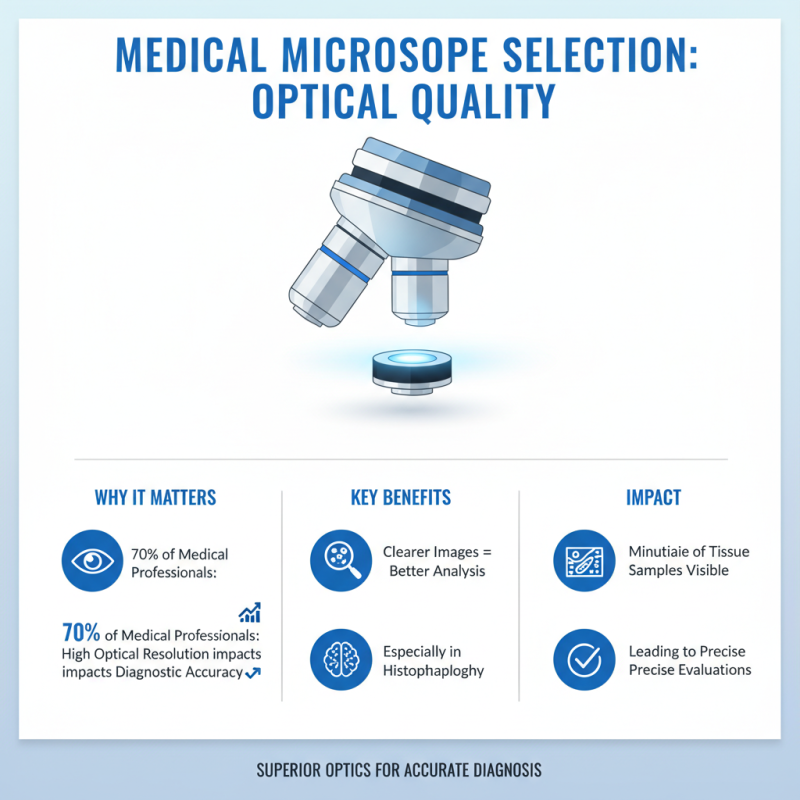
When selecting a medical microscope, optical quality stands as a paramount consideration. According to industry reports, 70% of medical professionals say that high optical resolution significantly impacts diagnostic accuracy. Clearer images allow for better analysis, especially in histopathology. The minutiae of tissue samples become visible with superior optics, leading to precise evaluations.
Color fidelity and contrast are also crucial. Subpar optical systems may distort colors, which can misrepresent tissue structures. A recent survey indicated that 60% of healthcare practitioners experienced frustrating diagnostics due to optical inaccuracies. Relying on inferior equipment in critical situations can jeopardize patient care.
Selecting a microscope often involves trade-offs. Many users find themselves in a dilemma between cost and quality. Optimal optical performance usually requires higher investment. Reports suggest a direct correlation between price and optical quality. Yet, some still opt for budget options, potentially missing vital diagnostic information. The challenge persists: balancing cost with the imperative for precision.
Assessing Ergonomics and Usability for Long-Term Use
When selecting a medical microscope, assessing ergonomics is crucial. A comfortable setup is essential for long hours of use. Microscopes should have adjustable heights and angles. This minimizes strain on the neck and back during long procedures. Users often forget to consider posture, leading to fatigue.
Another factor is usability. The controls should be intuitive. Complicated mechanisms can frustrate users, impacting focus on work. Simple adjustments are vital. It should feel natural, not clunky. Users often rush through their selection without testing how easy it is to operate.
Lighting is another key detail. Proper illumination affects visibility and accuracy. Ensure that the light source is adjustable. Weak or harsh lighting can lead to misinterpretations. Some may overlook this aspect until it becomes a problem. A microscope may seem great at first, but usability tests reveal hidden flaws.



 08045479132






 Send Inquiry

 Send Inquiry
 Send SMS