| Common Distribution Box Types |
| Type | Residential consumer unit | Distributes electricity from the supply to household circuits and provides circuit-level protection. | Typically serves lighting, socket, and dedicated appliance circuits in a home. |
| Type | Commercial or industrial panelboard | Supplies and protects multiple branch circuits in larger buildings or facilities. | Usually has a higher circuit capacity and may be designed for three-phase supplies, depending on the installation. |
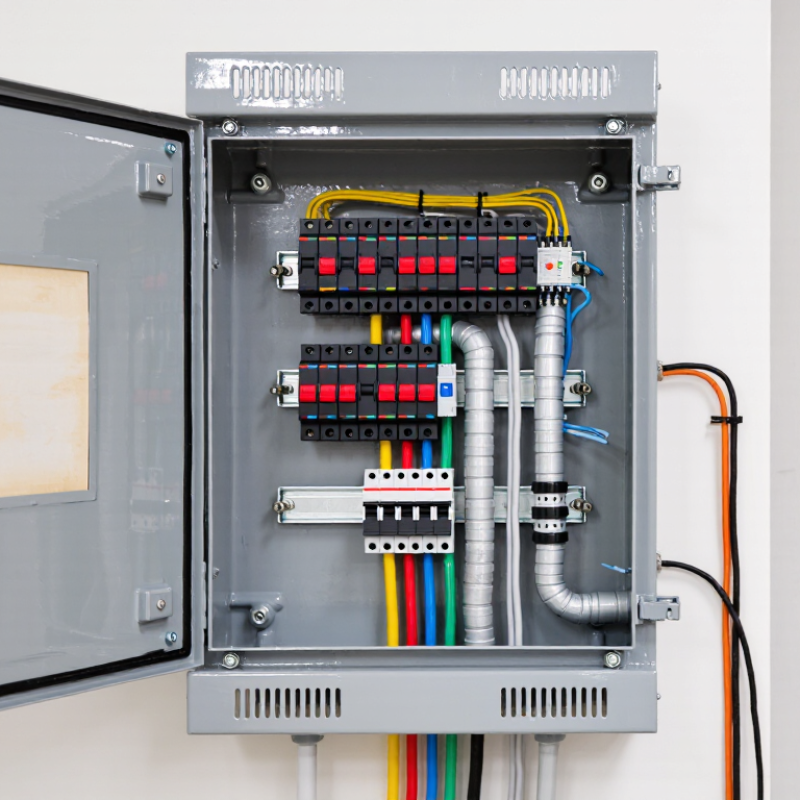
| Type | Surface-mounted enclosure | Houses distribution equipment while mounted on the face of a wall. | Often selected where installation inside a wall is impractical or access to existing wiring is needed. |
| Type | Flush-mounted enclosure | Houses distribution equipment within a wall recess. | Leaves the front cover close to the wall surface; requires a suitable wall cavity and installation space. |
| Type | Weather-resistant distribution box | Encloses electrical devices to help protect them from environmental exposure. | Used outdoors or in damp locations when its enclosure rating and installation are suitable for the conditions. |
| Main Components and Their Functions |
| Component | Enclosure and cover | Provides a physical housing for electrical equipment and helps prevent accidental contact with live parts. | Material, ingress protection, and construction must suit the location and applicable electrical requirements. |
| Component | Main switch or isolator | Disconnects the distribution board from its incoming supply. | Allows the installation or board to be isolated for maintenance; its rating must suit the system. |
| Component | Busbar | Distributes incoming electrical power to protective devices. | Conductive bar or assembly rated for the board; arrangement varies by design and supply configuration. |
| Component | Miniature circuit breaker (MCB) | Disconnects a circuit when an overcurrent or short circuit occurs. | Typically protects an individual branch circuit; rating and trip characteristics must match the circuit design. |
| Component | Residual-current device (RCD) | Disconnects the supply when it detects residual current that may indicate current flowing through an unintended path. | Provides additional protection against electric shock in specified applications; it does not generally provide overcurrent protection by itself. |
| Component | Residual-current circuit breaker with overcurrent protection (RCBO) | Combines residual-current protection with overcurrent and short-circuit protection for a circuit. | Can provide individual circuit protection; the required device type and rating depend on the installation. |
| Component | Neutral bar | Provides a termination point for neutral conductors. | Connections must follow the board design and protection arrangement; neutrals may need to remain separated between protected circuits. |
| Component | Protective earth bar | Provides a termination point for protective conductors connected to exposed conductive parts and the earthing system. | Supports continuity of the protective earthing arrangement; it is distinct from the neutral bar. |
| Component | DIN rail or device mounting supports | Secure compatible modular protective devices within the enclosure. | Common in modern distribution boards; the arrangement depends on the enclosure and equipment design. |
| Component | Cable entries, glands, and wiring space | Allow conductors to enter the enclosure and provide space for routing and termination. | Entries should be suitable for the cable type and location, with wiring arranged to avoid undue strain or damage. |



 08045479132

 Send Inquiry


 Send Inquiry
 Send SMS

