| Manual griddle or hot plate | Low; batter dispensing, turning, filling, and assembly are mainly done by staff. | About 20–60 finished pieces per hour per operator. | Small runs of roughly 20–100 pieces. | Cafés, market stalls, product trials, and businesses with varied or seasonal menus. | Lowest equipment complexity and flexible portion sizes; output and pancake consistency depend heavily on operator skill. |
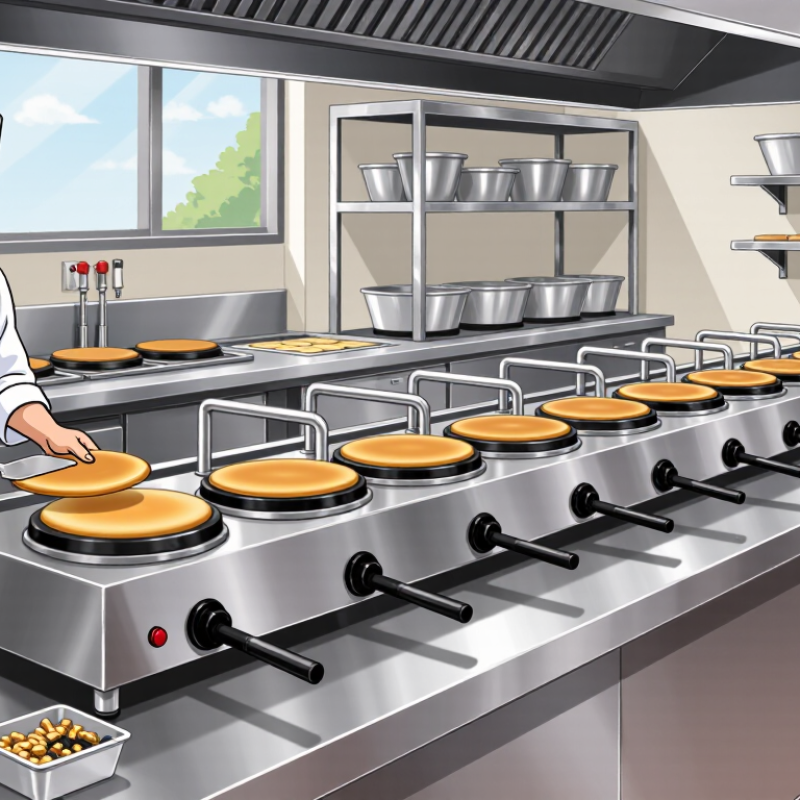
| Semi-automatic multi-mold griddle | Moderate; timed heating and multiple molds support faster baking, while loading, turning, filling, or assembly may remain manual. | About 60–200 finished pieces per hour, depending on mold count and workflow. | Medium runs of roughly 100–500 pieces. | Bakeries and small food producers with regular demand and a small production team. | Check whether quoted capacity counts pancakes or assembled dorayaki; finished-product output requires two pancakes per piece. |
| Automatic depositing and baking line | High for batter dosing and continuous baking; filling and pairing may be integrated or handled separately. | Often planned in the range of 200–800 finished pieces per hour; actual capacity varies substantially by line design. | Large runs of roughly 500–2,000 pieces or more. | Established producers with predictable demand and repeatable product specifications. | Confirm line speed, changeover time, cleaning access, staffing needs, and whether the quoted rate includes filling and final assembly. |
| Integrated continuous production line | Very high; may combine batter depositing, baking, transfer, filling, pairing, and discharge. | Typically designed for several hundred to over 1,000 finished pieces per hour, subject to the full line configuration. | Very large runs, generally 2,000 pieces or more. | High-volume factories supplying multiple retail or food-service channels. | Requires space, utilities, trained operators, and planned sanitation and maintenance; verify the output rate for the exact recipe and product size. |



 08045479132

 Send Inquiry


 Send Inquiry
 Send SMS

