How to Choose the Right Coaxial Attenuator for Your Needs?
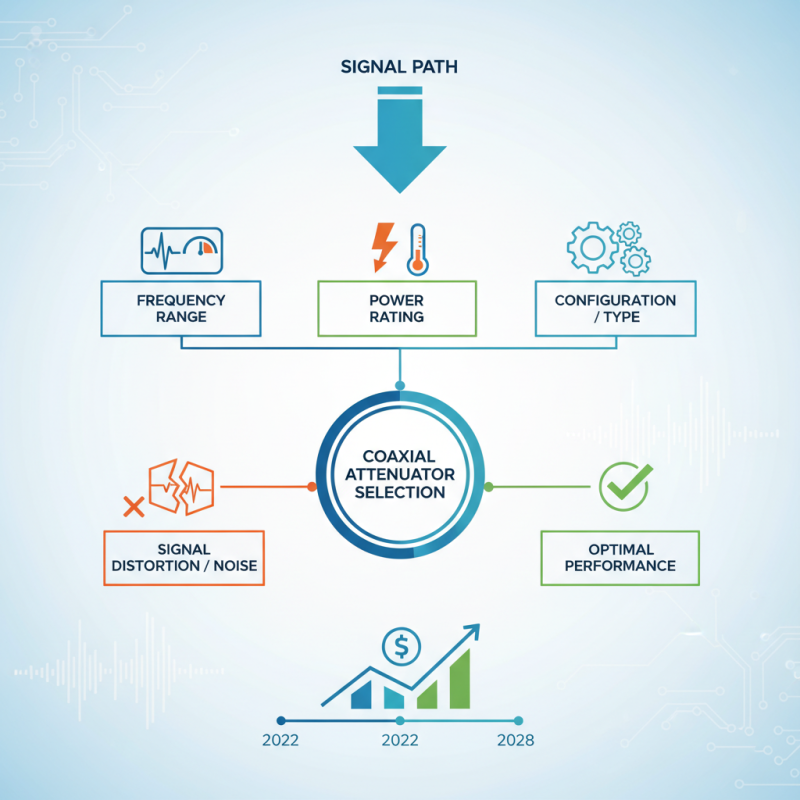
Choosing the right Coaxial Attenuator is crucial for optimal signal performance. According to a 2022 market report by Research and Markets, the coaxial attenuator market is projected to reach USD 3.1 billion by 2028. As technology advances, so do the requirements for reliable signal transmission.
Coaxial attenuators come in various configurations, frequency ranges, and power ratings. Understanding these specifications is vital. An ill-suited attenuator might lead to increased noise or signal distortion, impacting communication systems. In some cases, users underestimate the importance of these components.
Consider applications in telecommunications and broadcasting. A poorly designed coaxial attenuator can cause significant issues. Proper selection enhances quality and shifts focus from errors to efficiency. Given the stakes, investing the time to research and understand your needs is essential.
Understanding Coaxial Attenuators and Their Functionality
Coaxial attenuators play a vital role in radio frequency applications. They reduce signal strength to prevent distortion. Understanding their functionality is crucial for effective usage. According to industry reports, using the right attenuator can enhance system reliability by up to 30%. This means selecting the appropriate type significantly impacts overall performance.
Attenuators can be passive or active. Passive units use resistive materials to lower signal strength. Active attenuators, on the other hand, rely on powered elements to manage signal levels. The choice depends on the specific needs of your application. For example, passive units are preferred where power consumption is a primary concern.
Some users face challenges when selecting their devices. It’s essential to consider impedance, power rating, and frequency range. A mismatch can lead to signal loss or damage. Approximately 25% of installations experience issues due to incorrect specifications. Taking time to analyze these factors improves outcomes. However, many overlook this step, leading to unnecessary complications.
Identifying Your Specific Needs for Signal Attenuation
When choosing a coaxial attenuator, identifying your specific needs is crucial. Consider the type of signal you are dealing with. Different signals require varying levels of attenuation. For example, RF signals might need precise attenuation to avoid distortion, while video signals can handle more variability. A report from the Institute of Electrical and Electronics Engineers (IEEE) suggests that an improper attenuation level can lead to a 30% loss in signal quality.
Next, assess the frequency range of your application. Some attenuators function well at specific frequency ranges, typically between 1 MHz and 26 GHz. Knowing the frequency band helps ensure you select the right component. Researchers indicate that attenuation mismatch at certain frequencies could cause reflection, further degrading performance.
Finally, think about your power handling needs. Some applications can generate high power levels, requiring attenuators rated for substantial wattage. Industry data reveals that for high-frequency applications, up to 10 watts of power loss can be expected. Evaluate both the maximum power rating and the desired attenuation level to achieve optimal results. Remember, failure to specify these needs precisely can lead to inefficiencies in your overall system performance.
Evaluating Key Specifications: Power Rating and Frequency Range
When selecting a coaxial attenuator, understanding power rating and frequency range is crucial. Power rating indicates how much power the attenuator can handle. It’s essential to choose one that can manage your system's power without overheating. If it’s too low, damage may occur. Look for options that offer a margin above your expected power levels.
Frequency range affects performance significantly. Attenuators should match your application’s frequency requirements. A unit that operates well at lower frequencies may not work effectively at higher ones. For instance, if you work with RF signals, ensure the attenuator supports the entire frequency range you plan to use.
While you might find options at various specs, not all will meet real-time needs. Some users regret choosing models with insufficient power handling or restricted frequency ranges. Reflection on use-cases can save a future headache. Researching and testing can lead to better choices that might not be evident at first glance. Always consider these specifications carefully to optimize performance.
Comparing Different Types of Coaxial Attenuators Available
When selecting a coaxial attenuator, it’s important to compare the different types available. Generally, they fall into two main categories: fixed and variable attenuators. Fixed attenuators provide a consistent level of attenuation, making them suitable for situations where signal strength needs careful control. For example, a report by the Telecommunications Industry Association indicates that fixed attenuators are commonly used in RF applications where linearity is crucial.
On the other hand, variable attenuators allow for adjustable signal reduction. This flexibility is invaluable during testing and in environments where dynamic control is needed. According to industry standards, the choice often depends on signal frequencies and power ratings. It's worth noting that some users tend to overlook the necessary power handling capabilities, leading to potential equipment damage.
Tips: Always review the power ratings before purchasing. Mismatched ratings can lead to distortion. If you are not sure of your requirements, consider contacting an industry expert for advice. Don't ignore the possibility of using attenuators in series or parallel; it can optimize performance in complicated setups.
Installing and Testing Your Chosen Coaxial Attenuator
When installing a coaxial attenuator, consider the specific requirements of your system. Ensure that the attenuator’s frequency range matches your application. Most attenuators operate efficiently within a preset frequency range, typically from DC to several GHz. According to industry reports, improper frequency alignment can lead to signal loss or distortion.
Testing the installed attenuator is crucial. Use a signal generator and a spectrum analyzer to check the output. Measure the signal levels before and after the installation. A well-functioning attenuator should demonstrate a consistent level of attenuation. Adjustments may be necessary if the deviation exceeds 1 dB from the expected values.
Pay attention to the physical installation. Ensure that the connectors are secure, which helps reduce reflections. Improper connections can introduce variables that complicate signal testing. It’s worth noting that approximately 15% of installation issues arise from connector faults. Regular maintenance checks can enhance the longevity of your coaxial system.



 08045479132
 Send Inquiry

 Send Inquiry
 Send SMS