| Standard dry interior | Bedrooms, living rooms, offices, retail areas | Lightweight aluminum panels with regular thickness and concealed or exposed suspension | Common panel thickness: approximately 0.6–1.0 mm; select size according to ceiling grid and stiffness needs | Powder-coated or pre-painted smooth finish | Low maintenance, clean appearance, and good dimensional stability | Suitable where humidity, impact, and acoustic demands are moderate. |
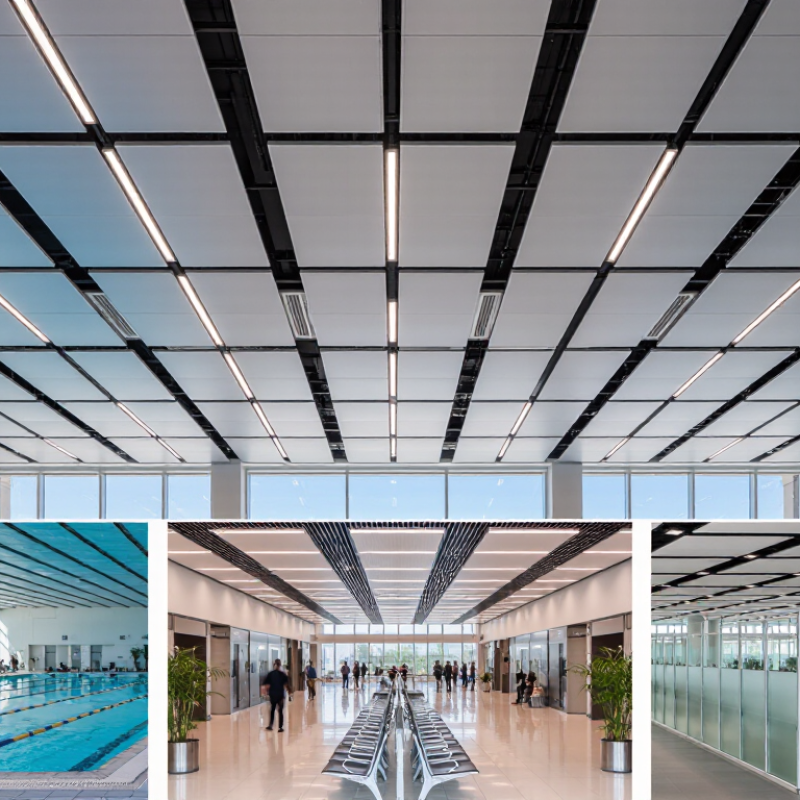
| High-humidity environment | Bathrooms, laundry rooms, indoor swimming-pool surroundings | Corrosion-resistant aluminum panels with durable coating and moisture-tolerant suspension components | Use corrosion-resistant fasteners and avoid materials that can rust when exposed to condensation | Powder coating or high-quality baked coating with sealed edges where required | Resists moisture-related deterioration and is easy to wipe clean | Provide adequate ventilation to limit condensation above the ceiling. |
| Coastal or salt-laden atmosphere | Buildings near the sea, coastal transport facilities | Aluminum panels with enhanced corrosion protection and compatible corrosion-resistant accessories | Confirm coating suitability for salt exposure; isolate incompatible metals to reduce galvanic corrosion | Durable exterior-grade coating appropriate for the exposure level | Improved resistance to salt-related surface and suspension-system corrosion | Regular inspection is recommended in exposed or semi-outdoor locations. |
| Kitchen or food-preparation area | Commercial kitchens, food-processing support rooms | Non-porous, washable panels with stable coating and accessible modules | Prioritize smooth joints, cleanable surfaces, and resistance to grease and routine detergents | Smooth light-colored finish with minimal texture | Supports hygiene routines and simplifies cleaning access | Coordinate panel layout with exhaust, sprinkler, lighting, and service access. |
| Healthcare or clean environment | Clinics, treatment rooms, laboratories, controlled work areas | Low-dirt-retention panels with sealed or carefully detailed joints and cleanable coatings | Consider smoothness, access requirements, fire performance, and compatibility with cleaning agents | Smooth, low-gloss, light-colored coating | Supports frequent cleaning and a visually clean environment | Verify the complete ceiling system, not only the panel, against project hygiene requirements. |
| Noise control required | Open offices, classrooms, conference rooms, restaurants | Perforated aluminum panels backed with an acoustic fleece or mineral-fiber acoustic layer | Acoustic performance depends on perforation pattern, backing material, ceiling plenum, and installation | Perforated or micro-perforated finish | Can reduce reflected sound and improve speech intelligibility when correctly specified | Request tested sound-absorption data, such as weighted absorption coefficients, for the complete assembly. |
| Strong reverberation or large open volume | Airports, halls, atriums, large public interiors | Acoustic aluminum ceiling system with substantial absorptive backing and a layout designed for sound control | Review ceiling coverage, room volume, occupancy, and reverberation targets during design | Perforated panels with acoustic backing | Provides better control of reflected sound than solid panels | Panels alone may not solve reverberation; combine with wall or suspended acoustic treatments when needed. |
| High-traffic public area | Shopping centers, corridors, stations, public lobbies | Rigid panels with impact-resistant coating and secure suspension details | Consider panel size, deflection, edge strength, access frequency, and resistance to accidental impact | Hard-wearing powder-coated finish | Maintains appearance and reduces the risk of frequent replacement | Use a robust suspension system where panels may be disturbed by maintenance or vibration. |
| Frequent maintenance access | Data rooms, offices with dense services, mechanical zones | Lay-in, clip-in, or easily demountable panels matched to the access frequency | Coordinate module size with lighting, air diffusers, detectors, valves, and inspection points | Finish selected for repeated handling and cleaning | Allows faster access to concealed building services | Do not choose a fully concealed system if regular service access is essential unless it is designed for demountability. |
| Fire and life-safety priority | Escape routes, high-occupancy buildings, public facilities | Non-combustible aluminum panels used with a suspension system approved for the project | Check applicable building codes, fire classifications, plenum requirements, and details for light fittings | Coating and finish selected to meet the required fire-performance specification | Aluminum itself is non-combustible, but coatings, backing, insulation, and other components must also be assessed | Obtain documentation for the complete ceiling assembly rather than relying on the panel material alone. |
| Exterior or semi-exterior use | Canopies, covered walkways, soffits, sheltered entrances | Panels and suspension components specifically designed for outdoor exposure | Consider wind load, drainage, thermal movement, UV exposure, fastener corrosion, and panel restraint | Exterior-grade coating with appropriate weather resistance | Better durability under changing weather and temperature conditions | Do not use an interior ceiling specification outdoors without structural and coating verification. |
| Strong lighting or visual design focus | Showrooms, hotels, reception areas, feature ceilings | Precisely formed panels with consistent color, flatness, and joint alignment | Review reflectance, panel tolerances, joint width, module layout, and compatibility with lighting | Matte, metallic, wood-look, or custom-color finish as required | Creates a coordinated ceiling appearance and supports lighting design | Request physical samples because color and gloss can vary under different light sources. |
| Thermal comfort or energy goals | Large offices, educational buildings, spaces with high cooling loads | Aluminum panels coordinated with insulation, ventilation, or radiant ceiling systems | Metal panels conduct heat; thermal performance depends mainly on the full ceiling build-up and building services | Finish selected according to reflectance and maintenance requirements | Can integrate with services and support efficient ceiling coordination | Do not treat the aluminum face panel alone as a significant thermal insulator. |
| Sustainability and long service life | Green-building projects, renovation work, long-term commercial facilities | Durable, repairable, demountable aluminum panels with documented material content | Assess recycled content, service life, replacement access, coating durability, and end-of-life recyclability | Durable finish with replaceable individual modules | Supports maintenance, refurbishment, and material recovery at the end of service life | Evaluate the full system life cycle, including suspension components and packaging. |



 08045479132
 Send Inquiry

 Send Inquiry
 Send SMS
