| Weight | Compare the drill’s stated operating weight, including any air leg or other support equipment you will use. | The complete setup can be positioned and controlled by the intended operator or crew. | A heavy drill may be difficult to maneuver in confined areas or during repeated repositioning. | Judge weight in relation to the drilling angle, working space, and whether support equipment carries part of the load. |
| Handling and ergonomics | Assess handle position, balance, controls, hose routing, and access to routine adjustment points. | Controls are reachable while maintaining a stable stance, and the drill can be aligned without awkward twisting. | Poor balance, obstructive hoses, or difficult-to-reach controls can make accurate positioning harder. | If possible, handle the drill in a safe, powered-off demonstration before purchase. |
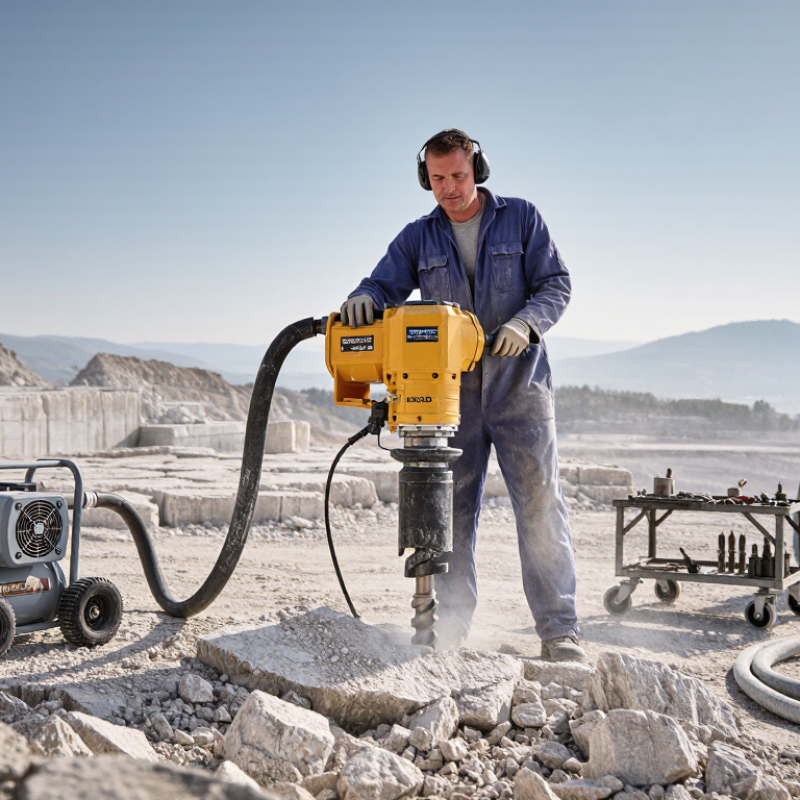
| Safety features | Check for a clearly operable throttle or shutoff, secure hose connections, suitable exhaust direction, and available vibration and noise information. | Controls are easy to identify, connections can be secured against accidental separation, and operating instructions specify required protective equipment. | Missing instructions, damaged hoses, unsecured couplings, or controls that are hard to operate increase risk. | Use the drill only with the required eye, hearing, hand, and respiratory protection, following site rules and the operating manual. |
| Air supply compatibility | Compare the drill’s specified working pressure and air consumption with the compressor’s delivered capacity and the hose setup. | The compressor can provide the required air at the drill under operating conditions. | A mismatch can reduce performance; long or undersized hoses and restrictive fittings can also contribute to pressure loss. | Verify requirements in the drill and compressor manuals rather than relying on compressor tank size alone. |
| Durability and serviceability | Review construction materials, protection of exposed parts, maintenance intervals, and availability of replacement parts. | Wear parts and service procedures are documented, and routine inspection and maintenance can be performed safely. | Unclear maintenance requirements or hard-to-source parts may increase downtime and repair difficulty. | Compare warranty terms and service support, and inspect the tool regularly for cracks, loose parts, and hose damage. |
| Worksite suitability | Match the drill configuration to the hole direction, rock conditions, access, and expected duty cycle. | The tool can be positioned and supported appropriately for the planned task and site conditions. | A drill suited to one setup may be cumbersome or inefficient in a different orientation or confined space. | Confirm the intended application with the manufacturer’s specifications and a qualified site supervisor. |



 08045479132

 Send Inquiry


 Send Inquiry
 Send SMS

