How to Choose the Best PV Accessories in 2026?
Choosing the best Pv Accessories in 2026 requires more than comparing prices. A connector, isolator, cable, fuse, mounting rail, or monitoring device can influence safety, yield, and maintenance costs. Small parts carry large consequences.
The IEA PVPS Trends 2024 report recorded more than 400 GW of new solar capacity worldwide in 2023. IRENA’s Renewable Capacity Statistics 2024 also reported solar as the fastest-growing renewable technology. This expansion increases demand for reliable accessories, but it also creates confusion. Product labels can look impressive. Field performance may tell another story.
Dr. Michael Köhl, a photovoltaic reliability researcher associated with IEA PVPS Task 13, has stated, “Reliability is a system property, not merely a module feature.” That principle should guide every purchasing decision. Buyers must examine certification, material quality, temperature ratings, compatibility, installation conditions, and supplier traceability. NREL’s photovoltaic reliability research repeatedly highlights the importance of connections, weather exposure, and long-term degradation. A cheaper accessory may save money today. It may also create avoidable service visits later. That shortcut is tempting. It is also risky.
This guide will compare the practical factors behind high-quality Pv Accessories, including electrical safety, mechanical strength, environmental resistance, warranty clarity, and lifecycle value. The process will not be perfect. Manufacturer claims still require verification. Real projects contain dust, heat, uneven roofs, rushed installations, and human mistakes. Good selection means planning for those realities, not ignoring them.
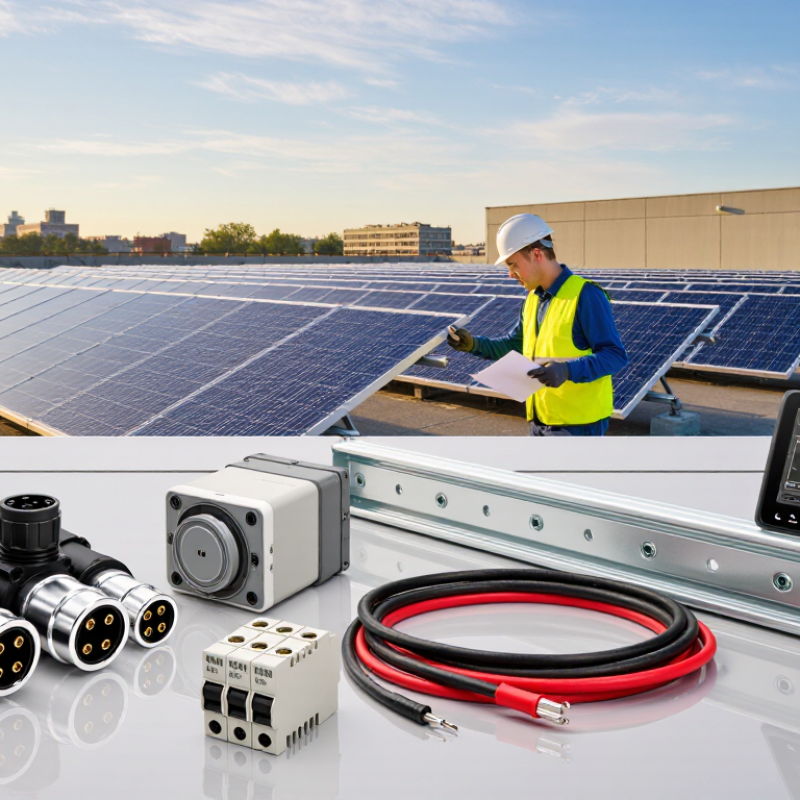
Define PV Accessories and Their Role in Solar Systems
PV accessories are the supporting components that make a solar system safe, stable, and serviceable. They include mounting rails, clamps, DC cables, connectors, fuses, isolators, combiner boxes, grounding devices, surge protection, and monitoring equipment. Panels generate electricity, but accessories control how that electricity moves.
Their role extends beyond connection. Mounting hardware resists wind and thermal movement, while correctly sized cables reduce voltage loss and overheating. Protection devices interrupt abnormal currents and help limit damage from surges. IEC 62548 addresses photovoltaic array design, wiring, and protection requirements. IEC 61730 also covers module safety, but the wider system still depends on correctly selected accessories. Small parts matter.
The market is expanding quickly. IRENA’s Renewable Capacity Statistics 2024 reported 346 gigawatts of new solar capacity added globally during 2023. More installations mean more roofs, climates, cable routes, and maintenance conditions to consider. During field inspections, loose connectors and poorly supported cables remain practical warning signs. A neat installation is not always a reliable one. The selection process should check current ratings, temperature range, UV resistance, fire performance, corrosion exposure, and compatibility. It should also follow the inverter and module specifications, not assumptions. I sometimes see accessory choices treated as minor purchases. That is a mistake, though installers can overlook details under schedule pressure. Reliable documentation and inspection records provide stronger evidence than appearance alone.
Select Accessories Based on Installation Conditions and System Scale
How to Choose the Best PV Accessories in 2026?
Select accessories based on installation conditions and system scale, not appearance or price alone. IRENA’s Renewable Capacity Statistics 2024 recorded about 1.4 TW of global solar capacity by the end of 2023. That scale increases demand for reliable cables, connectors, surge protection, monitoring, and safe mounting hardware. A small rooftop system may need compact protection devices and simple monitoring. A utility-scale project requires coordinated combiner boxes, longer cable runs, communication systems, and easier maintenance access.
Site conditions should guide every selection. Coastal installations need corrosion-resistant hardware and sealed enclosures. Snowy regions require stronger structures and careful drainage paths. Dusty ground-mounted sites benefit from higher enclosure protection and accessible cleaning points. IEA PVPS reported more than 400 GW of new PV capacity in 2023, but rapid deployment can encourage rushed decisions. I have seen oversized components create unnecessary losses and installation complexity. Bigger is not always better. Cable voltage drop, temperature, ultraviolet exposure, and local electrical requirements must be checked by qualified professionals.
Tips: Measure the site first. Match accessories with system voltage and current. Keep spare connectors and fuses documented. Review warranty terms carefully. Use independent testing data where available. NREL research has reported typical PV degradation near 0.5% annually, so durable accessories can protect long-term performance. Still, no accessory lasts forever. Inspect connections after severe weather, and reconsider the design when the site changes.



 08045479132
 Send Inquiry

 Send Inquiry
 Send SMS
