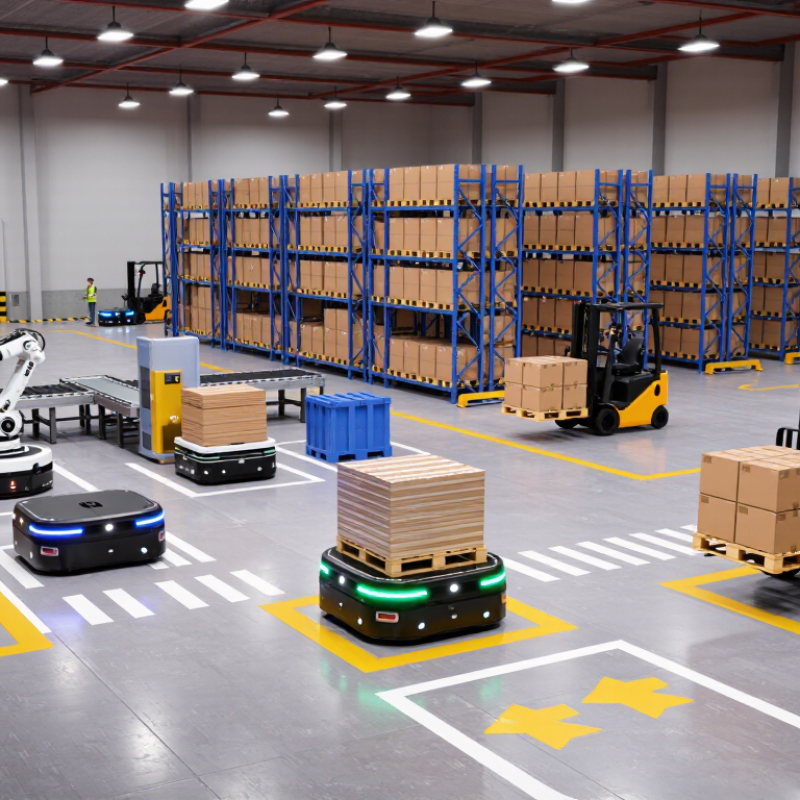
| Autonomous mobile robot (AMR) | Moving totes, components, carts, or other loads between workstations, storage, and packing areas. | Navigates using onboard sensors and mapping; can typically plan or adjust routes around obstacles. | Varies by model and platform; available solutions range from small-item carriers to heavy-load units. | Flexible routes; useful in changing layouts; can reduce repetitive transport work. | Needs suitable routes, traffic management, charging arrangements, and integration with doors, lifts, or workflow systems where applicable. |
| Automated guided vehicle (AGV) | Repeatable transport along established routes, such as moving pallets or production materials between fixed points. | Follows defined guidance or navigation infrastructure; route changes may require system updates or facility changes. | Available in configurations for light loads through heavy pallet and industrial loads. | Well suited to stable, repetitive transport flows and predictable routes. | Less adaptable than many AMR systems when routes or workflows change; assess aisle access and interaction with people and vehicles. |
| Articulated industrial robot | Machine tending, case packing, palletizing, depalletizing, and handling parts across a work cell. | A multi-joint arm moves an end-of-arm tool through a programmed work envelope. | Broad range, from small-part handling to heavy industrial loads; capacity depends on arm reach and configuration. | Flexible reach and motion; can perform repeated handling tasks at high production rates when properly engineered. | Requires application-specific tooling, programming, risk assessment, and appropriate safeguarding or safety-rated design. |
| Collaborative robot (cobot) | Light- to medium-duty pick-and-place, kitting, packaging, and machine tending where workers share a workspace under a validated safety setup. | A compact robotic arm designed with features that can support collaborative applications; the complete work cell must still be risk-assessed. | Generally selected for lighter loads than many large industrial arms; verify payload, reach, and tool weight for the application. | Often compact and comparatively straightforward to redeploy between suitable tasks. | Collaborative capability does not automatically make every application safe without guarding; speed and payload may be limited by the task and safety requirements. |
| Cartesian or gantry robot | Palletizing, case handling, loading and unloading, and movement over a large, rectangular work area. | Moves along linear axes, commonly in a straight-line X-Y-Z arrangement, often above or around the work area. | Can be configured for a wide range of loads, depending on the structure, axes, and end effector. | Provides predictable straight-line motion and can cover broad areas with a fixed installation. | Requires space for the frame and travel; less suited than an articulated arm to tasks needing complex approaches around obstacles. |
| Robotic forklift or pallet-handling vehicle | Transporting, staging, or storing palletized loads between docks, production areas, and warehouse locations. | A mobile vehicle with fork or load-handling equipment navigates facility routes and performs pallet pickup or placement. | Designed for palletized loads; check rated capacity, load dimensions, lift height, and load-center requirements. | Automates pallet movements without requiring a separate robot arm for each transfer point. | Needs compatible pallets, sufficient aisle and turning space, clear pickup locations, and safe coordination with people and other vehicles. |
| Robotic picking system with vision | Picking and sorting individual items from bins, totes, or conveyors for order fulfillment or production feeding. | Combines a robot, camera or other sensing, and software to identify item locations and guide the pick. | Usually selected for the item size and weight range in the application; irregular or fragile items may need specialized gripping. | Can handle varied item positions when the vision and grasping system is matched to the inventory. | Performance depends on item presentation, lighting, packaging, graspability, and the quality of vision-system training and integration. |



 08045479132

 Send Inquiry


 Send Inquiry
 Send SMS