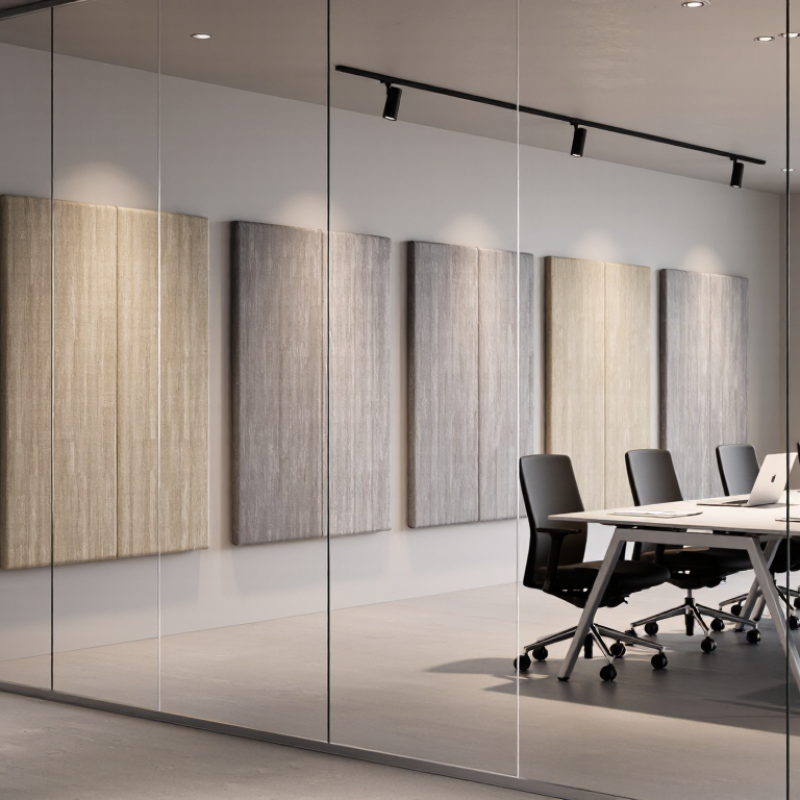
| Fabric-Wrapped Fiberglass or Mineral-Wool Panels | Often achieves an NRC of about 0.80–1.00 in commonly tested thicknesses and mounting arrangements. Performance varies with thickness, density, and air gap. | Offices, classrooms, meeting rooms, studios, and other spaces where reducing reverberation and reflections is a priority. | Check the tested panel thickness, edge construction, fire-performance documentation, fabric cleanability, and installation method. A deeper panel or air gap can improve lower-frequency absorption. | Primarily absorbs sound inside the room; it does not by itself provide sound isolation through walls. Fabric can be vulnerable to stains or damage in high-traffic areas. |
| PET-Felt Panels | Performance varies substantially by thickness, pattern, backing, and mounting. Compare tested NRC values for the complete panel assembly rather than relying on material type alone. | Offices, collaborative areas, corridors, and spaces that need lightweight panels or decorative shapes. | Review the tested acoustic report, recycled-content claims, panel thickness, edge finish, attachment system, and cleaning instructions. | Thin or highly patterned panels may absorb less sound than thicker absorptive assemblies. NRC alone does not describe performance at every frequency. |
| Wood-Slat Panels with Absorptive Backing | Can provide useful absorption when slat spacing, backing, and cavity are designed as a tested system. Results vary considerably between constructions. | Reception areas, conference rooms, dining spaces, and interiors where a timber finish is desired alongside reverberation control. | Ask for test data for the exact slat spacing, backing material, and mounting cavity. Check finish durability, fire requirements, and access for maintenance. | Decorative slats without suitable absorptive backing may reflect much of the sound. Do not assume that appearance or material alone indicates acoustic performance. |
| Perforated Wood Panels with Absorber Behind | Absorption depends on perforation size and pattern, panel thickness, backing, and cavity depth; use the rating for the complete tested assembly. | Rooms needing a durable, cleanable architectural surface, such as auditoriums, teaching spaces, and public interiors. | Confirm the tested configuration, including perforations and cavity depth. Consider cleanability, edge details, fire documentation, and access to concealed services. | A solid or incorrectly backed panel can remain largely reflective. Installation changes may alter performance from the tested result. |
| Acoustic Foam Panels | Absorption varies with foam thickness, shape, and frequency. Request product-specific test data rather than comparing by profile or appearance. | Some studios, practice rooms, or utility spaces where lightweight treatment is appropriate and the product meets applicable safety requirements. | Check fire-performance documentation, emissions information where relevant, thickness, mounting method, and performance across the frequencies of concern. | Foam is not automatically suitable for every occupied building. Thin foam may do little for low-frequency problems, and it does not block sound transmission between rooms. |
| Hybrid or Custom Panel Assemblies | Can be tuned to a room's acoustic goals, but performance must be verified for the specific combination of face material, absorber, cavity, and mounting. | Rooms with mixed needs, unusual dimensions, design constraints, or specific frequency-related acoustic problems. | Define the room's use, target reverberation, available wall area, installation depth, and required test evidence before specifying a custom assembly. | Custom designs may require more coordination and installation detail. Do not substitute materials or mounting methods without checking their effect on tested performance. |



 08045479132

 Send Inquiry


 Send Inquiry
 Send SMS

