| Product and load | Identify the products to be hung and the maximum weight each hook must support. | Choose a hook with a documented working load limit suitable for the product and handling conditions. Do not estimate capacity from appearance or wire thickness alone. | Record the heaviest item per hook and confirm the rated capacity with the supplier. |
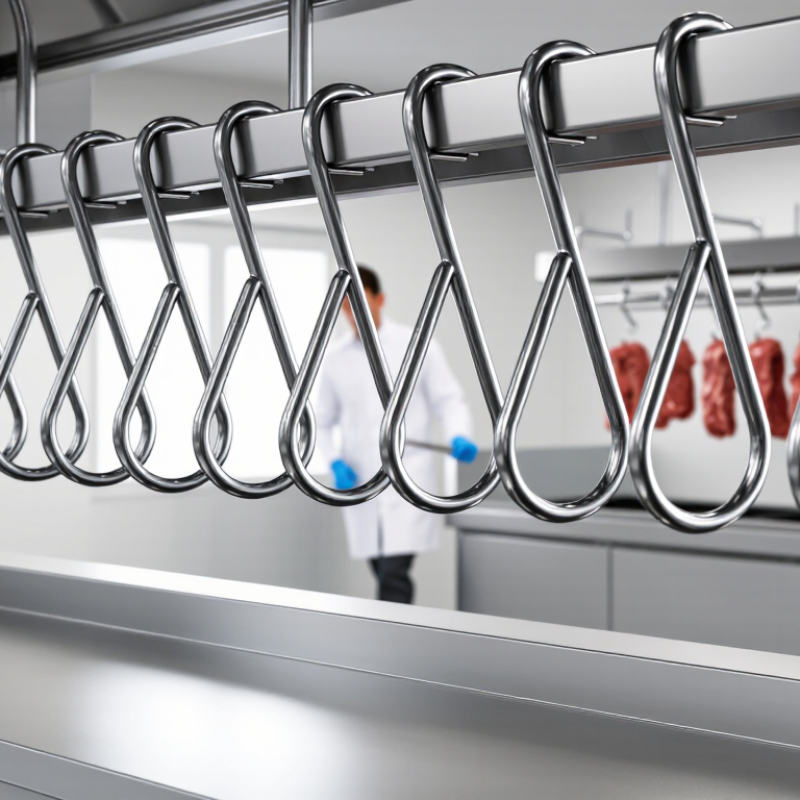
| Hook shape and points | Specify whether the product is hung by a single point, two points, or a spreader-style hook. | Match the hook geometry to the product and hanging method. Point design affects how the product is supported and how easily it can be loaded and removed. | Use a two-point design when the product needs support at two locations; confirm spacing against the product dimensions. |
| Hook and rail dimensions | Measure the rail, trolley, or hanging fixture, along with available clearance and required hook length. | Check that the hook’s top fitting is compatible with the support system and that the hanging product will not contact floors, walls, or nearby items. | Specify rail or trolley dimensions, hook length, and minimum clearance before ordering. |
| Stainless steel grade | Describe exposure to moisture, cleaning chemicals, salts, and other corrosive conditions. | Grade 304 stainless steel is commonly used in food-processing environments. Grade 316 offers greater resistance to chlorides than 304, but compatibility depends on the actual environment and cleaning routine. | Ask for the material grade to be documented and compare it with the facility’s cleaning chemicals and operating conditions. |
| Cleaning and sanitation | Define how often hooks are washed and sanitized, and whether they are cleaned manually or with equipment. | Prefer a smooth, accessible design that can be inspected and cleaned. Follow the facility’s sanitation procedures and the chemical manufacturer’s instructions. | Require hooks to be easy to inspect, free of hard-to-clean crevices, and suitable for the approved cleaning process. |
| Temperature and location | Note whether hooks are used in chilled rooms, freezers, washdown areas, or multiple locations. | Confirm that the complete hook and its supporting hardware are suitable for the operating environment and any temperature changes. | List the temperature range and whether hooks move between cold storage and warmer processing areas. |
| Handling and workflow | Describe how staff load, move, unload, store, and inspect the hooks. | Consider grip, hook balance, storage method, and whether hooks need to move along a rail. Standardize compatible designs where practical. | Choose a hook that staff can handle safely and that fits the existing hanging and storage system. |
| Inspection and replacement | Set inspection criteria and define how damaged, bent, corroded, or worn hooks are removed from service. | Use traceable specifications and a consistent replacement process. Follow the supplier’s guidance for inspection and discard limits. | Document the hook specification, rated capacity, inspection schedule, and replacement procedure. |



 08045479132

 Send Inquiry


 Send Inquiry
 Send SMS

