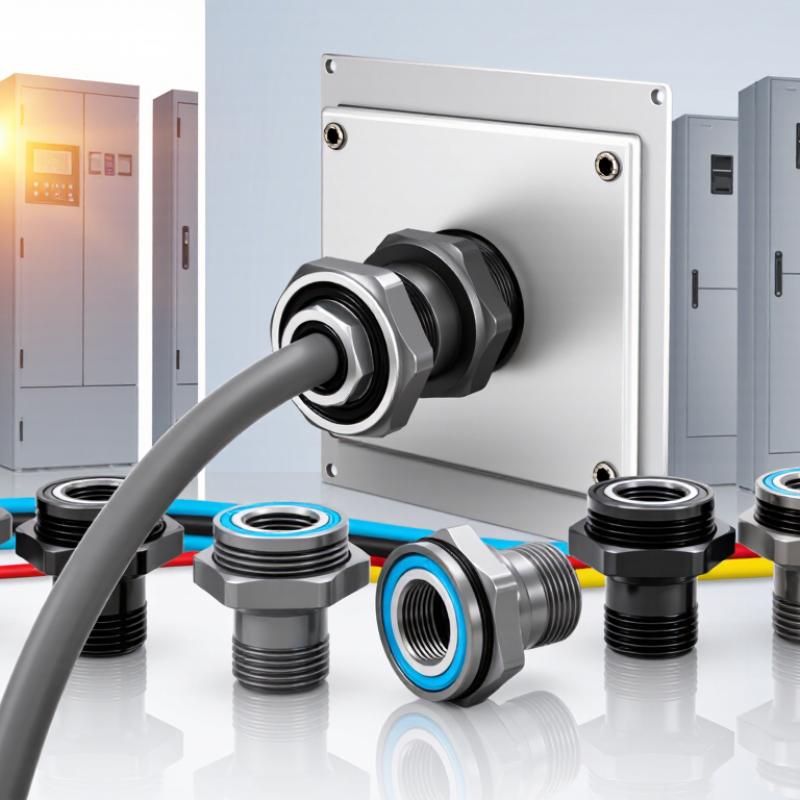
| Product Function | An industrial nylon cable fixing gland is a mechanical cable-entry fitting that secures a cable where it passes through an enclosure, panel, or junction box. | Provides cable retention, strain relief, sealing around the cable, and protection against dust or water when correctly installed. | Choose a gland that matches the cable diameter, enclosure thread, environmental conditions, and required ingress-protection level. |
| Gland Body Material | The body is commonly molded from engineering-grade polyamide, also known as nylon. | Common materials include PA6 and PA66. Glass-fiber-reinforced nylon may be used when higher mechanical strength or dimensional stability is required. | Use standard nylon for general industrial applications. Consider reinforced nylon for heavier cables, vibration, or demanding mechanical loads. |
| Operating Temperature | Temperature capability depends on the nylon grade, seal material, design, and installation conditions. | Many general-purpose nylon cable glands are specified for approximately -40°C to +100°C. Some designs have a wider or narrower range. | Check the manufacturer’s complete temperature rating rather than selecting by material name alone. Include both ambient temperature and cable surface temperature. |
| Ingress Protection | The IP rating indicates resistance to solid particles and water under defined test conditions. | Common industrial requirements include IP54, IP65, IP66, IP67, and IP68. The actual rating depends on the gland, seal, cable, enclosure, and installation quality. | Use IP65 or higher for outdoor or washdown-prone equipment when the application requires dust-tight and water-jet protection. IP68 is intended for specified temporary or continuous immersion conditions only when stated. |
| Cable Diameter Range | The sealing insert must compress around the cable without cutting the jacket or leaving an open gap. | Typical metric gland sizes may cover ranges such as 3–6 mm, 5–10 mm, 9–17 mm, or 13–21 mm, depending on the gland size. | Measure the actual outside diameter of the fully assembled cable. Select a range in which the cable sits securely without forcing it outside the specified limits. |
| Thread Standard | The thread connects the gland to the enclosure or mounting plate. | Common options include metric threads such as M12, M16, M20, M25, M32, and M40. Other thread standards may be used for specific installations. | Match the gland thread to the enclosure opening. Verify nominal size, pitch, thread length, and whether a locknut, washer, or adapter is needed. |
| Thread Length | Thread length is the portion that passes through the enclosure wall and engages with the locknut or threaded opening. | Short and long thread versions are available. Common thread lengths are approximately 8–15 mm, depending on size and design. | Use a longer thread for thick enclosure walls or mounting plates. Ensure sufficient thread engagement without interfering with internal components. |
| Seal Material | The sealing ring or insert forms the seal between the gland and the cable jacket. | Common sealing materials include nitrile rubber, EPDM, and other application-specific elastomers. | Select a seal compatible with oil, coolant, chemicals, sunlight, temperature, and the cable jacket. Do not assume all sealing materials have the same resistance. |
| Strain Relief | The clamping mechanism limits cable movement and reduces mechanical stress on terminals inside the enclosure. | Standard designs clamp the outer cable sheath. Stronger versions may provide enhanced pull-out resistance for heavier or more frequently moved cables. | Choose a suitable strain-relief design for fixed wiring, machine vibration, robotic motion, or suspended cable loads. A gland should not replace proper cable support. |
| Environmental Exposure | The installation environment affects material life and sealing performance. | Relevant factors include moisture, dust, ultraviolet radiation, oils, cleaning chemicals, salt spray, vibration, and impact. | For outdoor use, verify UV resistance. For industrial fluids, verify chemical compatibility. For high-vibration equipment, use a locking and sealing arrangement designed for vibration service. |
| Flammability Requirement | Flammability performance describes how the plastic behaves when exposed to an ignition source. | Some nylon compounds are available with a specified flammability classification, while standard grades may not provide the same performance. | Where required by the equipment standard or application, select a gland with documented flammability data and use it with compatible enclosure materials. |
| Electrical Considerations | Nylon is electrically insulating, so the gland does not normally provide metallic bonding or earth continuity. | Useful for insulated cable entries and non-metallic enclosures. Metallic glands or separate bonding arrangements may be required for cable screens or protective earth paths. | Confirm whether the installation needs electrical continuity, electromagnetic compatibility control, or screen termination before choosing a nylon gland. |
| Enclosure Wall Compatibility | The gland must seat correctly against the enclosure surface to maintain mechanical stability and sealing. | Compatible surfaces may include plastic, painted metal, stainless steel, or other enclosure materials, provided the opening is correctly prepared. | Remove burrs, use the correct hole size, and install a sealing washer where required. A damaged or uneven mounting surface can reduce the effective IP rating. |
| Installation Method | The gland is installed through a prepared opening and tightened around the cable. | Typical steps include inserting the gland, fitting the locknut or engaging the enclosure thread, routing the cable, and tightening the cap to the specified torque. | Use the recommended tightening torque. Over-tightening can damage the seal or cable jacket; under-tightening can reduce retention and water resistance. |
| Application Suitability | Different equipment types impose different requirements for sealing, vibration resistance, temperature, and cable movement. | Typical applications include control cabinets, instrumentation boxes, automation equipment, outdoor electrical enclosures, lighting equipment, and machinery. | For moving cables, high-pressure washdown, hazardous locations, or extreme temperatures, use a design specifically evaluated for that service rather than a general-purpose gland. |
| Recommended Final Check | A correct selection requires matching all critical dimensions and environmental requirements. | Verify cable diameter, thread size, thread length, IP rating, temperature range, material compatibility, strain relief, and installation torque. | Before production use, confirm the complete assembly against the enclosure specification and applicable electrical or machinery safety requirements. |



 08045479132
 Send Inquiry

 Send Inquiry
 Send SMS