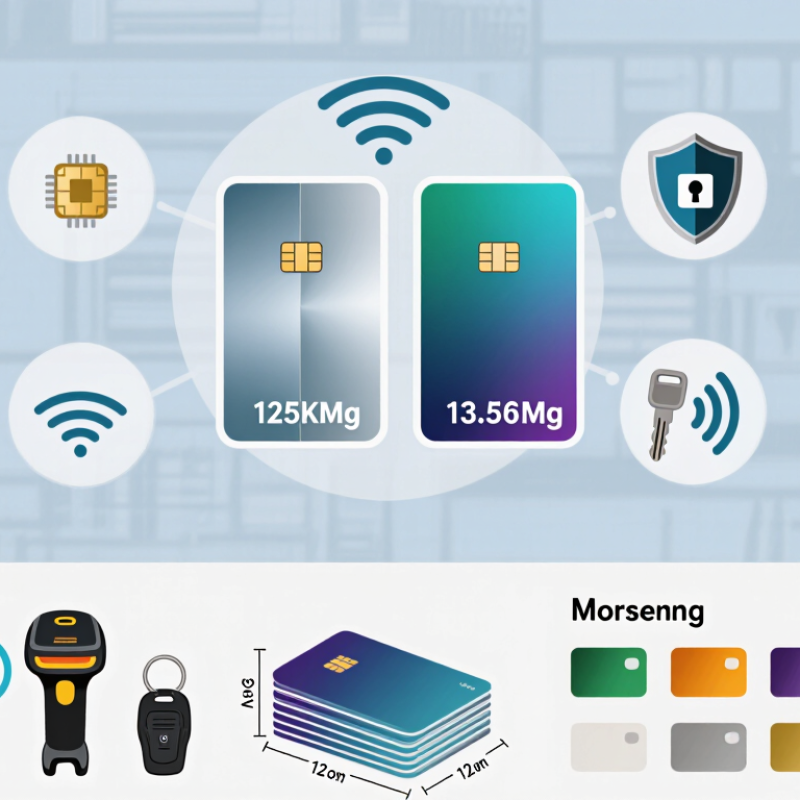
| Low-frequency (LF) technology | Many access credentials operate around 125 kHz. Implementations may use different modulation, data formats, and credential numbers. | Confirm the reader supports the card’s specific LF format—not just the 125 kHz frequency. | Matching frequency alone does not guarantee that a reader can decode or use a credential. |
| High-frequency (HF) technology | Common HF card technologies operate at 13.56 MHz. Standards include ISO/IEC 14443 and ISO/IEC 15693, with different variants and data structures. | Check the reader’s supported standard, card type, and any required protocol variant. | A 13.56 MHz reader may support some HF cards but not others. |
| Reader support for both frequencies | A dual-frequency card typically contains separate LF and HF functionality. A reader may support one frequency, both frequencies, or selected technologies within each frequency. | Review the exact reader model and configuration, including supported card technologies and firmware. | A card cannot use a frequency or protocol that the reader does not support. |
| Credential data and number format | Systems may use a card serial number, facility and card numbers, or application data. Number length and bit format can vary. | Ask which number the reader outputs and whether the access-control system accepts its length, format, and byte order. | Technically readable cards can still fail enrollment or be interpreted as the wrong credential. |
| Secure HF application | Some HF cards use protected application data, authentication, or diversified keys; others provide only limited or non-secure identification data. | Confirm that the reader and system support the required authentication method, keys, and application configuration. | Matching the card’s frequency or standard does not provide access to protected data automatically. |
| Existing system enrollment | Access systems generally require each credential to be registered with the correct identifier and permissions. | Check whether existing enrollment tools can read and enroll the card’s chosen credential, or whether records must be updated. | A compatible reader does not automatically make a new credential valid in the access-control database. |
| Use of both frequencies | Dual-frequency capability can support different readers or a migration between technologies. The two interfaces are not necessarily read simultaneously. | Determine which interface each reader will use and how the system will manage duplicate or different identifiers. | Planning avoids conflicting records and helps ensure consistent operation during a system transition. |
| Physical card requirements | Cards are available in different form factors and materials, with varying printability, durability, and mounting options. | Check dimensions, thickness, printing needs, environmental conditions, and any required card accessories. | Physical fit and durability are separate from electronic compatibility. |
| Practical compatibility test | A controlled test can confirm reading, data output, enrollment, and access decisions using the intended reader and system. | Test representative cards on each reader type and verify the displayed credential number and access result before bulk ordering. | Testing catches configuration and data-format issues that a frequency list alone may not reveal. |



 08045479132

 Send Inquiry


 Send Inquiry
 Send SMS

