Why Choose Profiled Aluminium for Your Project?
Choosing Profiled Aluminium for a project can influence its strength, weight, appearance, and ease of installation. The right section may support a canopy, frame, screen, or equipment enclosure without adding unnecessary bulk. Profiles also offer clean lines and repeatable shapes, useful when several components must fit together. Small details matter. A groove, flange, or hollow section can affect fastening, drainage, and how the finished assembly meets adjoining materials.
This guide explores how to compare profile shapes, alloys, finishes, and fabrication requirements. It also considers practical questions, such as expected loads, exposure to moisture, available space, and the tools needed for cutting or joining. A supplier’s technical drawings and material specifications can help confirm dimensions and suitability; assumptions from a sketch alone are rarely enough. Measure twice. Aluminium is not automatically the best choice for every project, and performance depends on design, installation, and operating conditions. A lightweight profile may simplify handling, but a poorly chosen section can flex or complicate assembly. That trade-off deserves attention. By weighing benefits against limitations, project teams can make a more informed choice and identify where expert advice or testing may be appropriate.
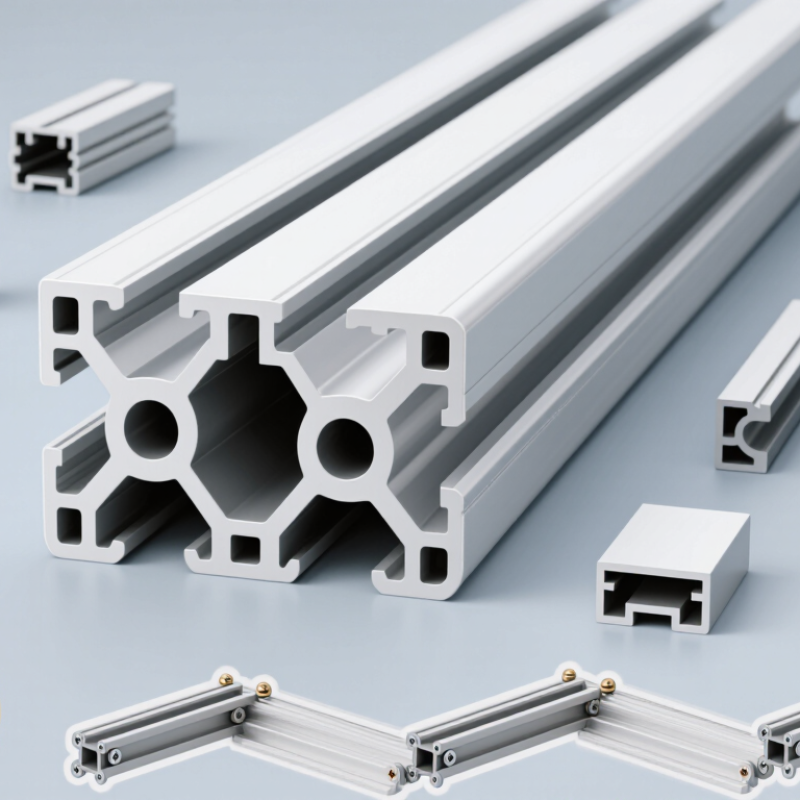
What Is Profiled Aluminium?
Profiled aluminium is aluminium shaped into a consistent cross-section for a particular function. Most profiles are made by pushing a heated billet through a precision die, a process called extrusion. The die defines the shape: a solid bar, hollow tube, or section with grooves and mounting slots. This geometry can combine low weight, useful strength, and practical assembly features in one component.
Small details matter.
Profiles appear in window frames, machine guards, equipment rails, heat sinks, and structural supports. Some use standard shapes; others are custom-made to match a drawing, fastener, or adjoining part. Not every shape works. Die limits, corner radii, and wall thickness can require design changes, even when a CAD model looks straightforward.
Alloy and temper affect strength and machinability, while thickness influences stiffness, weight, and cost. Surface finishes can support appearance or durability, but they cannot fix an undersized section. A careful review of loads, tolerances, and production limits helps determine whether a profile suits the project.
How Profiled Aluminium Is Manufactured
How Profiled Aluminium Is Manufactured
A profiled aluminium section starts as a solid billet, warmed until it can flow through a shaped steel die. A hydraulic press pushes the metal through the opening. The die determines the cross-section, from a simple channel to a hollow frame with narrow internal walls. Small details matter. Slight changes in wall thickness can affect strength, weight, and how easily the section can be finished.
After extrusion, the hot profile is cooled, often with controlled air or water. Workers may stretch it gently to correct twists and improve straightness, then cut it to specified lengths. Depending on the alloy and required properties, heat treatment may follow. Not every profile needs the same sequence; choosing one without checking the alloy and intended load can create avoidable problems.
Inspection checks dimensions, surface marks, and straightness. A sample may be measured with gauges or checked against a drawing before production continues. This step is practical, not cosmetic: a few millimetres of variation can complicate assembly on site. The process still has limits. Complex shapes may require careful die design, and small batches can make setup less efficient. Tell the manufacturer where the profile will be installed, what it must support, and whether it needs drilling or coating.
Key Properties of Profiled Aluminium
Profiled aluminium combines low weight with useful structural stiffness. The Aluminum Association’s Aluminum Design Manual lists a typical density near 2,700 kg/m³ and an elastic modulus around 69 GPa. That makes a long extrusion easier to handle than a comparable steel section, while its shape can place material where loads demand it. A ribbed channel, for example, can resist bending without making the whole part solid. Small design choices matter.
Its corrosion resistance comes from a thin oxide layer that forms naturally on the surface. This can suit exterior trim, frames, and equipment housings, though coastal salt, trapped moisture, and dissimilar-metal contact still need attention. Aluminium also conducts heat well; the exact performance depends on alloy and temper. The International Aluminium Institute reports that recycling aluminium requires about 5% of the energy used for primary production. That is a strong lifecycle advantage, but only when collection and sorting systems are available.
Profile design is not magic. Thin walls may dent, and tight corners can complicate extrusion or machining. The Aluminum Association’s design guidance is useful for checking section properties, but real loads, fasteners, and finish requirements should shape the final choice. Even a neat drawing can miss a drainage problem. That deserves a second look.
Factors to Consider When Choosing Profiled Aluminium
When choosing profiled aluminium, begin with the job the section must do: carry a load, guide a moving part, shed water, or hide services. Check span, support spacing, fixing points, and expected loads before comparing profile shapes. A slim section may look adequate on a drawing but flex noticeably across a long opening. Small details matter.
Alloy and temper affect strength, formability, and machinability, so request verified mechanical properties for the exact profile and condition. Then check dimensional tolerances, wall thickness, and whether the section can be cut or drilled without weakening critical areas. For outdoor use, consider drainage, galvanic contact with other metals, and the finish’s exposure conditions. The International Aluminium Institute reports that recycling aluminium uses about 5% of the energy required for primary production.This is a useful material-level comparison, not a guarantee about any specific profile’s footprint; recycled content and manufacturing energy vary.
Ask for product data, coating specifications, and relevant test evidence rather than relying on appearance alone. Also consider installation: a profile that is difficult to handle or align can add labour and create inconsistent joints. I would not choose on weight alone. A heavier section may be simpler to install, while a lighter one may need closer supports. Check the trade-off against the project’s actual loads and maintenance plan.



 08045479132

 Send Inquiry


 Send Inquiry
 Send SMS

